
Economist Warns Data Centre Investment Could Be Damaged by Dedi Mulyadi's Actions
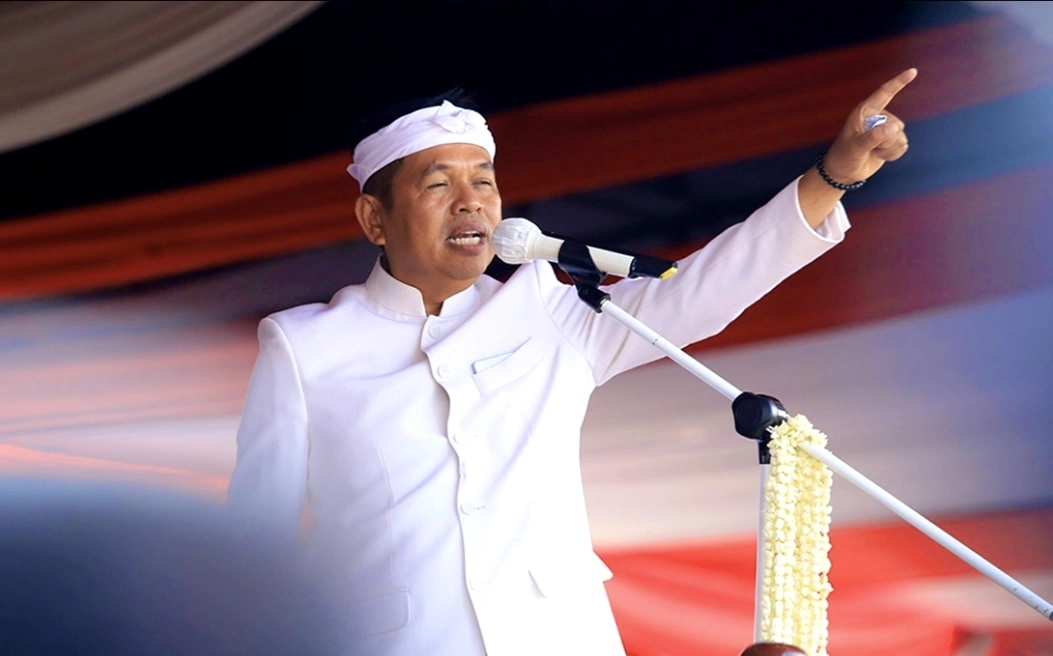
The decision by West Java Governor Dedi Mulyadi to temporarily halt the construction of an Artificial Intelligence (AI) data centre by BDx Data Centres in Jatiluhur, Purwakarta, has drawn criticism from economists. Didik J. Rachbini, an economist at INDEF and Rector of Paramadina University, assessed that this policy risks disrupting the investment climate just as Indonesia is chasing data centre investment opportunities worth up to Rp360 trillion.
“In West Java, there is unrest where data centre construction was halted unilaterally by the governor, citing environmental concerns, water supply, and various other reasons. Policy practices that damage the investment climate like this pose a major obstacle to the future of the economy, which is currently experiencing moderate growth at around five per cent,” Did/ik stated in a written statement received on Wednesday, 7 October 2026.
For Didik, the issue extends beyond a single halted project. Indonesia is attempting to attract large-scale data centre investments while Southeast Asian neighbours compete to become hubs for AI infrastructure. He noted that the government has set an investment target for AI data centres of approximately Rp360 trillion, with Batam, West Java, Madura, and Bali identified as key target locations.
To understand the context behind Didik’s statement, the details of the Jatiluhur project must be examined. The project halted by Dedi is an AI data centre owned by BDx Data Centres with an investment value of approximately Rp3.5 trillion. The facility is being built in the Jatiluhur area, Purwakarta, with an initial capacity of 120 megawatts and plans to expand up to 640 megawatts.
Construction began on 22 September 2026. Eight days later, Dedi conducted a sudden inspection of the site and ordered work to stop. The West Java Provincial Government stated that the decision was made because two critical requirements had not been finalised: the Environmental Impact Assessment (AMDAL) and the Building Approval (PBG).
“The PBG and AMDAL have not been issued. Do not proceed with the project yet. Halt the construction for now,” Dedi said, as quoted from the official West Java provincial website.
This issue had actually surfaced before construction commenced. Dedi stated that he visited the site on 28 July 2026 after meeting a group of entrepreneurs intending to build the data centre. At that time, he enquired about the completeness of permits and requested that the licensing process be expedited.
The Head of the West Java Communication and Informatics Office, Adi Komar, previously stated that the Provincial Government continues to support the project, but construction must comply with all applicable regulations given the large scale of the project and the resources involved.
Didik warned that these opportunities must not evaporate due to policies that cause investors to lose certainty. He noted that Indonesia has experienced similar mistakes in the past, failing to maintain momentum in the semiconductor industry during the 1980s.
“We could be as foolish as a mousecatcher falling into the same hole twice,” said Didik.
Didik assessed that investor interest in Indonesia is already significant enough that the government should move beyond merely discussing potential. He noted that investments equivalent to Rp360 trillion are being contested to enter Indonesia, with several regions targeted for data centre development.
“Investor interest and enthusiasm are already quite advanced; the government must be prepared because the scale of this investment is so massive,” he added.
One of Indonesia’s strengths is its established ecosystem. Didik mentioned that there are approximately 182 operational data centres in Indonesia. Jakarta is the largest hub with 94 units, followed by Batam with 16 units.
These figures indicate that Indonesia is not starting the data centre industry from scratch. Infrastructure and operational experience are already available. The challenge lies in how the government can transform this foundation into an ecosystem capable of attracting even larger-scale investments.
Batam holds significant potential to become a data centre hub. Its proximity to Singapore provides a geographical advantage, especially as the city-state faces land and energy constraints for data centre expansion.
Didik estimates that planned data centre investment in Batam is in the range of USD 15–20 billion, or approximately Rp268.5–358 trillion at an exchange rate of Rp17,900. The national target capacity is aimed at approximately 1.3 GW. With regional economic growth at around 7 per cent, Batam has the potential to become a new growth centre supported by digital infrastructure investment.
This opportunity is increasingly attractive as computing needs in Southeast Asia continue to rise. Data centres serve as fundamental infrastructure for cloud services, artificial intelligence, digital trade, and various data-based services.
However, such a massive opportunity requires massive investment. Data centres require enormous amounts of electricity that must be available stably. Servers cannot operate with the same logic as factories, which can pause briefly during energy supply disruptions.
Consequently, the competition between nations to attract data centre investment is gradually shifting. While land prices and electricity tariffs remain important, investors are also looking at a region’s ability to provide reliable, high-quality, scalable electricity with a guaranteed supply.
Didik believes the suspension of data centre construction in West Java warrants close scrutiny because such investments are not easily relocated. Investors must commit significant capital to land, buildings, cooling systems, power grids, connectivity, and computing hardware.
Once an investment is underway, a decision to halt or alter permits does not merely impact a single project. Investors will recalculate the policy risks for all subsequent projects.
Source: jawawa.id (https://jawawa.id/newsitem/economist-warns-data-centre-investment-could-be-damaged-by-dedi-mulyadis-actions-1791373905)
Originally published by kabarbursa.com (https://www.kabarbursa.com/makro/ekonom-didik-rachbini-wanti-wanti-investasi-data-center-bisa-rusak-gegara-dedi-mulyadi), translated from Indonesian