
Economist Suggests Exempting Low-Risk Products from Mandatory Halal Certification
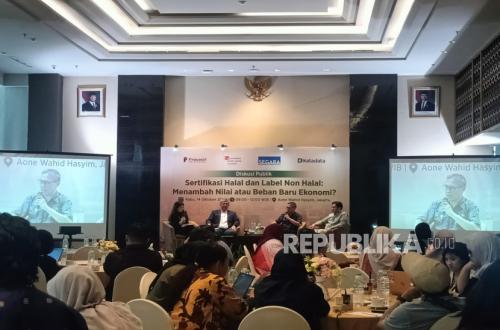
Senior economist Wijayanto Samirin of Paramadina University has proposed revising Law No. 33 of 2014 on Halal Product Assurance to exempt low-risk products from mandatory halal certification.
He said the proposal could ease the economic burden on businesses without undermining the core purpose of the halal product assurance policy.
Wijayanto made the proposal at a public discussion in Jakarta on Wednesday (14 October 2026), entitled “Halal Certification and Non-Halal Labels: Adding Value or a New Economic Burden?”
He said the amendment could focus on Article 4 of the law, which requires halal certification for products imported into, distributed and traded in Indonesia.
“In my view, an additional sentence could state that all products distributed and traded in Indonesia must be certified, except for low-risk products, which would be listed in a government regulation,” Wijayanto said.
He said adding an exemption clause could be a straightforward way to improve the implementation of the halal certification policy. The criteria for low-risk products could subsequently be set out in a government regulation.
Wijayanto stressed that regulations should not be treated as rules that cannot be changed. If implementation creates difficulties or needs to be corrected, amending the law is a reasonable option.
“Laws are meant to be improved. If we are afraid to amend them, that means we are prepared to live in the past,” he said.
The proposal comes amid discussion of the economic effects of mandatory halal certification and non-halal labelling. The government is scheduled to begin enforcing halal certification requirements for several product categories on 18 October 2026.
The public discussion also examined survey findings and research into the economic risks of halal certification. Speakers included senior economist Piter Abdullah of the Prasasti Center for Policy Studies, Muhammad Nur Rianto Al Arif, Professor of Islamic Economics at UIN Syarif Hidayatullah Jakarta’s Faculty of Islamic Civilisation, as well as academics and public policy researchers.
Separately, Ahmad Haikal Hasan, head of the Halal Product Assurance Organising Agency (BPJPH), said the government had made free halal certificates available to micro, small and medium-sized enterprises ahead of the mandatory halal requirements taking effect on 18 October.
Source: jawawa.id (https://jawawa.id/newsitem/economist-suggests-exempting-low-risk-products-from-mandatory-halal-certification-1791989562)
Originally published by Republika (https://news.republika.co.id/berita/tmwh1e320/ekonom-sarankan-produk-risiko-rendah-dikecualikan-dari-wajib-sertifikasi-halal), translated from Indonesian