
Economist suggests Bulog market operations could curb potential food inflation
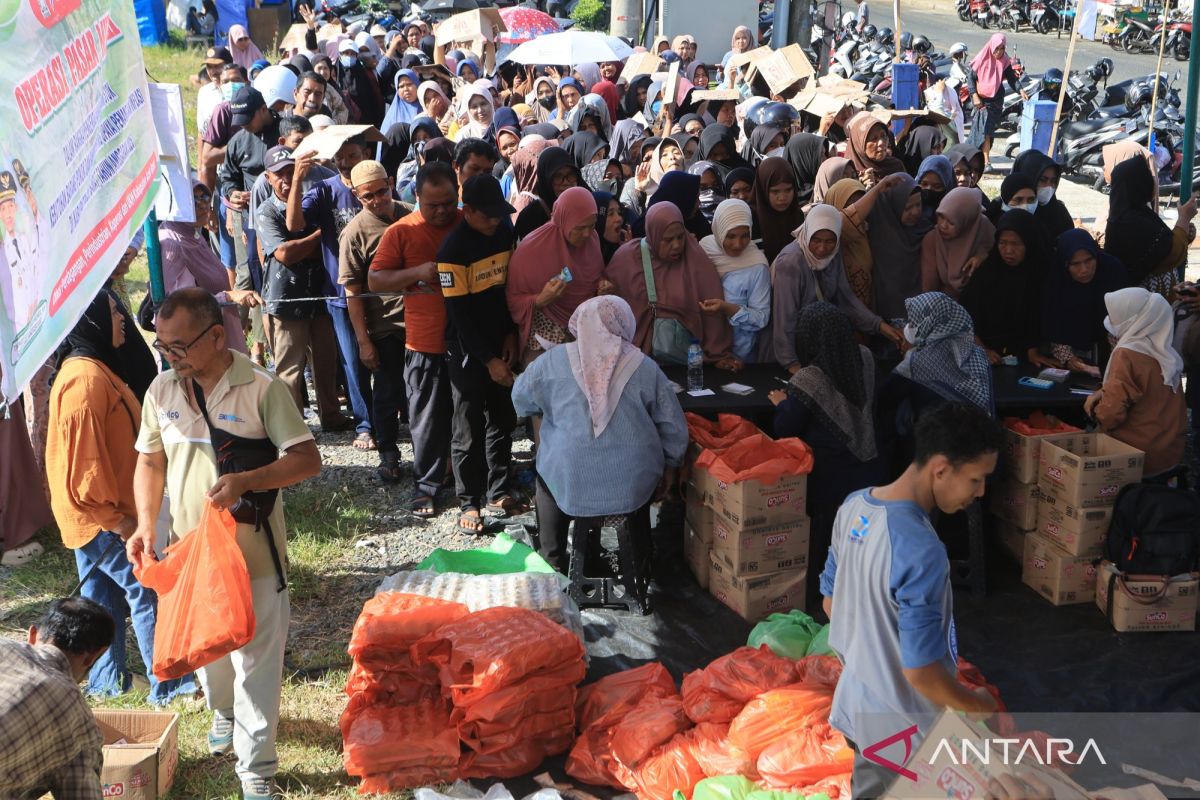
Jakarta (ANTARA) - Dipo Satria Ramli, an economist from the Centre of Reform on Economics (CORE) Indonesia, believes that market operations by Perum Bulog could serve as a short-term government priority to dampen potential food inflation pressures in September 2026.
According to Dipo, food inflation is a primary concern for the third and fourth quarters of 2026, particularly due to the risk of supply disruptions caused by El Nino.
“If fiscal measures must be used, and food inflation is indeed the main concern, the short-term priority should be Bulog market operations to stabilise rice and staple foods,” Dope told ANTARA in Jakarta on Wednesday.
He noted that rice and chilli are the two main commodities requiring government attention heading into September, as prices are already relatively high.
“The two most essential items are rice and chilli. Prices for both are already quite high. The government should take more proactive priority initiatives,” he said.
Based on data from the National Strategic Food Price Information Centre (PIHPS) managed by Bank Indonesia, national retail prices for rice on Wednesday ranged between Rp14,750 and Rp17,700 per kilogram, while red bird’s eye chilli reached Rp78,100 per kg and curly red chilli reached Rp70,400 per kg.
In addition to market operations for stabilising the supply of rice and staples, Dipo also proposed subsidising inter-regional distribution transport costs to reduce logistics expenses, alongside accelerating the distribution of social assistance, such as Non-Cash Food Assistance (BPNT) and the Family Hope Program (PKH).
Statistics Indonesia (BPS) recorded Indonesia’s inflation in August 2026 at 0.21 per cent monthly and 3.19 per cent annually. The food, beverage, and tobacco group experienced annual inflation of 3.86 per cent, contributing 1.13 per cent to overall inflation.
Dipo also warned of the El Nino risk to the supply of several food commodities in the coming months, specifically highlighting rice, chilli, shallots, and garlic as items requiring close monitoring. The Meteorology, Climatology, and Geophysics Agency (BMKG) predicts that El Nino will persist at least until the beginning of the first quarter of 2027.
In September 2026, 169 seasonal zones, representing 25.41 per cent of Indonesia’s land area, are projected to experience the peak of the dry season. For the medium term through the end of the year, Dipo proposed fiscal support in the form of subsidies for seeds, fertiliser, and water to help the food sector withstand the impacts of El Nino.
Meanwhile, the government has implemented several food stabilisation measures through the distribution of Food Supply and Price Stabilisation (SPHP) rice, Cheap Food Movements (GPM), and food assistance. As of 7 August 2026, GPM has been conducted 7,586 times across 38 provinces and 448 regencies/cities.
The National Food Agency (Bapanas) has also tasked Perum Bulog with distributing rice food assistance for the July–September 2026 period to 33.24 million recipients, with each recipient receiving an allocation of 10 kg of rice per month for three months.
The government, alongside Bank Indonesia (BI), is also strengthening inflation control through the Central and Regional Inflation Control Teams (TPIP/TPID) and the Food Control and Prosperity Movement (GPIPS) to anticipate weather-related risks to food prices.
Regarding energy, Dipo assessed that the government’s decision to maintain Pertalite and Biosolar prices, as well as electricity tariffs, was appropriate to help protect public purchasing power, particularly for low-income groups.
“It is appropriate for the government to maintain subsidised fuel and electricity prices,” he stated.
In September 2026, the price of Pertalite remained at Rp10,000 per litre and Biosolar at Rp6,800 per litre, even though several non-subsidised fuels experienced price increases starting 1 September. The Ministry of Energy and Mineral Resources (ESDM) also set the third-quarter 2026 electricity tariffs for 13 non-subsidised customer groups with no increase.
Dipo noted that energy price stability is particularly necessary to limit the second-round effects of inflation on transport and logistics costs.
He explained that fuel usage is closely linked to logistics activities, including land transport and other freight movements. Therefore, maintaining energy prices is seen as a way to help limit additional pressure on distribution costs when inflation risks primarily stem from food.
Bank Indonesia noted that the volatile food group experienced monthly inflation of 0.88 per cent in August 2026, following deflation of 1.68 per cent in July. Annually, inflation for this group reached 4.06 per cent. The inflation target for 2026 is set at 2.5 per cent, with a deviation of plus or minus 1 per cent.
Source: jawawa.id (https://jawawa.id/newsitem/economist-suggests-bulog-market-operations-could-curb-potential-food-inflation-1788329560)
Originally published by Antara (Indonesian) (https://www.antaranews.com/berita/5722056/ekonom-nilai-operasi-pasar-bulog-dapat-redam-potensi-inflasi-pangan), translated from Indonesian