
Economist: State Budget Still Capable of Bearing Whoosh Debt Burden
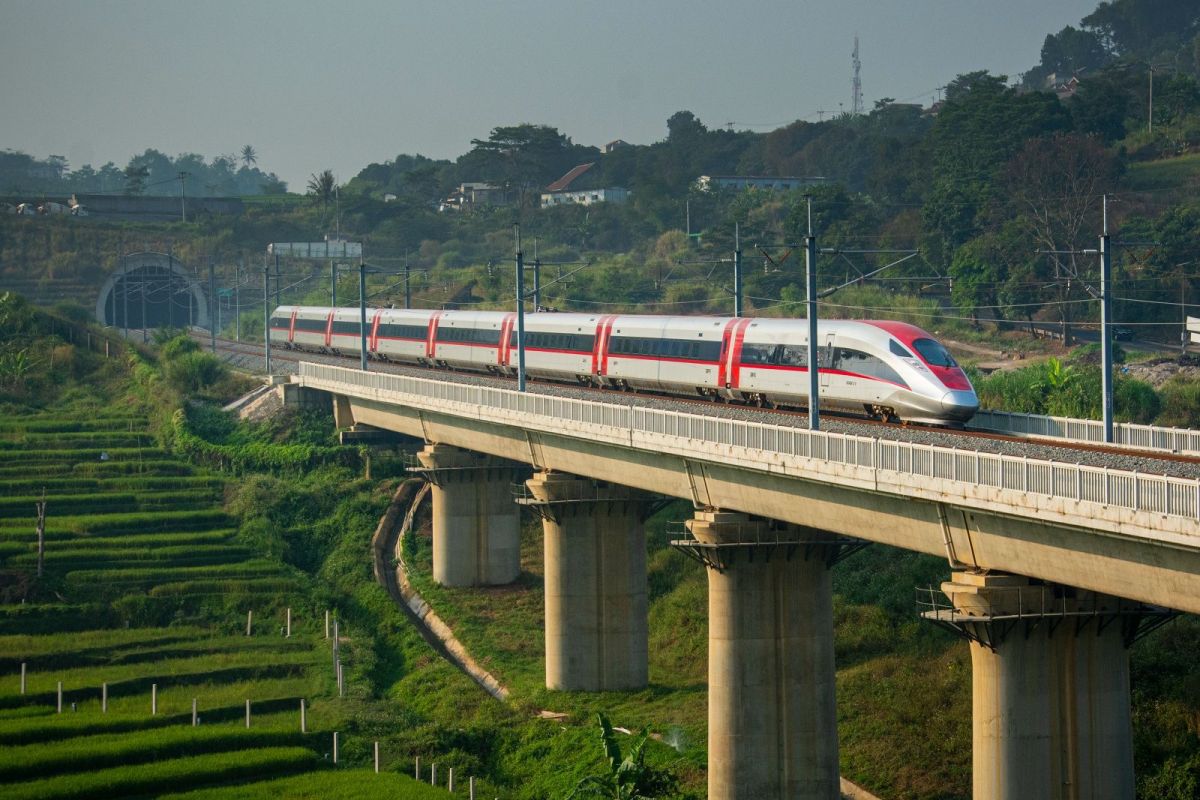
The Jakarta-Bandung High-Speed Railway, known as Whoosh, does not immediately place the State Budget (APBN) under significant pressure in the current year.
Yusuf Rendy Manilet, an economist from the Centre of Reform on Economics (CORE), assessed that the State Budget still has sufficient room to cover the annual obligations of the Whoosh project. “Whoosh does not automatically place the APBN under great pressure in the current year. A burden of approximately Rp1 trillion per year is still relatively small compared to the scale of the APBN,” Yusuf stated when contacted in Jakarta on Friday.
However, Yusuf warned that the government needs to be wary of long-term fiscal risks that may arise from this scheme. Based on explanations from the Minister of Finance, the debt restructuring for the Whoosh project will involve an annual instalment scheme of approximately Rp1 trillion with a tenor of up to 80 years.
Yusuf noted that the annual instalment of around Rp1 trillion is relatively small compared to the total state expenditure for 2026, which reaches approximately Rp3,843 trillion. Nevertheless, he emphasised that the ability to pay instalments is not the only measure of risk.
According to him, while extending the debt tenor to approximately 80 years can reduce the annual payment burden, the principal and interest must still be paid in the long term. Furthermore, loans denominated in US dollars make obligations vulnerable to increases whenever the rupiah weakens.
Yusfer also argued that risks persist even if the management of obligations is transferred through a Special Mission Vehicle (SMV) under the Ministry of Finance. Such a scheme is deemed not to automatically eliminate sovereign risk, as it still involves government capital and support.
He assessed that the greatest risk arises if the operational performance of Whoosh fails to generate sufficient cash flow to meet its obligations, thereby necessitating additional capital injections, guarantees, or government support. “If government support is ultimately required, the space for budget adjustment is more likely to be found in relatively flexible expenditures,” he said.
Capital expenditure or infrastructure projects that can be delayed, ministerial goods expenditure, state capital injections into other State-Owned Enterprises (SOEs), and certain discretionary programmes are considered to have greater adjustment potential compared to civil servant salaries, debt interest, or education spending.
He continued, noting that the expenditures most easily adjusted are often those related to investment and stimulus. However, when these items are reduced to make room for the obligations of old projects, there are consequences for the government’s ability to drive growth and strengthen state revenue in the future.
“What needs to be maintained is ensuring that these obligations do not evolve into a need for guarantees, new cost overruns, or repeated capital injections that ultimately return to the state,” Yusuf remarked.
He also reminded that projects initially positioned as business-to-business (B2B) must maintain commercial discipline, so that when performance does not meet projections, the entire risk does not automatically shift to the state.
Source: jawawa.id (https://jawawa.id/newsitem/economist-state-budget-still-capable-of-bearing-whoosh-debt-burden-1789125504)
Originally published by Antara (Indonesian) (https://www.antaranews.com/berita/5736719/ekonom-nilai-apbn-masih-mampu-tanggung-beban-utang-whoosh), translated from Indonesian