
Economist: Risk of food inflation in September expected to remain moderate
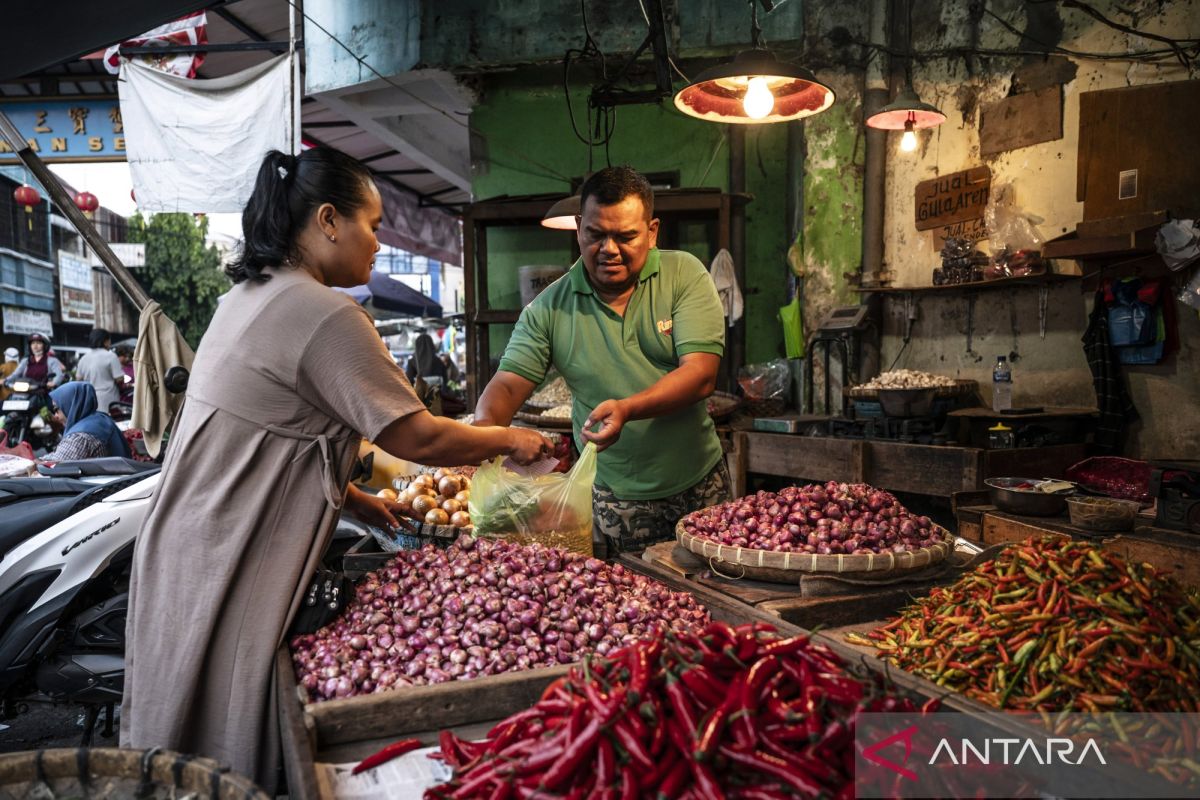
Jakarta (ANTARA) - Eliza Mardian, a researcher at the Centre of Reform on Economics (CORE) Indonesia, predicts that the risk of food inflation for September 2026 remains moderate and selective, with bird’s eye chilli and broiler chicken being the commodities that require the most vigilance.
According to Eliza, food price pressures still need to be closely monitored, but the current situation does not indicate a national supply crisis, as the factors affecting each commodity differ.
“The forecast for food inflation risk in September 2026 is moderate, not a national supply crisis. There is pressure, but it is not out of control,” Eliza told ANTARA in Jakarta on Wednesday.
Bank Indonesia (BI) noted that the volatile food group experienced an inflation rate of 0.88 per cent month-on-month in August 2026, following a deflation of 1.68 per cent in July. This inflation was primarily driven by broiler chicken, bird’s eye chilli, and rice.
On an annual basis, inflation in the volatile food group in August reached 4.06 per cent, an increase from 2.52 per cent in the previous month.
According to the National Strategic Food Price Information Centre (PIHPS), the average price of red bird’s eye chilli reached Rp82,850 per kilogram (kg), an increase of 11.96 per cent, while fresh broiler chicken was Rp42,600 per kg and rice ranged from Rp14,650–Rp17,850 per kg depending on quality.
Eliza warned that the pressures on these three commodities have different characteristics. According to her, chicken is more influenced by demand developments and production costs, chilli is vulnerable to weather, while rice issues are more closely related to inter-regional distribution.
“Equating everything as an impact of the dry season is an oversimplification to be used as a basis for policy,” she said.
Entering September, Eliza assessed that bird’s eye chilli would be the commodity most vulnerable to price pressure due to its perishable nature and sensitivity to weather conditions.
“The most vulnerable commodities in September are bird’s eye chilli, followed by chicken. Chilli is easily damaged, cannot be stored for long, and is very sensitive to hot weather. Therefore, its price can rise quickly,” she said.
Meanwhile, regarding chicken, she observed that pressure stems more from fundamental market factors, including feed costs, day-old chicks (DOC), demand developments, and limited cold storage facilities.
Eliza noted that the perishable nature of broiler chicken means that changes between supply and demand affect prices more rapidly.
Independent farmers also face cost pressures from feed and DOC at the upstream level, while simultaneously having to sell live chickens immediately upon harvest.
As for rice, Eliza assessed that the risk in September is more related to the smooth distribution of supply to regions in need, rather than a national shortage of stock.
BPS (Statistics Indonesia) projects that rice production for population consumption from January–September 2026 will reach 28.71 million tonnes, a slight increase of 0.01 per cent compared to the same period the previous year.
Meanwhile, the National Food Agency (Bapanas) noted that the Government Rice Reserve (CBP) managed by Perum Bulog reached 5.25 million tonnes as of 12 August 2026.
“A rice stock of over 5 million tonnes is an achievement in reserves, but not a guarantee of prices in traditional markets,” Eliza remarked.
In her view, the large stock must be accompanied by the ability to distribute rice quickly to regions experiencing supply shortages or price increases.
Regarding weather, the Meteorology, Climatology, and Geophysics Agency (BMKG) projects that 169 seasonal zones, or approximately 25.41 per cent of Indonesia’s land area, will experience the peak of the dry season in September 2026.
Nevertheless, Eliza believes the impact of the drought should be viewed based on the specific conditions of each region and commodity, so it does not automatically indicate a national food supply disruption.
The Ministry of Agriculture noted that the area of paddy cultivation affected by drought nationwide from January–July 2026 reached 44,694 hectares. Of that amount, 12,304 hectares experienced crop failure.
The government has undertaken mitigation through the mapping of drought-prone areas and the optimisation of water sources from dams, irrigation networks, rivers, springs, and groundwater. Utilisation includes pumping, piping, wells, small dams, and pump-based irrigation.
To prevent price pressures from spreading further, Eliza suggested that the government ensure the water supply for crops that can still be maintained, move food supplies from surplus areas to deficit areas, and distribute rice stocks to regions experiencing price increases.
Source: jawawa.id (https://jawawa.id/newsitem/economist-risk-of-food-inflation-in-september-expected-to-remain-moderate-1788337266)
Originally published by Antara (Indonesian) (https://www.antaranews.com/berita/5722295/ekonom-risiko-inflasi-pangan-september-diperkirakan-moderat), translated from Indonesian