
Economist Outlines Four Key Challenges for New Finance Minister Suahasil
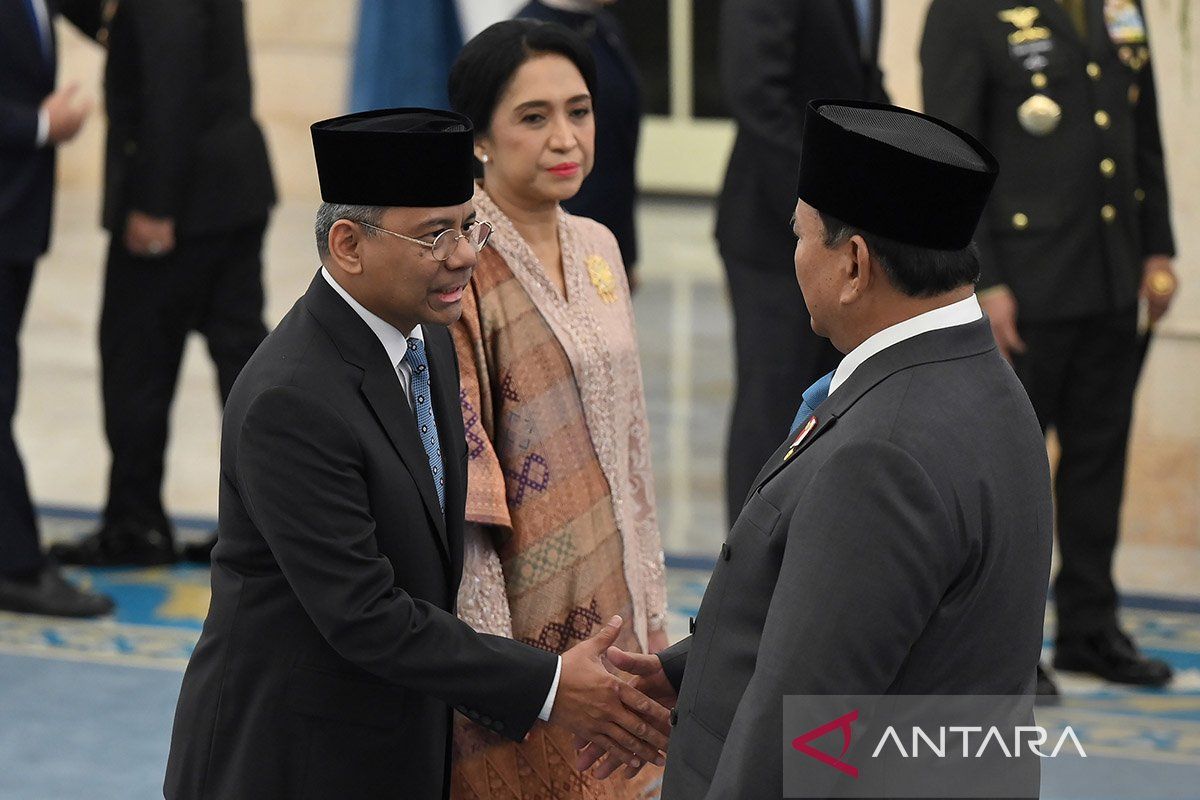
Jakarta (ANTARA) - The Director of the NEXT Indonesia Center, Herry Gunawan, stated that there are at least four homework assignments that require the attention of Suahasil Nazara as the new Minister of Finance.
These issues relate to the credibility of the State Budget Draft (RAPBN), relationships with stakeholders, the internal condition of the organisation, and the quality of technocracy in policymaking, Herry said in a statement received in Jakarta on Wednesday.
Furthermore, he noted that the first challenge is to ensure that state revenue targets do not transform into pressure on the economy.
“Revenue targets should not be used as a form of threat to the business world. While the government certainly needs strong revenue, the methods used to achieve it must not create an economic contraction,” said Herry.
He highlighted the tax revenue target in the 2027 RAPBN, which reaches Rp2,908 trillion, an increase of 10.51 per cent compared to the 2026 outlook of Rp2,631 trillion. He noted that this increase in revenue targets must be viewed alongside other fiscal policies, particularly the reduction of energy subsidies.
“On one hand, the government speaks of economic expansion, but on the other, the tax revenue target is rising by 10.51 per cent. This is coupled with the reduction of energy subsidies, particularly for petrol and LPG. The impact on consumption, production costs, and public purchasing power must be calculated,” he said.
He assessed that the combination of increased revenue pressure and subsidy reductions could create a paradox in fiscal policy. The government aims to encourage economic expansion, yet several policy indicators have the potential to suppress consumption and production activities.
Therefore, he believes Suahability needs to ensure that the RAPBN does not only appear healthy in terms of revenue figures but is also capable of supporting economic growth. “High revenue targets must not be paid for with economic contraction. State revenue is important, but the quality of growth and public purchasing power must also be maintained,” he added.
The second challenge is to improve the relationship between the government and the business world, he continued. Herry emphasised that the business sector should be positioned as a partner in development, as the government requires investment and business expansion to create jobs.
“The business world is not an opponent of the government. They are partners in development and a source of economic growth. Therefore, there is no need to brandish threats of audits or tax issues for cases where the status is not even clear,” he said.
He referenced taxation issues involving 40 steel companies and audits of 10 palm oil companies. He stated that while the government retains the authority to conduct audits if violations are indicated, the dissemination of information to the public must be handled proportionally. An approach based on threats, he argued, could increase uncertainty for business players. In an economic climate requiring investment and expansion, legal and policy certainty are vital factors.
The third issue lies within the Ministry of Finance itself. According to Herry, Suahasil needs to ensure that various official appointments in the previous period do not leave behind long-standing organisational problems. Changes in personnel do not automatically resolve organisational issues.
He stated that the government needs to address the root causes of conflicts and ensure effective internal coordination. “Personnel changes should not merely address problems on the surface. What needs to be fixed is the work system, coordination, and organisational stability. The Ministry of Finance must return to being a technocratic institution that operates based on a system, rather than depending on individual figures,” he said.
The fourth challenge, he said, relates to governance and the ethics of relations between state institutions. Herry believes that conflicts between state officials should be resolved through institutional mechanisms.
He also highlighted the controversy regarding the request for a Rp120 trillion contribution from Danantara to the state treasury. “Conflicts with fellow state officials should not be resolved through pressure in the public arena. The case of the Rp120 trillion contribution request from Danantara to the state treasury is an example,” he said.
He noted that while the government’s need for additional revenue is understandable, any request for contributions from the state’s investment management agency must consider the mechanism, the purpose of fund usage, and the interests of long-term asset management.
He assessed that the issue is not merely about whether a fiscal need exists, but that the way the government makes decisions is also a part of policy credibility.
Herry views these four issues as evidence that Suahasil’s challenges extend beyond merely seeking additional state revenue. “Suahasil also needs to ensure that fiscal policy does not suppress economic activity, rebuild trust with the business world, improve the internal stability of the Ministry of Finance, and ensure that inter-institutional relations function based on healthy mechanisms,” he added.