
Economist on Perry Warjiyo's Resignation: Will Not Trigger Market Concerns
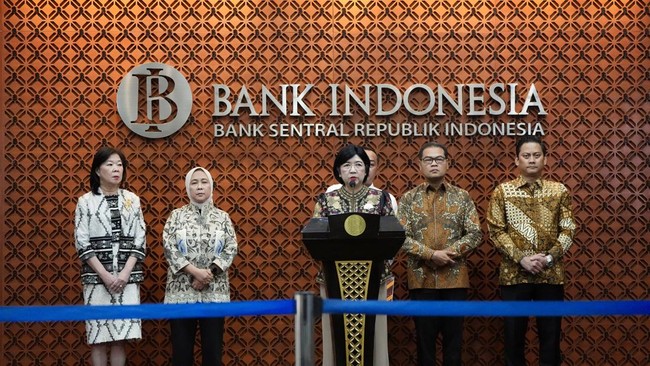
Chief Economist of Permata Bank, Josua Pardede, said Perry Warjiyo’s resignation should be viewed as an orderly leadership transition rather than a vacuum of control at Bank Indonesia.
Bank Indonesia (BI) has appointed Senior Deputy Governor Destry Damayanti as Acting Governor following Perry Warjiyo’s voluntary resignation for personal reasons.
“That appointment was decided through a Board of Governors meeting and in accordance with the prevailing laws and regulations. On a human level, Perry Warjiyo’s decision to rest deserves respect,” he explained.
He believed policy continuity remains assured because BI’s decisions fundamentally do not rest on a single figure. Decisions are also taken through deliberation among all members of the Board of Governors.
“Overall, Perry Warjiyo’s resignation need not trigger excessive concern. Bank Indonesia has a legal foundation, a Board of Governors that works collectively, a complete policy toolkit, and an Acting Governor who has long been immersed in the financial markets,” Josua said.
According to him, the key message to the business community and investors is that there is no leadership vacuum, no change to Bank Indonesia’s mandate, and no reason for exchange rate policy or financial markets to shift abruptly.
“The most important challenge now is not Destry’s ability to carry out her duties, but ensuring the transition is communicated quickly, consistently and convincingly,” he said.
Josua considers Destry Damayanti a well-prepared figure to safeguard such continuity. She has been Senior Deputy Governor since 2019 and is currently serving her second term, which runs until 2029.
Before joining BI’s leadership, Destry’s experience included Citibank Indonesia, Mandiri Sekuritas, Bank Mandiri, the Ministry of State-Owned Enterprises, and the Deposit Insurance Agency.
“That track record shows a strong understanding of market participant behaviour, capital flows, banking, securities, and the formation of investor expectations,” Josua said.
Her focus at BI has also encompassed money and foreign exchange market development as well as rupiah exchange rate stability. For that reason, Josua said, the way BI reads the markets and manages the rupiah is unlikely to change abruptly as a result of this transition.
He is confident that continuity is further reinforced by the policy toolkit already in operation.
BI will continue to intervene in the foreign exchange market, manage money market interest rates, maintain adequate banking liquidity, and expand value protection facilities for investors.
“All of these instruments are already embedded in the institutional framework and can continue to be implemented under Destry,” he said.
However, he noted that continuity does not mean BI can treat this transition period as risk-free. Markets will assess three things: the consistency of BI’s communication, its firmness in safeguarding independence, and certainty over the selection process for a new Governor.
Therefore, he believes BI needs to affirm promptly that inflation targets, the rupiah stabilisation approach, and interest rate decisions will remain based on data and risk developments.
“The government also needs to convey that the process of appointing the new Governor is not intended to steer BI towards cutting interest rates or financing government policy,” he asserted.