
Economist: Off-taker certainty needed for MSME credit recovery
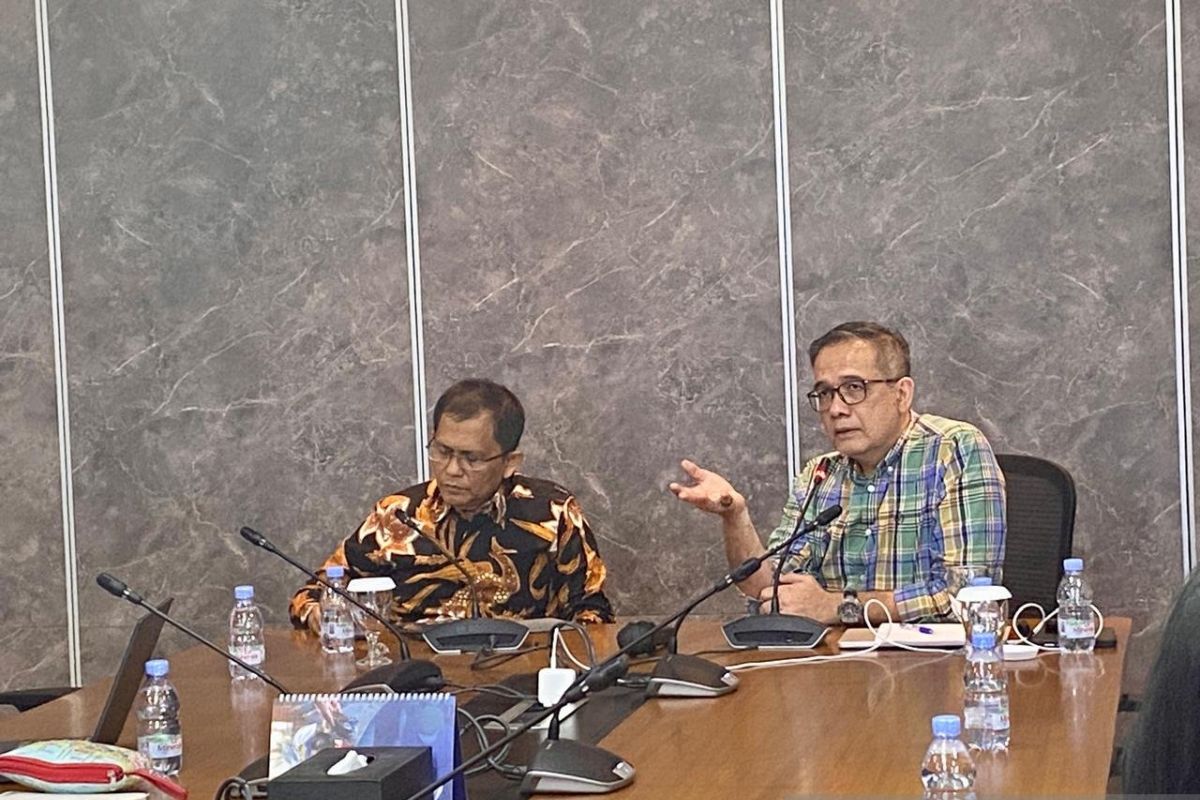
Jakarta (ANTARA) – Winang Budoyo, Chief Economist of the Association of National Banks (Perbanas), believes that certainty of off-takers, or guaranteed absorption of products, must be established so that MSME players become bolder in expanding, which would ultimately drive a recovery in credit to this segment.
He noted that the majority of MSMEs have not yet entered a closed-loop ecosystem, namely a business model with an assured supply chain and buyers.
As a result, business owners are reluctant to increase production because they are unsure whether the additional goods produced will be absorbed by the market.
“The weakness is that the majority of MSMEs are still not part of a closed-loop ecosystem. For instance, currently they can only sell 10 units. They want to expand to 20 units, but they are not yet certain whether the additional production will sell or not,” said Winang at a Perbanas journalist class in Jakarta on Thursday.
According to Winang, the situation is different when an MSME is within a closed-loop ecosystem. Under this scheme, a business already has clear production targets from the next link in the supply chain, allowing it to estimate the value of receivables, inventory needs and stock more accurately.
Such certainty also makes it easier for banks to assess the viability of financing. With documented data on receivables and inventory, banks will more readily accept both instruments as collateral, rather than relying solely on fixed assets.
“This means the digitalisation of MSME business models needs to be encouraged so that collateral can be based on accounts receivable as well as inventory. In fact, banks have long applied such practices to large companies,” he explained.
However, Winang also noted that most MSME players still mix personal and business finances, so their financial records are not properly organised. For this reason, MSME digitalisation should be directed at strengthening business bookkeeping.
Citing a World Bank study, he said MSME digitalisation remains concentrated on the payment-receipt side (cash in), while expenditure transactions are still largely done manually, meaning cash-flow records have not been formed comprehensively.
Yet, Winang explained, a balance between cash in and cash out would produce a more complete transaction track record, making it easier for banks to assess the business patterns of MSMEs.
Therefore, he said, digitalisation going forward should be directed not only at facilitating payments but also at forming comprehensive cash-flow records.
In addition, Winang urged the government to shift policy from a dominance of interest-rate subsidies towards risk-based credit guarantees.
In his view, lower interest rates have not been able to restore MSME credit growth because the main problem lies in the absence of off-taker certainty.
Hence, government support needs to be more comprehensive, through guarantee schemes capable of reducing business risk.
“Even if there is a guarantee, if the off-taker is unclear or the buyer is uncertain, the result will be the same. In my view, it is not merely the guarantee quota that must be increased, but there must also be certainty about the business cycle, from production all the way to the end user,” said Winang.
According to data from the Financial Services Authority (OJK), MSME credit in May 2026 grew 0.60 per cent year on year (yoy) amid pressure on people’s purchasing power and domestic economic dynamics. The performance began to improve after contracting at the start of the year.
According to the OJK, the growth in MSME credit was driven by micro and medium business credit, which grew 0.64 per cent (yoy) and 1.84 per cent (yoy) respectively, although small business credit contracted 0.24 per cent (yoy).
By contrast, overall bank credit in May 2026 showed positive double-digit growth of 11.51 per cent (yoy), reaching Rp8,918 trillion.