
Economist: Non-subsidised fuel price cut will aid public economy
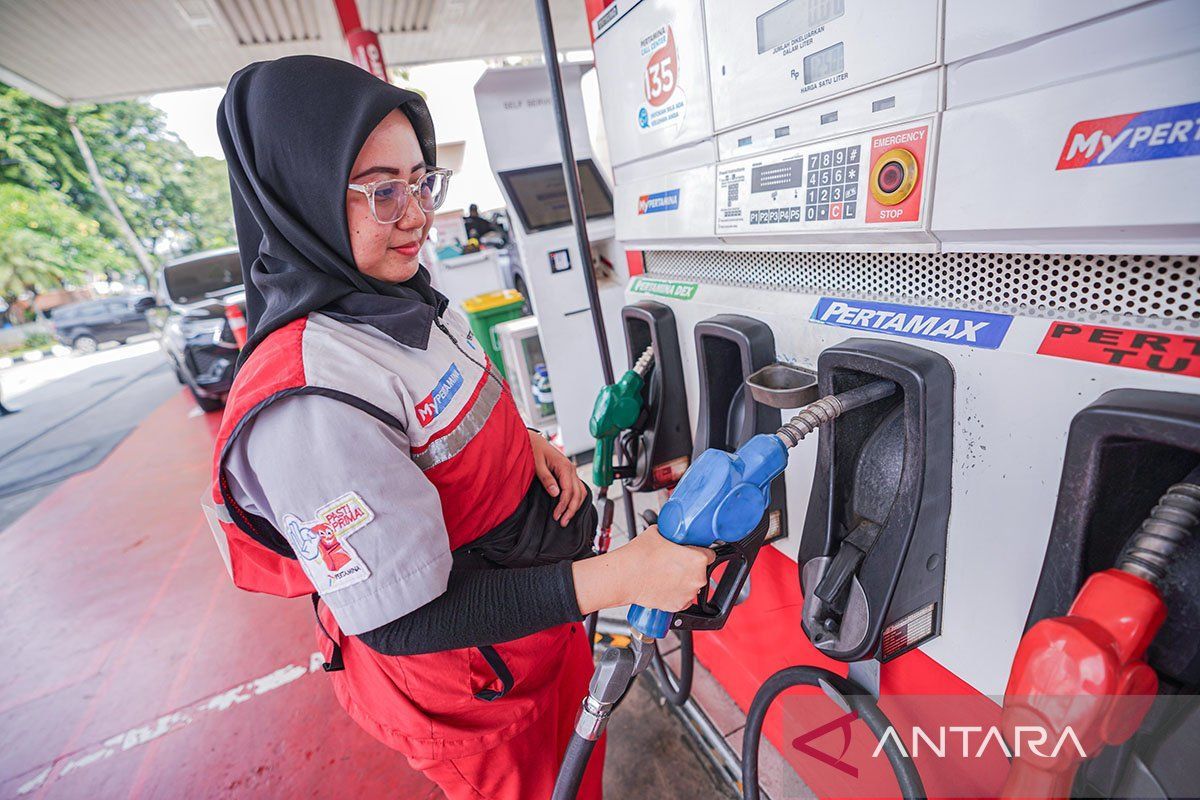
Jakarta - Executive Director of the Center of Reform on Economics (CORE) Indonesia, Mohammad Faisal, assessed that the planned reduction in non-subsidised fuel prices would aid the public economy, especially the middle class. “So, if the world crude oil price is now around 70 US dollars per barrel, and West Texas Intermediate (WTI) crude is even at 68 dollars per barrel, the price of non-subsidised fuel should fall. This will also help address the problems faced by consumers in Indonesia, particularly concerning the decline of the middle class, for example,” Faisal said when contacted in Jakarta on Saturday. He explained that non-subsidised fuel prices are fundamentally floating, thus following international crude oil prices. This differs from subsidised fuel, which receives government subsidies, meaning its price determination—whether international crude oil prices rise or fall—depends on government policy. “In my opinion, there should be no delay. The non-subsidised fuel price should be lowered soon, because it is essentially floating, so it must be reduced. Moreover, if the price stabilises around 70 US dollars per barrel, then it is time to lower it,” Faisal stated. For context, Pertamina’s Chief Commissioner Mochamad Iriawan provided strategic input to the board of directors to immediately prepare for a phased reduction in non-subsidised fuel prices starting in early July 2026. This follows the recent downward trend in global crude oil prices. West Texas Intermediate (WTI) crude oil was trading at 71.533 US dollars per barrel this morning, while the Brent crude oil benchmark was at 74.835 US dollars per barrel. Iriawan therefore said his party would hold further discussions with Pertamina’s board of directors and the Ministry of Energy and Mineral Resources regarding the potential adjustment of non-subsidised fuel prices. As of 10 June 2026, retail non-subsidised fuel prices at petrol stations saw Pertamax (RON 92) rise from Rp12,300 per litre to Rp16,250 per litre, and Pertamax Green 95 (RON 95) rise from Rp12,900 per litre to Rp17,000 per litre. Meanwhile, Pertamax Turbo (RON 98) remained at Rp20,750 per litre, Dexlite (CN 51) at Rp23,000 per litre, and Pertamina Dex (CN 53) at Rp24,800 per litre. However, he stressed that fuel price adjustments must go through a number of procedures and cannot be done in a short time. According to him, the periodic evaluation formula applied by the company serves as a consumer protection instrument to prevent them from being tossed about by extreme daily price volatility.