
Economist: Needs mapping should support reduction of salt imports
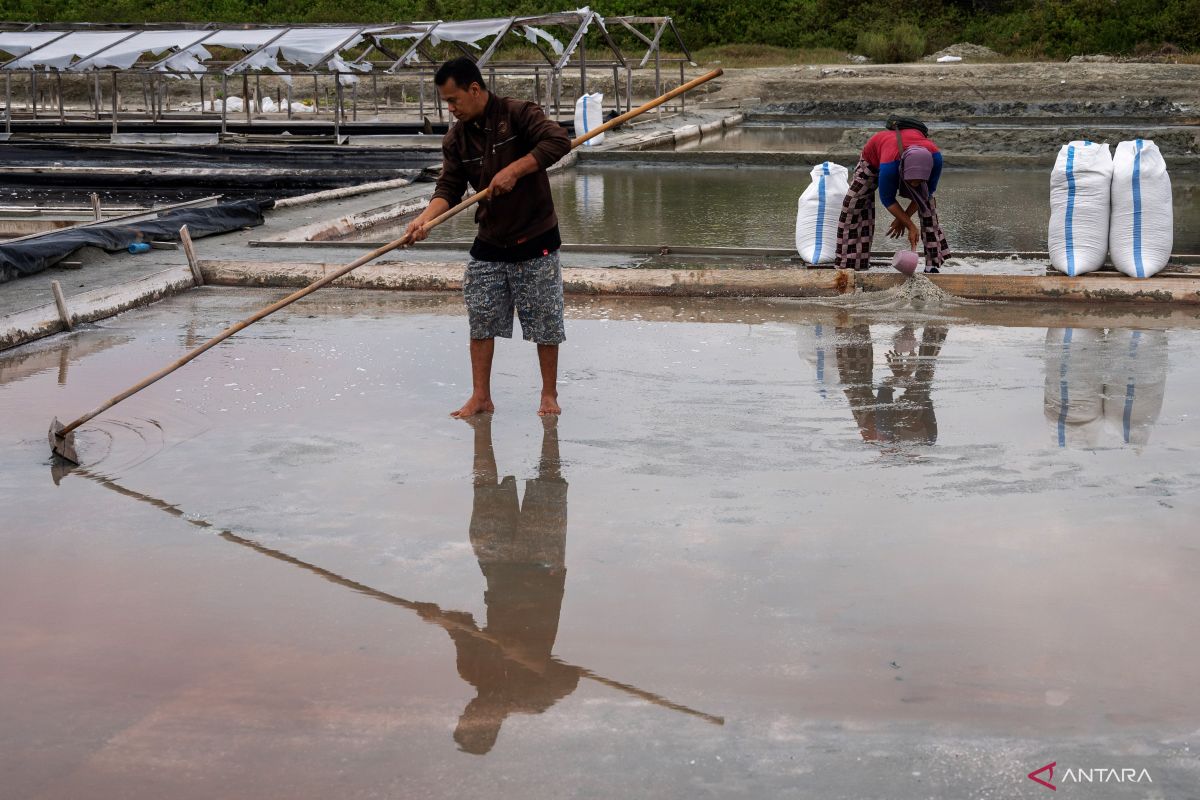
Jakarta (ANTARA) - Eliza Mardian, a researcher at the Center of Reform on Economics (CORE) Indonesia, has said that mapping salt needs by user type must be strengthened to support the gradual reduction of industrial salt imports towards the target of halting imports altogether in 2029.
Eliza said industrial salt requirements cannot be equated with household consumption salt, because each industrial group has different raw material requirements.
“For industrial salt, we currently need to reduce imports gradually. We do not have to produce every type of industrial salt from ponds all at once,” Eliza told ANTARA in Jakarta on Tuesday.
According to her, the government needs to know in detail the requirements of each user group so that supply and import policies can be adjusted to domestic production capacity for each segment.
“The government needs to compile data on needs by user type, so that import quotas are not blurred,” she said.
Industrial salt is used, among others, by the food, chemical and pharmaceutical industries, each with different raw material requirements.
According to her, an increase in domestic production in tonnage terms does not necessarily directly replace the same volume of imported salt.
“Therefore, one million tonnes of salt from community ponds does not automatically replace one million tonnes of imported salt,” Eliza said.
The Ministry of Marine Affairs and Fisheries (KKP) projects national salt demand to reach around 5.3 million tonnes in 2029, with demand growing by around 2 per cent per year.
Under the government’s latest roadmap, salt imports are targeted to fall from a range of 2.6 million tonnes to 2 million tonnes in 2026 and 1 million tonnes in 2027, before being halted in 2029. National production in 2029 is targeted to reach 5 million tonnes.
On the governance side, in August 2026 the KKP strengthened the data collection and validation of salt businesses as the basis for determining national salt needs, controlling imports, and measuring progress towards self-sufficiency.
The government has also differentiated the regulation of needs by user group. For 2026, the Coordinating Ministry for Food set the industrial salt balance for chlor-alkali plants (CAP) at 1.18 million tonnes.
Meanwhile, for non-CAP salt, including for the processed food and pharmaceutical industries, imports are conducted under a special circumstances mechanism after the government assesses the adequacy of domestic production.
In the monitoring and evaluation of the Commodity Balance for the first quarter of 2026, the government reaffirmed that fulfilling needs is prioritised from domestic production, while adjustments are made for commodities that cannot yet be fully met in terms of availability and specifications.
Furthermore, Eliza said the national production target needs to be read alongside the readiness of domestic output to meet the needs of each user group, not merely on the basis of tonnage.
“Five million tonnes of production is not five million tonnes of industry-ready salt. Some remains dry-season salt of varying quality. Demand may also rise every year,” she said.
Therefore, she believes the reduction of industrial salt imports needs to be carried out based on properly mapped needs and to proceed in step with improvements in domestic supply capacity to meet the requirements of each user group.