
Economist: Manufacturing PMI Enters Danger Zone, Indonesian Industry Has Long Been Ailing
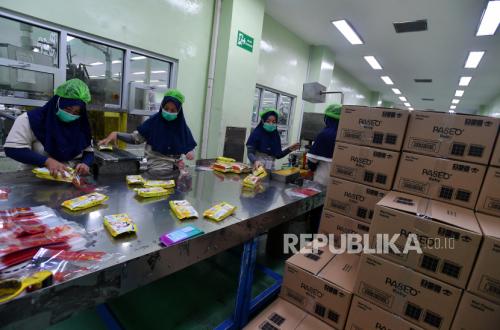
Senior Economist at the Institute for Development of Economics and Finance (Indef), Didik J. Rachbini, assesses that the decline in Indonesia’s Manufacturing Purchasing Managers’ Index (PMI) is a signal of the worsening condition of the national industrial sector. According to him, Indonesian industry has long faced fundamental issues and has now entered a ‘danger zone’ after the manufacturing PMI fell below the 5_0 level.
“The overall state of the Indonesian economy can be predicted or even captured from a single indicator, namely the declining or even plummeting PMI data. This PMI figure is an indication that our industrial sector has been ill for a long time and has now entered the red danger zone with an index level below 50,” Didik told Republika.
S&P Global data shows that Indonesia’s Manufacturing PMI stood at 46.9 in June 2026. A figure below 50 indicates that manufacturing activity is in a contraction phase or experiencing a slowdown.
Didik stated that this condition shows the industrial sector lacks a strong policy foundation. This is despite the fact that the manufacturing industry has long been one of the main engines of economic growth and job creation.
“Indonesia’s industrial sector has long been adrift without a clear policy footing. The manufacturing PMI data declining into the contraction zone is indeed the fruit of an absence of policy towards the industrial and investment sectors,” he said.
According to Didik, pressure on the industrial sector stems not only from global geopolitical dynamics but also from domestic issues. The business world, he noted, still faces high production costs, convoluted bureaucracy, and a lack of incentives capable of driving investment in the manufacturing sector.
He assessed that business actors will find it difficult to expand if the government has not provided policy certainty that supports the investment climate.
Furthermore, the weakening of public purchasing power is considered closely linked to the sluggishness of the industrial sector. When industry does not grow, productive job opportunities decrease, thereby putting pressure on household consumption.
“This condition is like a vicious cycle. Industry weakens, employment decreases, purchasing power falls, and ultimately, demand for industrial products also weakens,” he said.
As a comparison, Didik highlighted the success of Vietnam, which officially entered the upper-middle-income country category in July 2026. According to him, this achievement is inseparable from Vietnam’s consistent development of its industrial sector for over two decades.
“Unlike Vietnam, whose economic growth reaches 8 per cent, the supporting factor is nothing other than the industrial sector, which has been developed over the last two to three decades,” said the Rector of Paramadina University.
Didik explained that Vietnam implements investment-friendly policies by directing foreign direct investment (FDI) into productive, export-oriented sectors. At the same time, the Vietnamese government also encourages technology transfer and innovation development so that domestic industries can move up the value chain.
In his view, this strategy differs from Indonesia, which is assessed as still attracting much investment into sectors with relatively low added value.
“Vietnam’s industrial strategy is an outward-looking strategy, exactly like what Indonesia did in the 1980s. The stage is to attract quality FDI. This is different from Indonesia, which attracts low-quality investment, such as restaurants, trading services, packaging, and so on. In Vietnam, investment is directed towards export markets while developing domestic industry. Most importantly, there is the process of technology transfer and innovation development,” he said.
Didik warned that Indonesia needs to urgently undertake industrial policy reforms if it does not want to fall further behind neighbouring countries in the Southeast Asian region.
“We are now losing to a ‘newcomer’ (Vietnam) whose people were still fleeing as refugees to Galang and Rempang Islands in the 1970s. If there is no policy to massively revive industry and improve the business climate, then Indonesia could become a ‘sick nation’ within ASEAN,” Didik emphasised.
Source: jawawa.id (https://jawawa.id/newsitem/economist-manufacturing-pmi-enters-danger-zone-indonesian-industry-has-long-been-ailing-1783236009)
Originally published by Republika (https://ekonomi.republika.co.id/berita/thousf349/ekonom-pmi-manufaktur-masuk-zona-bahaya-industri-indonesia-sudah-lama-sakit), translated from Indonesian