
Economist Highlights Risks of DSI to Natural Resource Exports and Investor Confidence
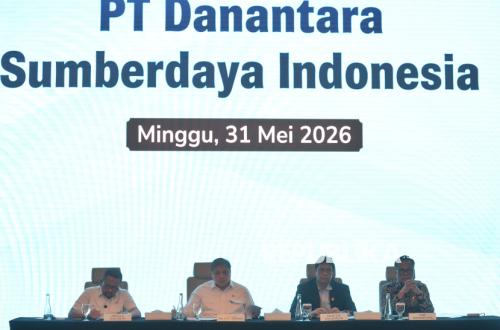
Yusuf Rendy Manilet, an economist at the Centre of Reform on Economics Indonesia (CORE), stated that the inauguration of PT Danantara Sumber Daya Indonesia (DSI) is an administrative decision. Meanwhile, the benefits for natural resource governance and the national economy will depend heavily on the quality of policy design and its implementation.
“We do not view DSI as a policy with proven benefits, but rather as a major policy that still holds various risks because its foundation has not been fully prepared,” Yusuf said when contacted by Republika in Jakarta on Tuesday.
Yusuf noted that many fundamental aspects regarding the existence of DSI have not yet been clarified. In evaluating DSI, he believes it is important to distinguish between the objectives and the instruments used.
“From the beginning, we have appreciated the government’s goal to strengthen supervision over the export traffic of strategic natural resource commodities,” he said.
He explained that practices involving the reporting of export volumes or values that do not reflect real conditions remain an issue and have the potential to reduce state revenue. However, according to Yusuf, this is fundamentally a matter of supervision rather than a matter of transaction ownership.
He stated that strengthening supervision could be achieved through improvements in verification, reporting, and auditing systems for existing export mechanisms, without needing to alter the entire trade architecture into a single-door system controlled by one entity. Therefore, Yusuf appreciates the policy objective of improving natural resource export governance, rather than the institutional model of DSI, which is designed to act as both the sole buyer and sole seller.
“In terms of natural resource governance, this design actually raises significant concerns,” Yusuf continued.
When a single entity acts as the sole buyer at the upstream level and the sole seller at the downstream level, producers lose direct access to international buyers, potentially weakening their bargaining position. In industrial economic theory, this structure is known as a monopsony—a condition where a single buyer dominates the market.
Yusuf cited the experiences of various countries that have implemented marketing board models, noting that such structures often lead to problems such as rigidly set purchase prices, payment delays to producers, and reduced flexibility for businesses to choose the most profitable markets. He noted that these risks would be felt most heavily by palm oil farmers and medium-scale mining operators, who have more limited negotiation space.
“Consequently, the DSI design does not necessarily improve governance. What may occur instead is a shift in the problem, from transaction leakage to the concentration of market power within a single institution,” Yusuf concluded.