
Economist: Government needs to protect purchasing power amid manufacturing pressures
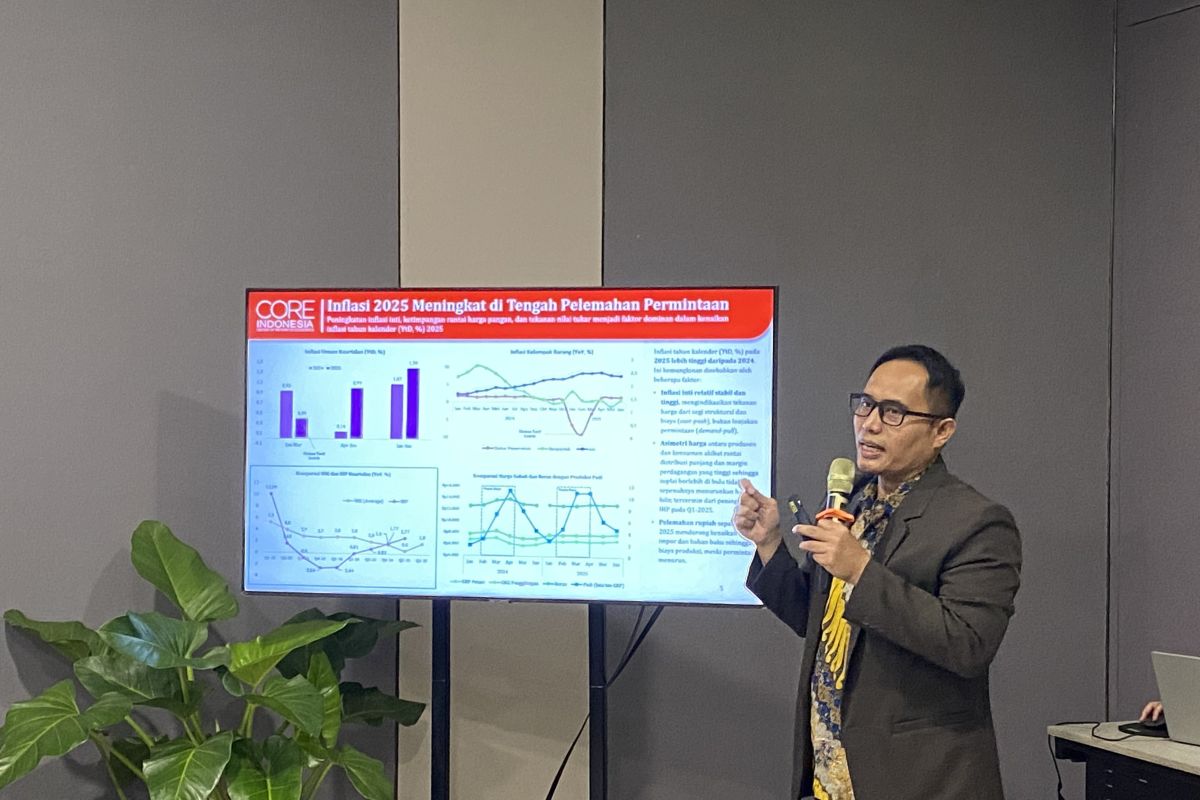
Jakarta (ANTARA) - Economist and Executive Director of the Center of Reform on Economics (CORE) Indonesia, Mohammad Faisal, believes the government needs to protect public purchasing power amid pressures on the manufacturing sector, reflected in the contraction of Indonesia’s manufacturing Purchasing Managers’ Index (PMI) to 49.1 in April 2026.
The manufacturing PMI is an indicator depicting the condition of manufacturing industry activity based on surveys of business players. A PMI figure above 50 indicates the manufacturing sector is experiencing expansion or growth. Conversely, a figure below 50 signals contraction or slowdown in manufacturing activity.
Faisal, when contacted in Jakarta on Wednesday, stated that the pressure on manufacturing is inseparable from the impact of global geopolitical conflicts, particularly the war in the Middle East involving Iran, the United States, and Israel.
He explained that before the conflict intensified, Indonesia’s manufacturing conditions were actually quite good, both in terms of industry performance and domestic demand.
However, he noted that the conflict in the Middle East then triggered rises in energy costs, production costs, and disruptions to global supply chains, which affected the domestic industry.
This situation is reflected in the manufacturing PMI, which fell from 53.8 in February 2026 to 50.1 in March 2026, then entering contraction territory at 49.1 in April 2026.
“The pressure is already so significant from production costs, and I think also due to demand factors,” he said.
Faisal recounted that during the second semester of 2025 up to March 2026, the manufacturing sector was still able to hold on, supported by strong domestic demand even though export demand weakened.
However, according to him, the current global pressures not only hit the production side but also affect public purchasing power through imported inflation, which causes rises in prices of goods and raw materials.
“Imported inflation then also erodes purchasing power, affecting demand in April 2026, and that certainly reduces demand for goods processed by the manufacturing industry,” he said.
He believes the government needs to focus on maintaining domestic consumption so that public interest and ability to shop remain strong, thereby supporting demand for manufacturing products.
In addition, the government is also said to need to keep production costs such as raw materials, energy, and logistics competitive and not burdensome to the industry.
“That must be the focus because this manufacturing pressure is inseparable from global pressures. Therefore, government policies must truly serve as a shock absorber for the negative impacts of the war,” Faisal stated.