
Economist: First-Half Investment Realisation Shows Indonesia's Appeal Remains Intact
However, the challenge in the second half is no longer attracting investment commitments, but ensuring that investment is promptly realised into productive projects.
Jakarta (ANTARA) - Head of the Macroeconomics and Finance Centre at the Institute for Development of Economics and Finance (Indef), M Rizal Taufikurahman, views the first-half 2026 investment realisation as evidence that Indonesia’s investment appeal remains reasonably intact amid global economic uncertainty.
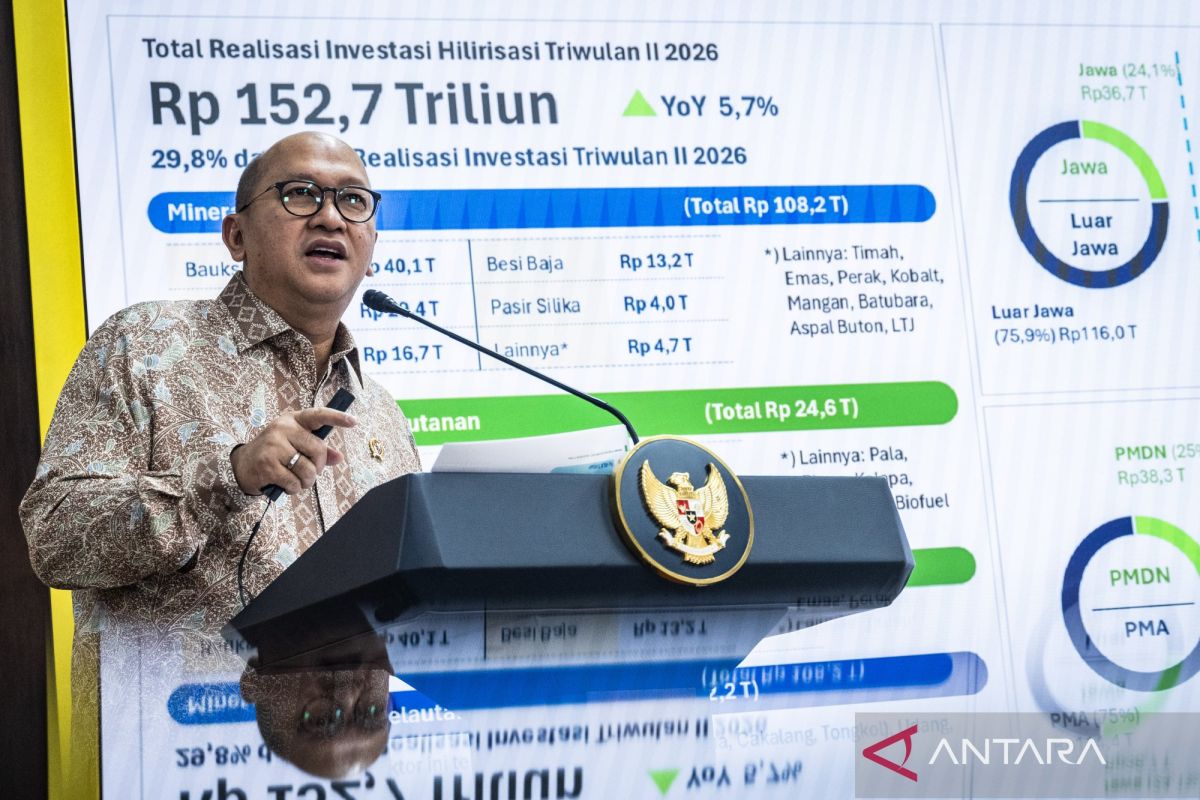
According to a report by the Ministry of Investment and Downstream Industry/BKPM, investment realisation for the period reached Rp1,010.6 trillion, or around 49.5 per cent of this year’s target.
“However, the challenge in the second half is no longer attracting investment commitments, but ensuring that investment is promptly realised into productive projects,” Rizal told ANTARA in Jakarta on Saturday.
Therefore, he said, the government needs to accelerate project execution through simplified licensing, regulatory certainty, faster infrastructure development, and the resolution of various obstacles in the field.
“This means investment should not only be high in nominal terms, but must also be capable of driving economic growth and boosting national production capacity,” he said.
Rizal considers Indonesia’s investment climate to still be relatively resilient, underpinned by a large domestic market, the downstreaming agenda, and maintained macroeconomic stability.
However, investors in the second half are expected to be more selective given elevated global uncertainty, geopolitical tensions, and still-high financing costs.
These conditions mean investment is likely to flow into sectors offering assured returns and high added value, such as mineral downstreaming, manufacturing, the digital economy, data centres, energy, and logistics.
“Therefore, policy consistency becomes a key factor in keeping Indonesia competitive compared with other investment destinations in the region,” Rizal said.
Meanwhile, first-half 2026 investment realisation absorbed 1.44 million workers, an increase of 15 per cent compared with the same period last year, according to Ministry of Investment and Downstream Industry/BKPM records.
Rizal views the increase in job creation as a positive development, but said it is not yet sufficient to conclude that investment has been of high quality.
“The measure of investment success is not only determined by the number of jobs created, but more importantly by productivity, wage levels, technology transfer, improvements in workers’ skills, and the amount of added value generated,” he said.
To that end, Rizal said, investment policy orientation needs to shift from merely chasing realisation figures towards investment that is more productive, inclusive, and sustainable, so that it can strengthen the competitiveness of national industry while improving public welfare.
Source: jawawa.id (https://jawawa.id/newsitem/economist-first-half-investment-realisation-shows-indonesias-appeal-remains-intact-1784368420)
Originally published by Antara (Indonesian) (https://www.antaranews.com/berita/5655260/ekonom-realisasi-investasi-semester-i-tunjukkan-daya-tarik-ri-terjaga), translated from Indonesian