
Economist: Financial Literacy and Deepening Must Go Hand-in-Hand to Build Financial Readiness
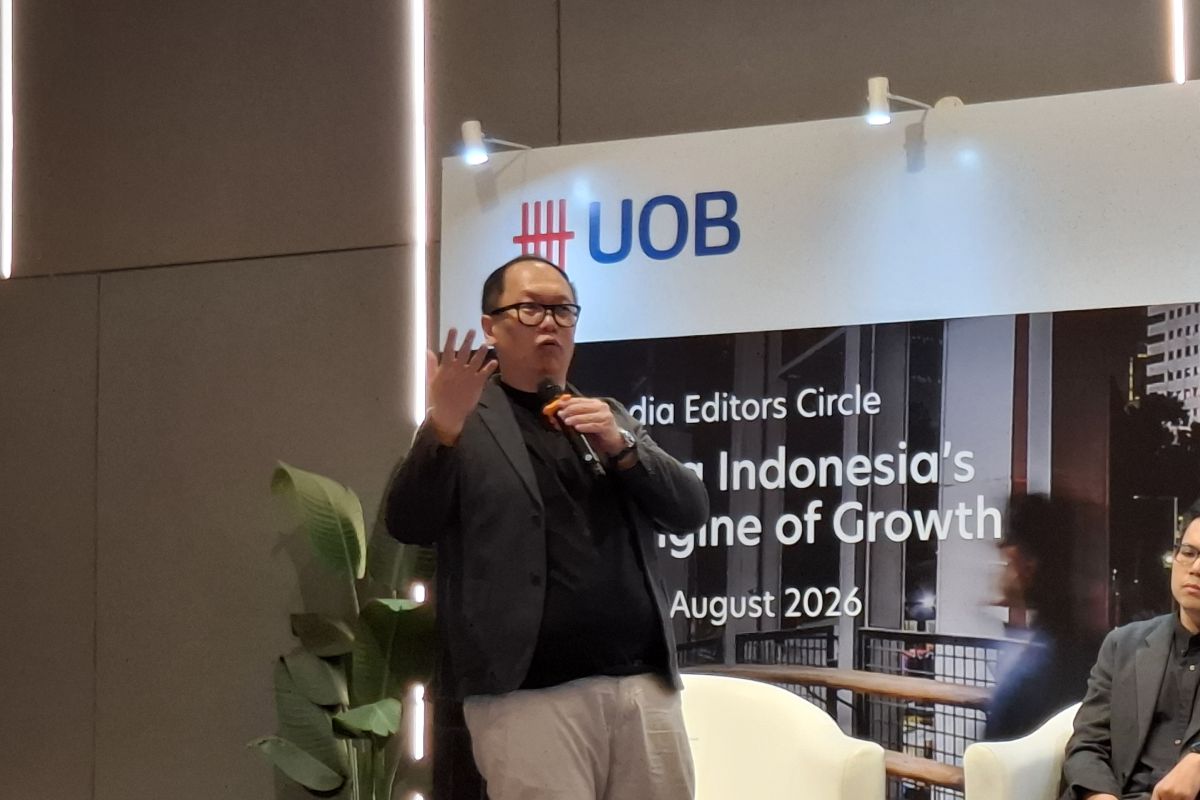
ASEAN Economist at United Overseas Bank (UOB) Enrico Tanuwidjaja has assessed that the deepening of Indonesia’s financial sector must go hand-in-hand with strengthening literacy to build the public’s financial readiness. According to him, Indonesia still has significant room to deepen its financial sector as several indicators show the level of financial depth and access is relatively low compared to some ASEAN countries. “Indonesia’s credit penetration is the lowest. This means there is still much that can be explored,” Enrico said at the UOB Media Editors Circle 2026 in Jakarta on Wednesday. In UOB’s comparative data sourced from the World Bank, Indonesia’s private debt-to-gross domestic product (GDP) ratio was recorded at 36 percent, compared to the Philippines’ 48 percent, Malaysia’s 117 percent, Singapore’s 129 percent, and Thailand’s 154 percent. Meanwhile, the market capitalisation of domestic companies relative to Indonesia’s GDP stood at 46 percent, lower than the Philippines’ 59 percent, Malaysia’s 94 percent, Thailand’s 122 percent, and Singapore’s 124 percent. In terms of financial access, the bank account ownership rate among the population aged 15 and above was recorded at 52 percent in Indonesia, compared to 51 percent in the Philippines, 88 percent in Malaysia, 96 percent in Thailand, and 98 percent in Singapore. The population aged 15 and above making or receiving digital payments was recorded at 39 percent in Indonesia, the same as the Philippines, but lower than Malaysia’s 76 percent, Thailand’s 88 percent, and Singapore’s 93 percent. Enrico assessed that these conditions indicate there is still potential to expand the utilisation of financing and various financial services in Indonesia. However, he noted that expanding access is insufficient if the public is not equipped with the ability to understand and manage financial products responsibly. “So financial literacy must run concurrently with financial deepening to build financial readiness, only then will we grow in a very sound, very solid manner,” he stated. Enrico specifically highlighted the younger generation, whose consumption patterns are increasingly oriented towards experiences such as travel and entertainment. He argued that this consumption capability needs to be balanced with readiness in managing finances. He warned that increased consumption without saving habits and good financial management could increase the risk of debt dependency. “If young people are just consumptive, that’s half the good story. You need to be financially responsible. If you don’t save now and just travel, later when you have no money, you keep borrowing, using online loans, whatever it is, that’s not good,” Enrico said. Therefore, he believes financial deepening should not only increase the use of financial products but also help the public make more responsible financial decisions. Domestically, the results of the 2025 National Survey of Financial Literacy and Inclusion (SNLIK) conducted by the Financial Services Authority (OJK) together with Statistics Indonesia (BPS) showed the national financial literacy index reached 66.46 percent and the financial inclusion index 80.51 percent. Both indices increased compared to the 2024 SNLIK, when financial literacy was recorded at 65.43 percent and financial inclusion at 75.02 percent. However, there remains a 14.05 percentage point gap between the literacy and inclusion levels in 2025. To strengthen public understanding alongside expanded access, Bank Indonesia (BI) together with the Coordinating Ministry for Economic Affairs in March 2026 launched the Programme to Strengthen Financial Literacy and Inclusion for Welfare (AKSI KLIK), directed at strengthening literacy and access to productive financing. BI, together with the Ministry of Finance, OJK, and the Indonesia Deposit Insurance Corporation (LPS), is also running the 2026 Leading Indonesian Financial Literacy (LIKE IT) programme with special attention on the younger generation. The programme is directed at strengthening the ability to make wise financial decisions while expanding the domestic investor base. According to Enrico, strengthening literacy and deepening the financial sector ultimately need to proceed together so that increased access to financial services can be transformed into stronger financial readiness within society.