
Economist: Economic impact of forest and land fires far wider than burnt land value
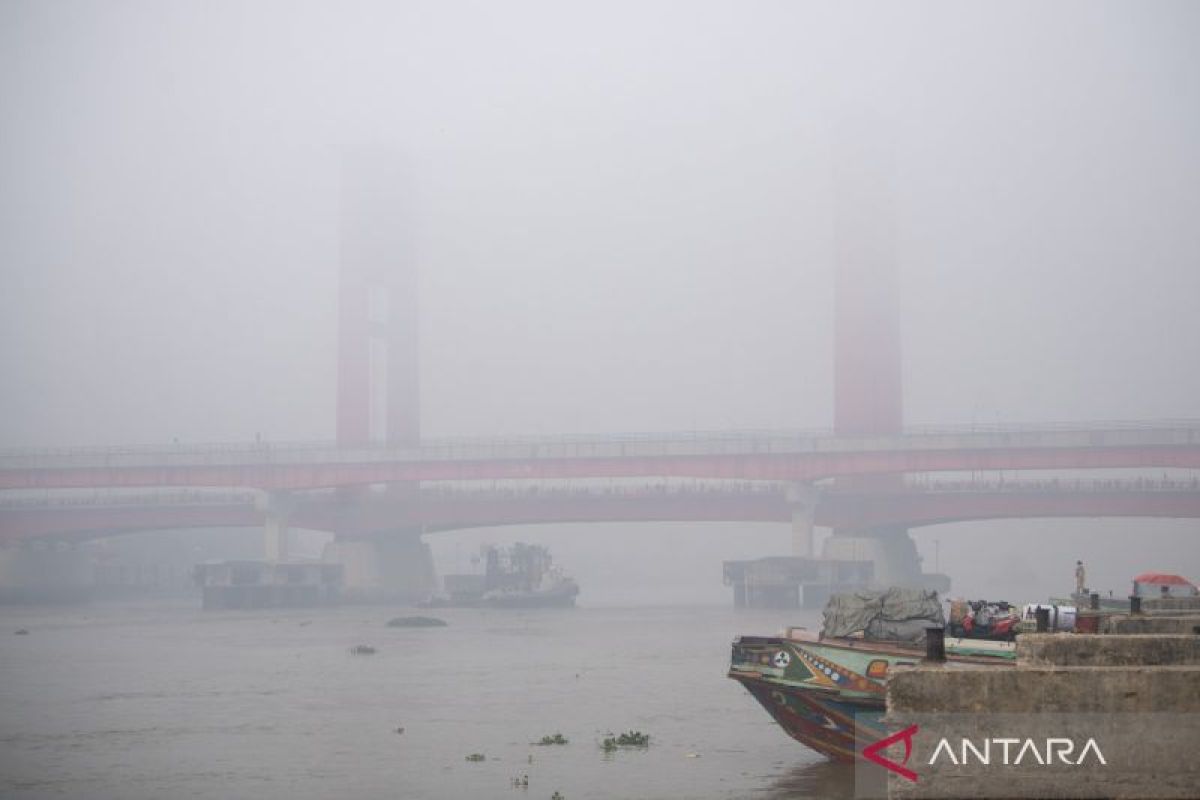
Jakarta (ANTARA) - Trimegah Sekuritas Indonesia chief economist Fakhrul Fulvian believes that forest and land fires (karhutla) amid the current El Niño development could have a far broader economic impact than the value of the burnt land or forest itself.
“Disasters have a multiplier effect that is often invisible on the first day. Initially it may be a land fire. After that, health problems emerge, work activities are disrupted, schools are disrupted, transport is disrupted and ultimately economic activity and people’s livelihoods weaken,” Fakhrul said in a statement in Jakarta on Sunday.
He explained that smoke haze can increase respiratory problems and public health costs. School activities can also be disrupted and worker productivity can decline when air quality deteriorates.
Disruption can also spread to aviation and transport, goods distribution, local trade and people’s daily activities.
In regions dependent on agriculture, prolonged dry conditions can also affect water availability and food production. If it lasts long enough, the impact can appear in the form of food price pressures and declining household incomes.
According to Fakhrul, disaster prevention is actually part of maintaining the continuity of economic activity. One unique characteristic of disaster budgets, he said, is that their success is often visible precisely when something does not happen.
When fires are successfully controlled before spreading, no economic activity stops. When early warning systems work well, communities can anticipate risks earlier.
When logistics and equipment are already available, responses can also be carried out without having to wait for conditions to worsen.
In his view, the losses successfully prevented rarely appear in economic statistics, but have real value for society.
“We can often calculate the cost of a disaster after it occurs. What is far more difficult to calculate is the loss that did not materialise because prevention worked. Yet economically its value can be very large,” Fakhrul said.
Therefore, according to Fakhrul, the principle of prevention being better than cure is not merely a social or health principle, but also has strong economic logic.
He reminded that preparedness costs can be planned. Conversely, once a disaster has escalated, the government and society face costs that are far more difficult to control.
In this regard, Fakhrul believes the budget capacity of the National Disaster Management Agency (BNPB) needs to be strengthened if the increased disaster risk indeed requires greater preparedness.
Even so, he said, the most important measure is not simply the size of the budget, but whether the required prevention and response capacity is truly available.
Priority should be given to preparedness, risk monitoring, early warning, personnel, logistics, equipment maintenance, coordination with regional disaster management agencies (BPBD) and the ability to respond quickly when hotspots or disasters begin to emerge.
Fakhrul also believes there is a simple principle in risk management. The greater the probability of an event occurring and the greater the potential loss, the more important the readiness to face it.
Therefore, he added, when the risks of El Niño and forest and land fires increase, disaster management capacity should not weaken.
“We certainly hope that the risks of El Niño and forest and land fires this year can be navigated well. But hope must be accompanied by preparedness. Because the cost of prevention is almost always smaller than the economic, health and social costs once a disaster has already escalated,” Fakhrul said.
Source: jawawa.id (https://jawawa.id/newsitem/economist-economic-impact-of-forest-and-land-fires-far-wider-than-burnt-land-value-1787493242)
Originally published by Antara (Indonesian) (https://www.antaranews.com/berita/5707963/ekonom-dampak-ekonomi-yang-timbulkan-oleh-karhutla-jauh-lebih-luas), translated from Indonesian