
Economist: Deregulation Task Force is the Solution to Stagnant 5% Economic Growth
May 16, 2026
16:55 WIB
Economist: Deregulation Task Force is the Solution to Stagnant 5% Economic Growth
The economist emphasized the need for bureaucratic reform and deregulation to encourage foreign investment and maximize exports in order to achieve high economic growth for Indonesia, similar to East Asian countries.
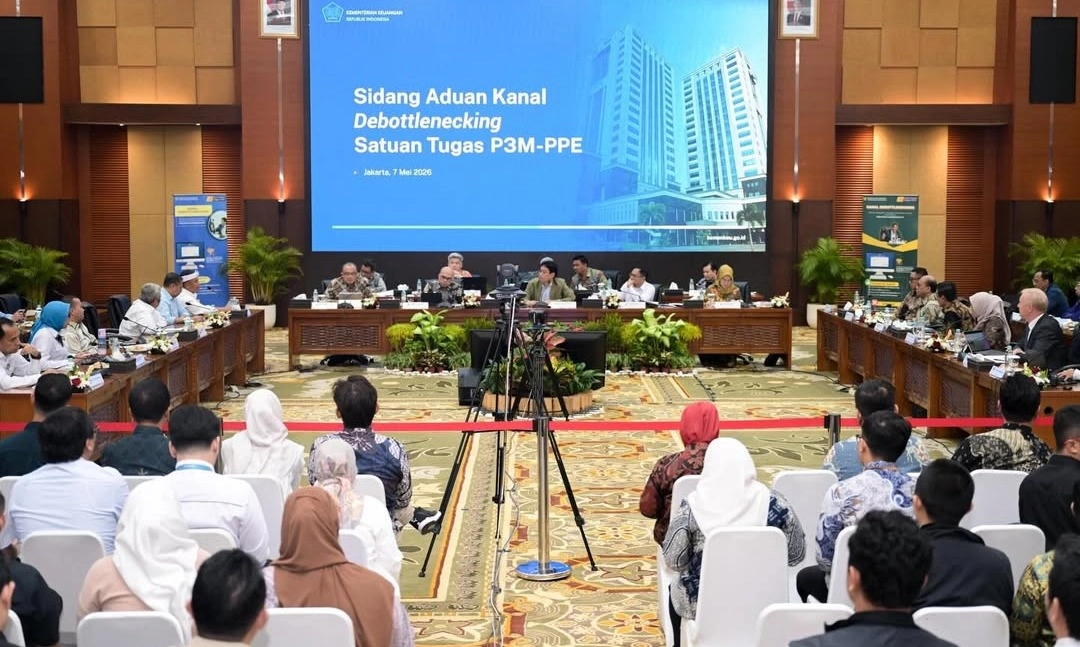
Finance Minister Purbaya Yudhi Sadewa led a meeting on the debottlenecking report, Jakarta, Thursday (7/5). Instagram/@MenkeuRI
JAKARTA - Rector of Paramadina University, Didik J Rachbini, believes that the idea of forming a Deregulation Task Force is logical to lift Indonesia out of its economic stagnation at 5%. According to him, East Asian countries that have successfully implemented industrialization used a ‘war room’ for bureaucratic reform directly controlled by the highest political leader.
For example, Vietnam, through the Đổi Mới reforms, has succeeded in maintaining economic growth up to 8%. Indonesia achieved this in the late 1980s and early 1990s, resulting in economic growth of up to 7%.
“All developed countries have done this, such as South Korea during its industrialization era, Singapore under Lee Kuan Yew, and China during the Deng Xiao Ping era. Without bureaucratic reform and institutional improvement, it is impossible for industry and the economy to grow rapidly,” he explained in a written statement, Jakarta, Saturday (16/5).
“If we want to escape the curse of 5% economic growth, then there must be policies to achieve maximum export performance to drive high industrial growth,” said the Senior Economist at Indef.
He regretted that the national industry, which should be the locomotive of the economy, is currently growing slowly and cannot be relied upon to boost economic growth. Therefore, a conducive business climate is needed so that foreign investment comes in and export performance grows rapidly as a sign that Indonesian products are competitive and successful in the international market.
“Relatively compared to other countries, we are far behind. Meanwhile, foreign investment in Vietnam reached 4.2%; Malaysia 3.7%; and Singapore 27.8%,” he said.
He even emphasized that Indonesia’s export performance is far behind Vietnam as a new economic engine in Southeast Asia. Vietnam’s international trade has grown very rapidly to US$1000 billion, or twice the value of Indonesia’s international trade.
“That is why Vietnam’s economy can grow up to 8% in 2025. As long as export performance and foreign investment are sluggish, don’t expect us to escape the curse of 5% growth,” he said.
Furthermore, he also highlighted the issue of bureaucracy and regulations, which President Prabowo has also complained about as hindering many businesses, as a major economic problem. For comparison, it takes up to two years to process investment permits in Indonesia, while in other countries it can be completed in just two weeks.
“Complicated regulations are considered to create opportunities for unhealthy practices in the bureaucracy. Therefore, the President plans to form a special deregulation task force to cut rules and permits that are deemed to hinder investment and business activities in Indonesia,” he said.
“But it won’t be easy, because the current conditions are more difficult than in the 1980s because the economic structure is more complex, the bureaucracy is larger, vested interests are greater, and the global landscape has changed,” he added.
“Deregulation and debureaucratization are for accelerating domestic and foreign investment, new industrialization, competitiveness in penetrating international markets, and job creation. This policy must be carried out with strong governance to avoid the risk of repeating old patterns of rapid but fragile and oligarchic growth,” he concluded.