
Economist: 30kg Rice Aid Eases Household Spending Burden
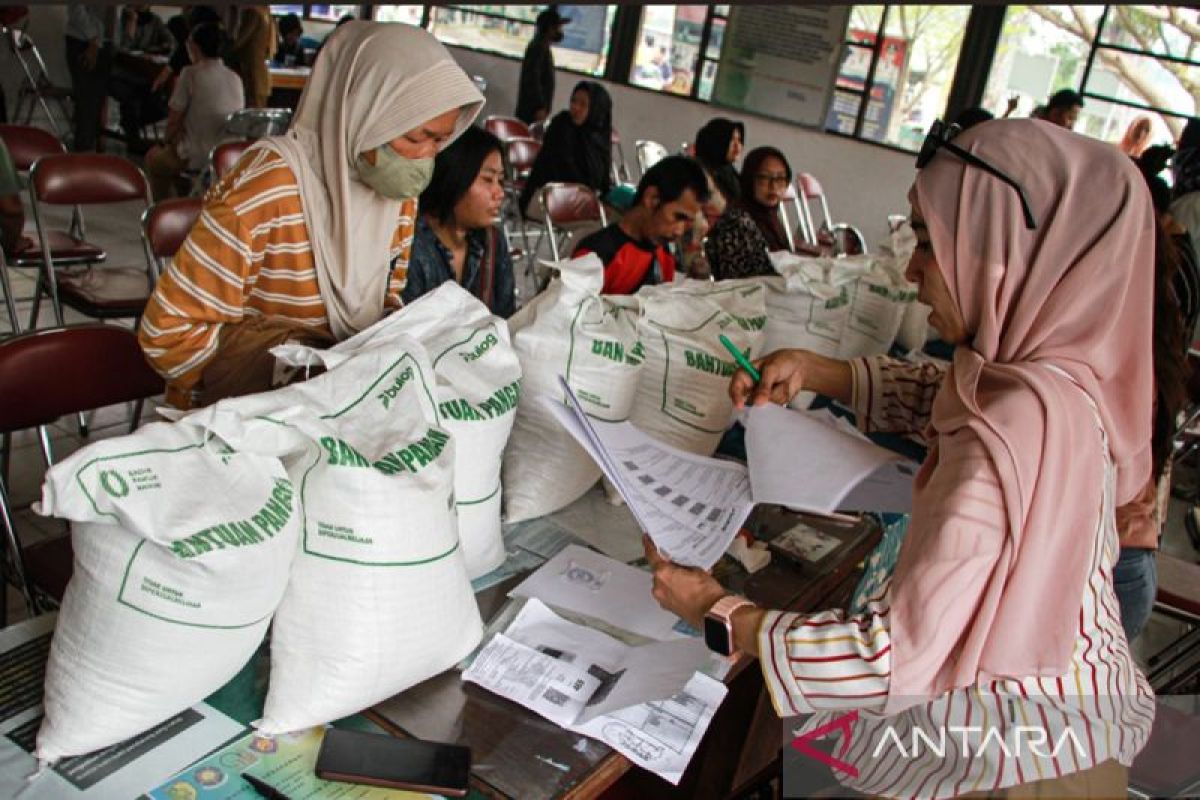
Jakarta (ANTARA) - Eliza Mardian, a researcher at the Centre of Reform on Economics (CORE) Indonesia, assesses that the 30-kilogram (kg) rice aid can reduce the food expenditure burden for lower-decile households in the short term.
“For lower-decile households, this amount is significant enough to curb food spending currently, allowing them to reallocate their budget to purchase protein, vegetables, transport, or settle small debts,” Eliza said when contacted by ANTARA in Jakarta on Tuesday.
However, she cautioned that aid in the form of rice does not increase household income, but rather reduces the portion of expenditure required to purchase rice.
“Goods-based aid does not raise income. It only reduces part of their need to purchase rice,” she noted.
She explained that the 30kg aid received all at once is an accumulation of the allocation for three months, specifically 10kg each for July, August, and September 2026.
As an illustration, Eliza used the assumption of household rice consumption at approximately 92kg per capita per year, or roughly 7.7kg per person per month. Under this assumption, a household of four members requires about 30kg of rice per month. Thus, the monthly allocation of 10kg meets about one-third of the household’s rice needs in this illustration.
“The 30kg lump-sum aid can serve as a buffer for lower-decile households to manage rice spending in the short term, but it is a supply for about one month, not a guarantee of food security for three months,” said Eliza.
Previously, the government decided that the rice food aid allocation for July–September 2026 for recipients in deciles 1 to 4 would be distributed all at once in a 30kg quantity so that distribution could be completed by September.
Coordinating Minister for Food Affairs, Zulkifli Hasan, stated that every recipient still receives an allocation of 10kg per month for three months, but the distribution has been consolidated into a single 30kg delivery. The programme targets more than 33.2 million food aid recipients.
The Head of the National Food Agency and Minister of Agriculture, Andi Amran Sulaiman, explained that the National Socio-Economic Single Data (DTSEN) used as the basis for recipients is an update released by Statistics Indonesia (BPS) as of 10 July 2026, which has undergone a screening process by the Ministry of Social Affairs.
This data is then received by the National Food Agency (Bapanas) to be finalised and communicated to Perum Bulog as the executor of the rice food aid distribution.
Eliza believes that lump-sum distribution provides benefits when household needs are urgent, rice prices are rising, and recipients have adequate storage facilities.
“On the positive side, simultaneous distribution accelerates the receipt of benefits and reduces the frequency of queuing and repeated delivery costs,” she revealed.
However, she noted that the distribution pattern should not be uniform because household conditions and the characteristics of each region differ.
For areas with high rice prices and households without adequate storage, Eliza believes a two-stage distribution is safer, with the second stage provided approximately four to five weeks after the first.
Conversely, for remote areas and regions with high logistics costs, lump-sum distribution can be more rational, provided the rice is well-packaged, communal storage is available, and quality monitoring is conducted.
“A single design for these 33.24 million families ignores differences in storage capacity, household size, and local price calendars,” said Eliza.
According to her, the choice between lump-sum and periodic distribution needs to consider the recipients’ needs as well as the ability to maintain rice quality.
“Lump-sum is faster; periodic is more even and maintains quality. The ideal design should adjust to the rhythm of household needs,” she said.
Through Perum Bulog, the government continues to strengthen food aid distribution as an instrument to maintain food security and assist the public in facing potential food price increases.
Furthermore, Coordinating Minister for Food Zulkifli Hasan stated that targeted distribution is expected to maintain purchasing power and ensure that the food needs of recipient groups continue to be met.
Source: jawawa.id (https://jawawa.id/newsitem/economist-30kg-rice-aid-eases-household-spending-burden-1790082218)
Originally published by Antara (Indonesian) (https://www.antaranews.com/berita/5753347/ekonom-nilai-bantuan-beras-30-kg-ringankan-beban-belanja-keluarga), translated from Indonesian