
Economist: 100 bps BI-Rate Hike Could Increase Banks' Cost of Funds
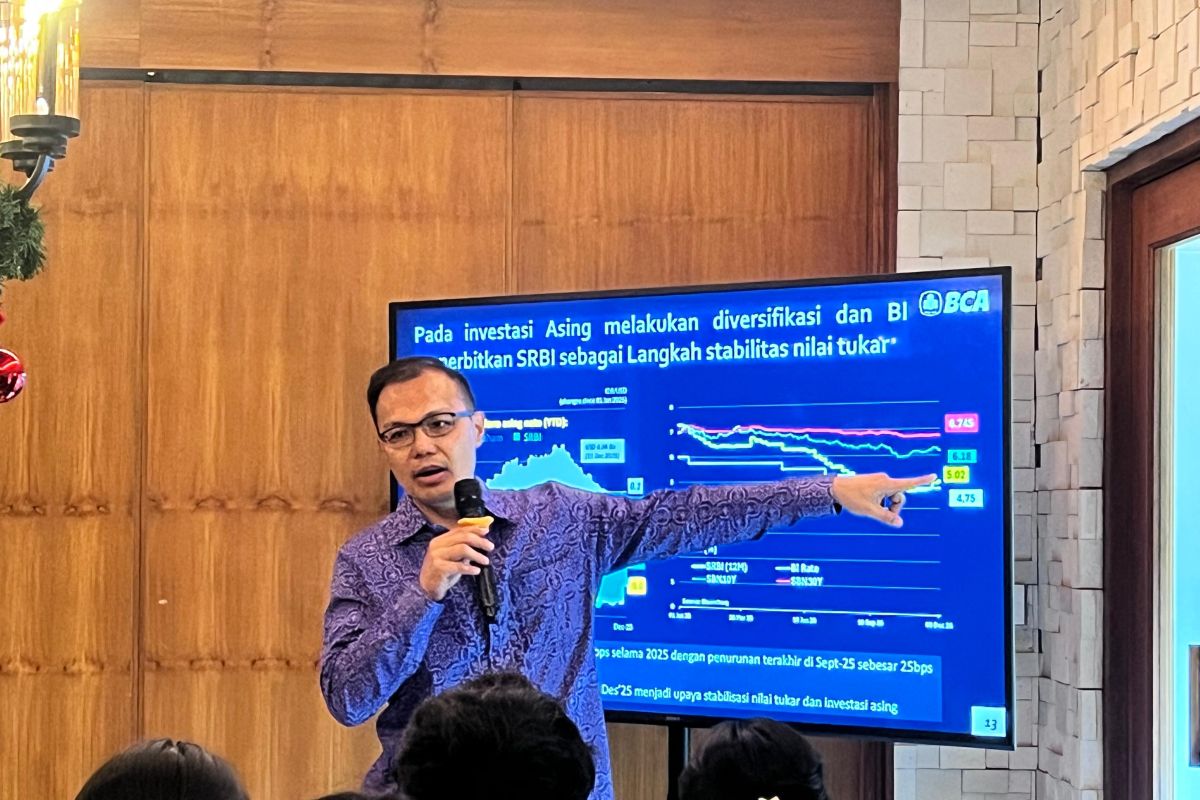
Jakarta (ANTARA) - BCA Chief Economist David Sumual believes the 100 basis point (bps) increase in the benchmark interest rate (BI-Rate) during May-June 2026 could potentially raise the cost of funds (CoF) for the banking industry going forward. The cost of funds refers to the expense banks incur to raise funds and is a key component in determining lending rates. “The cost of funds could increase, especially if the government withdraws funds (SAL fund placements) previously disbursed to Himbara banks, making liquidity tighter,” David said when contacted by ANTARA in Jakarta on Friday. David added that the outlook for credit growth is likely unchanged amid rising demand for working capital loans, although lending rates tend to rise in line with the BI-Rate increase.
Contacted separately, PermataBank Chief Economist Josua Pardede also assessed that the 100 bps BI-Rate hike could reverse the direction of banks’ cost of funds, although the increase is likely to be gradual rather than a sharp spike across the entire industry. He noted that early signs are already visible, with the rupiah third-party deposit (DPK) rate rising from 2.65 percent in April 2026 to 2.70 percent in May 2026. This increase, Josua said, indicates that competition for raising funds is beginning to intensify, particularly because cheap funding sources are limited while credit funding needs remain large. Nevertheless, he believes the pressure on the cost of funds has not yet become systemic because banking liquidity is still relatively adequate. On the other hand, Bank Indonesia (BI) continues to maintain sufficient liquidity through a policy mix, including repo auctions and strengthening banking liquidity instruments.
For context, throughout 2025, BI cut the benchmark rate five times for a total reduction of 125 bps. Following those cuts, BI data shows that bank lending rates only fell by 39 bps, from 9.20 percent at the start of 2025 to 8.81 percent in December 2025. In May 2026, the lending rate was recorded at 8.72 percent and the one-month deposit rate at 4.26 percent. Josua also observed that the downward trend in the cost of funds following the 125 bps BI-Rate cut in 2025 is indeed at risk of reversing in 2026. In April 2026, the cost of funds still edged down slightly, contributing to the prime lending rate (SBDK) falling from 8.63 percent to 8.62 percent. However, after BI aggressively raised rates in May-June 2026, the transmission direction began to change. “Banks with a low proportion of cheap funds, greater reliance on deposits, high liquidity needs, or aggressive lending will raise deposit rates more quickly. Conversely, large banks with strong cheap funding bases and ample liquidity still have room to hold off on increasing their cost of funds,” Josua said.
Previously, at the monthly BI Board of Governors Meeting (RDG) on 19-20 May 2026, the BI-Rate was raised by 50 bps, marking the first adjustment after being held at 4.75 percent since September 2025. However, the rupiah exchange rate continued to weaken, touching the Rp18,000 per US dollar level, prompting BI to raise the BI-Rate by another 25 bps through a Weekly RDG on 9 June 2026, outside the regular schedule. Most recently, on Thursday (18/6), at the Monthly RDG, the central bank decided to raise the BI-Rate by 25 bps. Thus, the cumulative BI-Rate increase reached 100 bps over the past month, bringing the rate to 5.75 percent. Alongside the benchmark rate tightening, BI is maintaining sufficient liquidity in the money market and banking system, including through the reopening of the repo instrument auction window for 3, 6, 9, and 12-month tenors for banks. BI also continues to pursue loose macroprudential policies, including the Macroprudential Liquidity Incentive Policy (KLM) for banks that set lending/financing rates aligned with the central bank’s policy. Bank lending in May 2026 grew by 11.51 percent year-on-year (yoy), higher than the 9.98 percent (yoy) growth in April 2026. Meanwhile, DPK grew strongly by 13.47 percent (yoy) in May 2026, with a liquid assets to third-party funds ratio (AL/DPK) of 24.74 percent.