
Economic value of Jamu reaches Rp1.2 trillion, BPOM pushes for herbal innovation
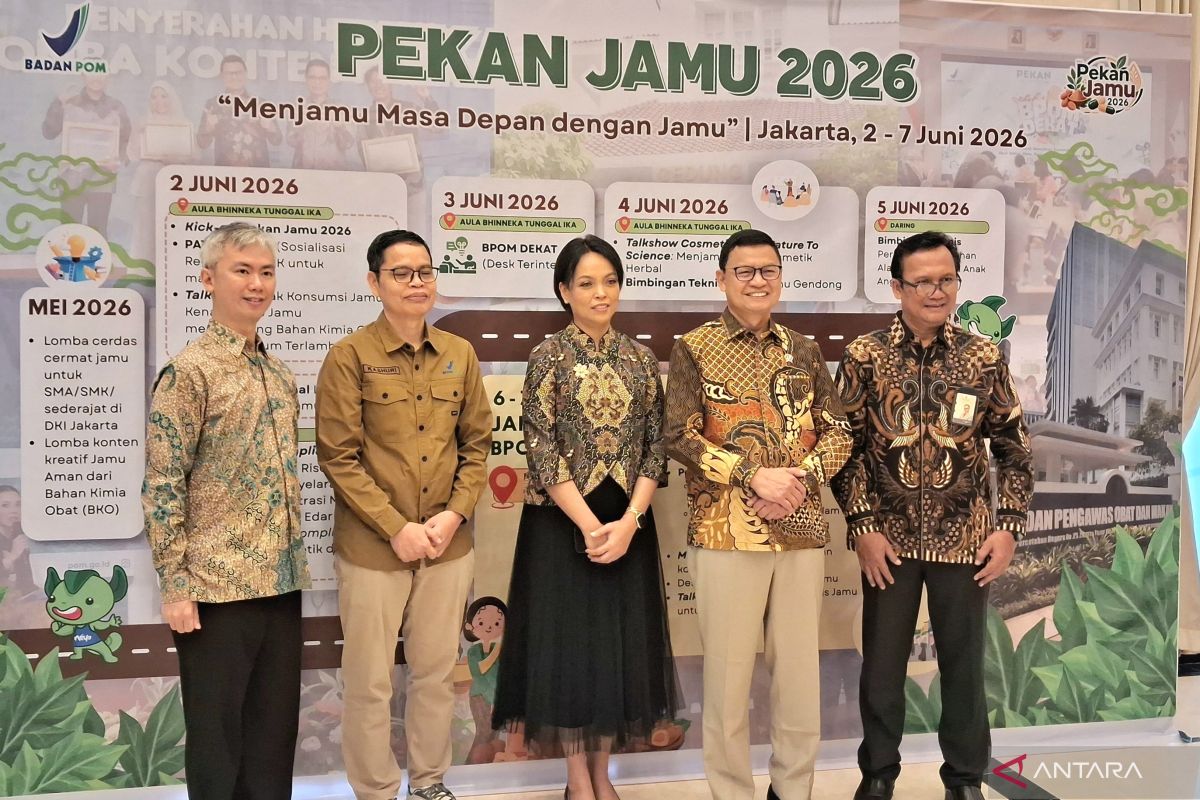
Jakarta (ANTARA) - The Indonesian Food and Drug Authority (BPOM) has stated that the annual economic value of Indonesia’s Jamu products can reach Rp1.2 trillion. Consequently, innovation in herbal plant cultivation to produce Standardised Herbal Medicine (OHT) must be continuously enhanced.
The Head of BPOM, Taruna Ikrar, noted that the global market potential for Jamu and health products is estimated to reach approximately Rp350 trillion per year. However, research and development regarding the biodiversity of herbal plants into certified herbal medicines remains sub-optimal.
“Currently, the economic value of the Jamu industry is around Rp1.2 trillion based on recorded industry data. The global wellness and health market potential is estimated to reach around Rp350 trillion for Indonesia, provided that our existing biodiversity can be utilised optimally,” he stated during the Kick Off of Jamu Week 2026 in Jakarta on Tuesday.
Taruna highlighted several advantages of Indonesian herbal plants, such as curcumin found in turmeric and temulawak, which are just as competitive as ginseng, the flagship product of East Asian countries like Korea, China, or Japan.
“Curcumin offers broader benefits than ginseng because it possesses antioxidant effects (protecting body cells from free radicals), anti-inflammatory properties (reducing inflammation), and vasodilator effects (widening blood vessels to improve circulation). Indonesia is actually capable of competing with South Korea and other nations, but the management, research, and downstreaming of herbal products still need improvement,” he explained.
Taruna also noted that many herbal plants, such as turmeric and various rhizomes, contain active compounds with antioxidant and anti-inflammatory properties, which have the potential to be developed into cosmetic and body care products.
Currently, there are approximately 22,000 Jamu products that hold a Distribution Permit Number (NIE) from BPOM. However, of that number, utilisation remains low; only about 71 products have been upgraded to OHT, and 21 products have reached the status of phytopharmaceuticals (medicinal preparations based on natural ingredients such as plants, animals, or minerals).
“Increasing the status from Jamu to OHT and phytopharmaceuticals requires stronger scientific research, including preclinical trials, stability tests, bioavailability research, and proof of efficacy. The higher the level of scientific proof, the greater the economic value,” he concluded.
Source: jawawa.id (https://jawawa.id/newsitem/economic-value-of-jamu-reaches-rp1-2-trillion-bpom-pushes-for-herbal-innovation-1780876736)
Originally published by Antara (Indonesian) (https://www.antaranews.com/berita/5590491/nilai-ekonomi-jamu-tembus-rp12-triliun-bpom-dorong-inovasi-herbal), translated from Indonesian