
Economic momentum behind Thai PM's visit to Indonesia
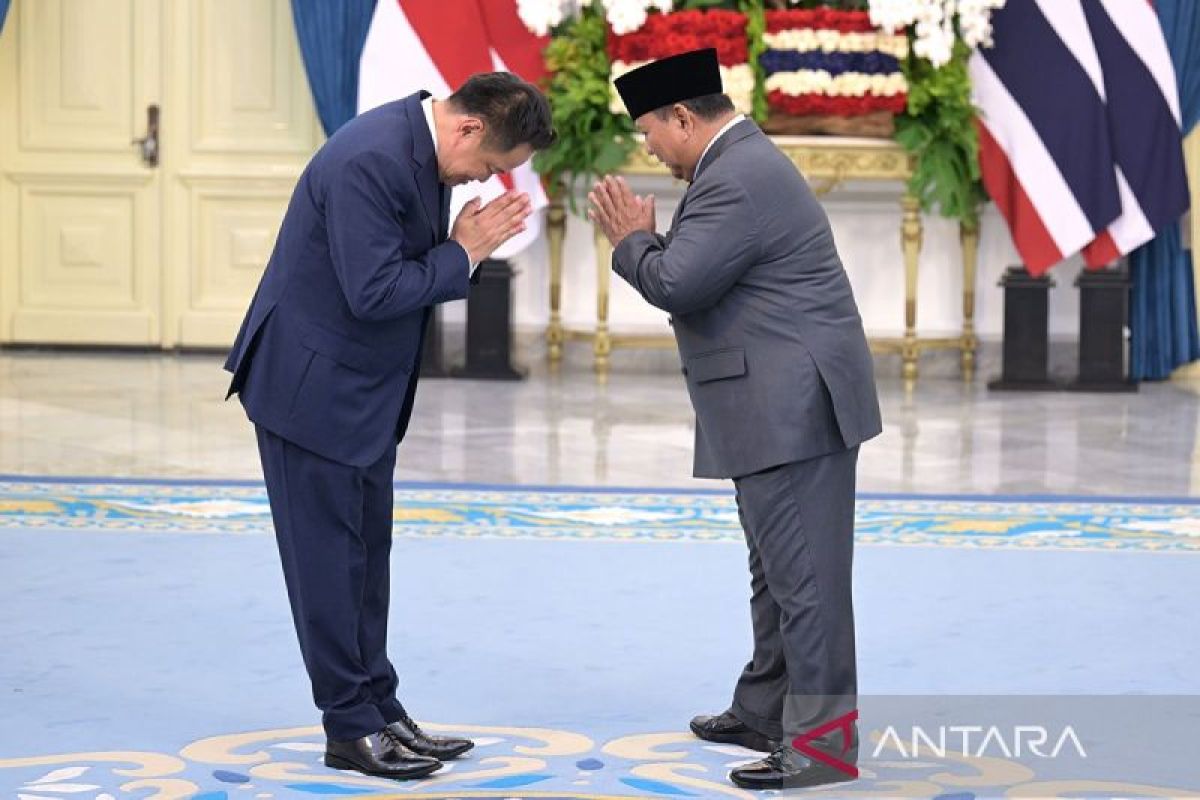
With the establishment of a Joint Trade Commission, a five-year roadmap, and expanded connectivity routes, the foundation of Indonesia-Thailand cooperation is now built on a more structured footing.
Jakarta (ANTARA) —
Thai Prime Minister Anutin Charnvirakul, who arrived at Halim Perdanakusuma Air Base on Monday afternoon, 3 August 2026, made history as the first official visit by a Thai PM to Indonesia in 15 years, and the first overseas trip by Anutin since he was sworn in as the 32nd Prime Minister in September 2025.
Behind the solemn welcoming ceremony at the Merdeka Palace — complete with a mounted guard, the Sekar Sahitya Ayu dance (a classical Jaipongan from West Java), and hundreds of students waving both nations’ flags — lay a series of significant figures and agreements.
The meeting shifted the focus of Indonesia-Thailand bilateral relations from mere diplomatic ceremony towards concrete substance.
The most prominent outcome of the meeting between President Prabowo Subianto and PM Anutin was the setting of a bilateral trade target of 20 billion US dollars by 2030, set out in the Indonesia-Thailand Strategic Partnership Roadmap 2026–2030.
At first glance, this figure looks like the kind of formal target typical of state visits. However, judged against the past five years of trade data, the target is in fact highly realistic and consistent with the ongoing trend.
Total trade between the two countries stood at 16.23 billion US dollars in 2021, jumped to 19.19 billion US dollars in 2022, and then stabilised at around 17.5 billion US dollars in 2023 and 2024. In 2025, trade value grew 1.35 per cent year-on-year to 17.67 billion US dollars.
Ministry of Trade data shows that cumulative trade in the first half of 2026 has already exceeded 9.80 billion US dollars. If this trend holds through the end of the year, Indonesia-Thailand trade in 2026 is projected to approach 19.6 billion US dollars — nearly surpassing the target set for 2030.
The roadmap agreed by the two leaders therefore functions as a regulatory framework to sustain the growth momentum that has been building since the start of the year.
The strengthening of relations is also reflected in the improving structure of Indonesia’s trade balance. According to official data from the Ministry of Trade and the Central Statistics Agency (BPS), Indonesia’s trade balance with Thailand has consistently run a deficit since 2011 due to high imports of automotive products and machinery, with the largest deficit reaching 3.05 billion US dollars in 2023.
However, that deficit narrowed significantly to 2.02 billion US dollars in 2024, and was down to just 140.6 million US dollars in 2025. The decline was driven by a 13.73 per cent annual surge in Indonesian exports. Indonesian exports — dominated by oil, coal, fishery products, and paper — grew faster than the increase in imports of rice, machinery, and vehicle spare parts from Thailand.
To nurture this positive trend, Prabowo and Anutin agreed to establish a Joint Trade Commission, tasked with expanding market access and dismantling trade barriers between the two countries.
The deepening of economic cooperation was matched by investment in human resources.
Indonesia and Thailand signed a memorandum of understanding (MoU) on education, inked by Minister of Primary and Secondary Education Abdul Mu’ti and Thai Education Minister Prasert Jantararuangtong. The cooperation focuses on knowledge and student exchanges, as a long-term investment to underpin future economic growth.
In the connectivity sector, Anutin’s visit produced a concrete step: the opening of new direct flight routes — Jakarta–Bangkok and Denpasar–Phuket.
President Prabowo welcomed the new routes as a means of strengthening people-to-people contact. PM Anutin added that the added routes target the health tourism segment, MICE activities (Meetings, Incentives, Conferences, and Exhibitions), and cruise tourism — high-value market niches compared with conventional mass tourism.