
Economic Hardship Drives Phenomenon of University Graduates Choosing Domestic Work
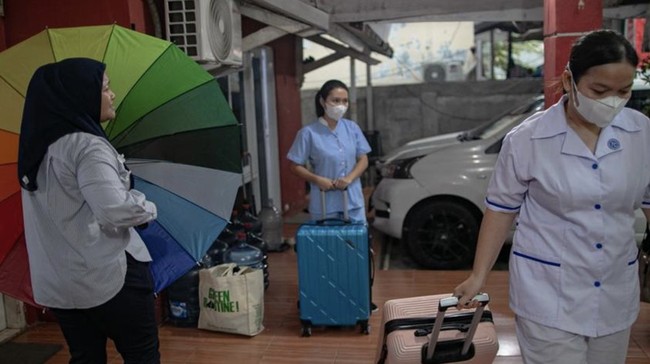
Economic hardship is forcing many individuals to step out of their comfort zones, doing whatever is necessary to survive. Amidst the ongoing volatility of the global economy, a phenomenon has emerged where many university graduates are undertaking manual labour or jobs that do not require a degree.
This is the reality for Maha, a 31-year-old woman who decided to leave her job in Indonesia to become a domestic worker in Taiwan. Maha made this decision when she was 27 years old.
A 2018 graduate in Development Economics from Muhammadiyah University of Ponorogo, she previously worked at Perhutani KPH Jember for two years within the human resources and finance divisions. However, her income, which was equivalent to the regional minimum wage (UMR), was entirely consumed by rent and daily living expenses. Furthermore, she had to support her parents’ debts, leaving her with no opportunity to save.
“Initially, I was very tired of my salary being used up just to pay for my boarding house and living costs in another city; I couldn’t even save because my salary was only the minimum wage,” Maha told CNBC Indonesia via a message on Threads on Wednesday (23/9/2026).
This situation led her to consider other jobs that would not require her to pay for accommodation. Her choice eventually fell on working as a domestic worker in Taiwan.
“I thought to myself, if I work again, I want a job where I don’t have to pay for a room, and Taiwan came to mind. It was quite a bold move,” she said.
Maha’s decision to work abroad was also influenced by her family background. She noted that her mother, elder sibling, and several extended family members have experience as migrant workers. This made it easier for her to obtain information regarding the departure process and working in Taiwan.
The process, from registration to departure, took approximately five months before she officially began working as a domestic worker in Taiwan. In her role, she is responsible for cooking three meals a day, cleaning a four-storey house, laundering clothes both by machine and manually, and shopping at the market. Occasionally, Maha also assists in looking after infants when her employer’s grandchildren visit.
Responsible for all these tasks, Maha’s income as a domestic worker reaches approximately Rp10 million per month.
Behind the higher income, Maha must face a quite heavy work routine. She stated that she begins work at 05:30 am and only finishes her duties around 08:30 pm. At times, due to extreme exhaustion, she has even fallen asleep in the bathroom.
Nevertheless, Maha is grateful because her employer allows her to perform her religious prayers and fasting, and provides her with a private bedroom and bathroom.
Able to Settle Family Debts Within a Year
One of the most significant changes Maha has experienced since working in Taiwan is her financial situation. Whereas previously her entire income in Indonesia was spent on daily needs and family debts, while working in Taiwan, she is able to set aside money every month.
The results of her hard work became evident in her first year. Maha successfully settled all the family debts she was responsible for.
“I am certainly grateful that all the debts I was carrying were paid off in my first year of working in Taiwan,” she said.
In addition to improving her financial condition, Maha feels that her experience in Taiwan has allowed her to grow personally. She has proven capable of adapting to different environments, cultures, and languages.
“I feel my mental strength was truly upgraded when working in Taiwan. Meeting new people from different cultures and languages,” she remarked.
Maha emphasised that she does not regret her decision to leave an office job to become a domestic worker. In her view, domestic work should not be looked down upon. She also does not feel that her university education has been wasted simply because she is now working in a different field.
“I believe working as a domestic worker is not a trivial matter. I don’t feel my education is wasted just because I am a domestic worker; in fact, I see it as a plus,” she said.
She believes that education helps shape one’s mindset, emotional management, and ability to communicate and interact with others. These skills remain useful even if one works in a field unrelated to their university major.
Many Other Graduates Have Similar Experiences
Maha’s experience, shared via the Threads account @noraisaly***, has received significant engagement. Several social media users claimed to have similar experiences.
One user, @maufy_i***, stated they are a 2012 graduate of a Diploma 1 in Administration who previously worked as a warehouse manager. They subsequently decided to resign and work as a domestic worker in Hong Kong.
“I am a D1 Administration graduate from 2012; I worked as a warehouse manager, resigned, and then chose to become a domestic worker in Hong Kong. Alhamdulillah, I have been with the same employer for six years and I am happy here,” they wrote.
Another experience came from user @austin698***, who identified as a Bachelor of Economics majoring in Management and is currently working as a domestic worker in Singapore.
Source: jawawa.id (https://jawawa.id/newsitem/economic-hardship-drives-phenomenon-of-university-graduates-choosing-domestic-work-1790221997)
Originally published by CNBC Indonesia (https://www.cnbcindonesia.com/lifestyle/20260924090505-33-770447/ekonomi-sulit-muncul-fenomena-sarjana-pilih-kerja-jadi-art), translated from Indonesian