
Economic Growth Is Not Just About the Numbers, but About Real Impact
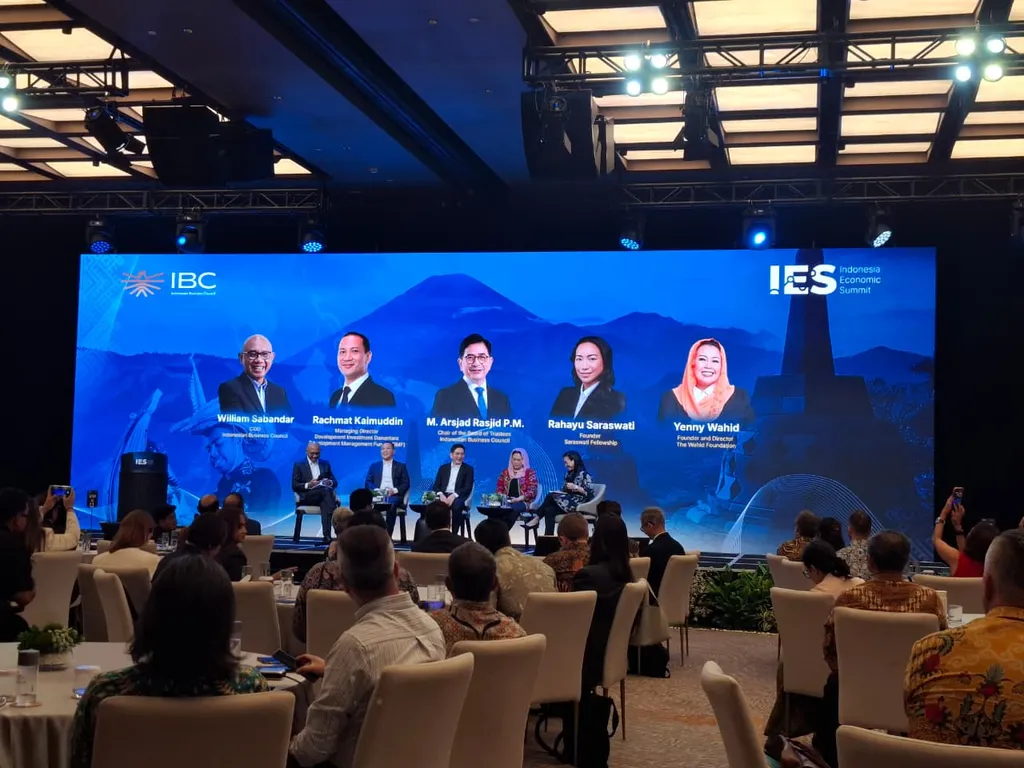
The synergy between the private sector and the government is essential to enhance economic growth that is not limited to numerical increases, but also to tangible social impacts.
13 Okt 2026 19:41 WIB · Ekonomi & Bisnis
FAKHRONAA AZIIZAH UNTUK KOMPAS
JAKARTA, KOMPAS – More than half of Indonesia’s population lives below the poverty line as defined by the World Bank. A close collaboration between the private sector and the government is urgently needed to determine quality economic growth, including the empowerment of SMEs.
The World Bank’s Macro Poverty Outlook (MPO) April 2026 report noted that 64.2 percent of Indonesians live below the global poverty line. This figure refers to the 2021 Purchasing Power Parity (PPP) standard of living for upper-middle-income countries, which is US$8.3 per person per day.
Meanwhile, Indonesia’s Gross Domestic Product (GDP) growth is projected to reach 5.2 percent in 2026, according to the East Asia and Pacific Economic Update report published in October 2026 by the World Bank. This figure is above the average for the East Asia and Pacific region, which is estimated to grow by 4.5 percent in 2026.
In light of this situation, the Chairman of the Indonesian Business Council (IBC), M Arsjad Rasjid, believes that the paradigm of national economic development needs to shift from merely focusing on GDP growth to achieving equitable prosperity that can be felt by all layers of society.
“I hope we (the private sector) can work together with the government, running businesses with a social enterprise mindset so that we can provide an inclusive and sustainable social impact that goes beyond mere numbers,” he said at the Launching of the Indonesia Economic Summit 2027 forum held at the Sudirman Hall of Sequis Tower, Senayan, South Jakarta on Tuesday (13/10/26).
This forum brought together four speakers from diverse backgrounds, including the Chairman of the Indonesian Business Council (IBC) M Arsjad Rasjid, the Managing Director of Investor Development at PT Danantara Development Management Fund (DDMF) Rachmat Kaimuddin, the Director of The Wahid Foundation Yenny Wahid, and the Founder of Sarasati Fellowship Rahayu Saraswati.
Arsjad cited the example of a Government-to-Business Partnership (PPP) scheme that could be implemented through local business development. Large-scale private corporations, along with the government, would step in to assist and upskill medium-sized businesses in the region. The goal is to enable them to participate and grow into national-level players.
“Here is where we can create a healthy and sustainable ecosystem. I believe this is a space for the private sector and DDMF to collaborate in embracing these medium-scale companies so that we can advance together,” said Arsjad.
In line with this, Rahayu Saraswati in the same session also emphasized the importance of treating small and medium enterprises (SMEs) as strategic partners in the supply chain, rather than merely as beneficiaries.
He suggested that corporations invest in scholarships to support skills training. While this investment in human resources (HR) requires initial costs, it will yield long-term benefits by creating a pipeline of job-ready talent. Corporations gain access to efficient local component and service providers, while SMEs are encouraged to raise their quality standards.
“Just like athletes, if SMEs are not provided with adequate training and are not faced with competition or high standards, they will never reach the quality level required by the global market,” said Rahayu.
In this regard, he also criticized the issue of access to financing. The current conventional banking and financing system still relies on physical collateral, such as land or buildings.
On the other hand, many small and medium-sized businesses are based on technology, ideas, or creativity, whose primary assets lie in their ideas and intellect. Lacking physical assets as collateral, they struggle to access expansion capital from banks.
“This happens because regulations often lump all SMEs into one category. However, ultra-micro, micro, small, and medium-sized enterprises each have very different scales and characteristics. Financing and incentive policies for the Small & Medium Enterprises (SME) sector must be specifically designed to suit their business scale so they can move up to the corporate level,” said Rahayu.
Yenny Wahid, during a discussion session, stated that economic growth and the improvement of social welfare must go hand in hand. Therefore, business sectors and state financial institutions such as DDMF are encouraged not only to serve as profit growth engines but also as engines of social justice.
This can be achieved through concrete steps, such as requiring the supply chains of companies to absorb products from local MSMEs. The primary measure of success for any social intervention is independence.
A successful program is not one that makes the community continuously dependent on social assistance, but rather a program that builds self-confidence, provides basic financial management skills, and restores sovereignty for citizens to make their own decisions.
“To realize this, close cross-sector collaboration is required. The government provides basic public infrastructure. Farmers in the interior of Kalimantan, if they cannot bring their products to the market, then it will be in vain, right? Then the private sector plays a role in contributing capital, market access, and management expertise,” said Yenny.
In response to the discussion, Rachmat Kaimuddin conveyed four strategic pillars that DDMF is implementing to focus on national development investment and public services that provide social and economic impacts.
First, the national sovereignty pillar focuses on energy independence through import substitution. Second, the essential infrastructure pillar focuses on developing connectivity and supporting facilities. Third, the downstream and industrialization pillar focuses on increasing added value and creating jobs. Fourth, the financial ecosystem development pillar focuses on assisting in the development of investment-worthy projects.
“Through these four pillars, the private sector can certainly be part of the PPP scheme. We can collaborate and prepare a list of joint projects. If we are the ones to implement it, that sends a clear signal that the project is a priority for the government,” said Rachmat.
This scheme follows Presidential Regulation (Perpres) No. 28 of 2026 concerning the Implementation of Development Investment to Accelerate Economic Growth. It regulates the selection procedures for preliminary feasibility studies (pre-feasibility studies) in the preparation of strategic investment projects, including National Strategic Projects (PSN) and PPP schemes.
Investment projects should not only focus on financial or commercial aspects but must also take into account other important factors such as economic and social impacts, environmental, social, and governance (ESG) components, as well as legal risk analysis and regulatory compliance.
Writer:
Fakhronaa AziizahEditor:
Budi Suwarna
Source: jawawa.id (https://jawawa.id/newsitem/economic-growth-is-not-just-about-the-numbers-but-about-real-impact-1791903030)
Originally published by kompas.id (https://www.kompas.id/artikel/economic-growth-is-not-just-about-numbers-but-also-real-impact?open_from=English_Page)