
Economic Crisis Deepens: Bolivian President Declares National Emergency
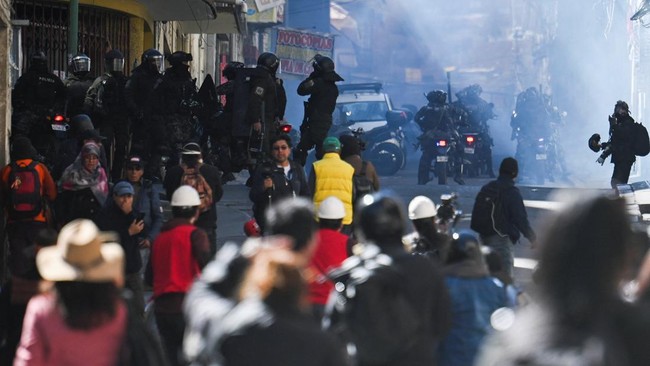
The Bolivian government has taken drastic steps to address a worsening crisis after President Rodrigo Paz announced a national state of emergency on Saturday (20/6/2026) local time. The decision came after weeks of anti-government protests triggered by rising living costs and economic pressures developed into a deepening political crisis.
The state of emergency was declared amid widespread road blockades across various regions of the South American nation. These actions have disrupted the distribution of essential goods, hit economic activity, and sparked fears of deteriorating humanitarian conditions.
A wave of demonstrations backed by trade unions, farmers’ groups, and supporters of former President Evo Morales is now not only demanding improved economic conditions but also urging President Paz to resign from office.
According to data from the Bolivian Ombudsman’s Office, road blockades lasting around 50 days have caused shortages of food, fuel, and medical supplies in several parts of the country. The situation has also brought economic activity to a near standstill. The Ombudsman’s Office recorded at least 14 deaths between 1 May and 15 June related to the ongoing turmoil.
In a state address to the public, Paz said the government could no longer allow the situation to continue. “I have ordered the implementation of a State of Emergency to free the roads in this country,” Paz said, as reported by CNN International. “Bolivians cannot continue to be held hostage by blockades that prevent them from working, studying, receiving medical care, meeting their daily needs, and bringing a livelihood home.”
Paz explained that the state of emergency paves the way for the military and police to take action to restore order across Bolivia. According to him, the measure aims to return conditions to normal in a country currently gripped by political and social tension. “Organised groups continue to use violence to paralyse the country,” he said.
Previously, last month, Paz had signed a law granting the military authority to engage in handling internal conflicts. However, at that time he stated that imposing a state of emergency would only be a last resort if dialogue efforts failed to produce a solution. In his speech on Saturday, Paz said all dialogue efforts had been exhausted before the government decided to take this step.
“After exhausting all efforts at dialogue, after reaching agreements with those who have legitimate demands, and after clearly identifying those who use violence to try to shake Bolivia’s stability, we have made the decision to impose a state of emergency across the entire national territory,” he said.
Paz, a centrist politician, only assumed the presidency seven months ago after winning an election that marked a major shift in Bolivian politics. He took over the government amid the worst economic crisis the country has experienced in a generation. The crisis helped bring an end to nearly two decades of political dominance by the left-wing Movement to Socialism (MAS).
Since 2006, Bolivia has been almost continuously ruled by governments affiliated with MAS, including under the leadership of Evo Morales. Paz’s election was seen as a historic political change for the country. Since taking office, Paz has sought to strengthen diplomatic relations with the United States, which had been strained since 2009. Last September, he announced a US$1.5 billion economic cooperation plan with US officials to help secure fuel supplies for Bolivia.
Washington’s support for the Paz administration was reaffirmed earlier this month. On 4 June, the US Department of State released a summary of a conversation between Secretary of State Marco Rubio and Bolivian President Rodrigo Paz. The statement noted the “unwavering commitment of the United States to support Bolivia’s democracy and the Paz administration as it rebuilds the country after 20 years of failed socialist policies.”
US State Department spokesperson Tommy Pigott also said Washington is increasing emergency aid for Bolivia. “The Secretary noted that the United States is increasing emergency assistance and logistics operations support in Bolivia to help those facing acute shortages of food and medical supplies due to illegal road blockades intended to shake the stability of Bolivian society,” Pigott said.
The ongoing crisis began in May when the Paz government cut long-standing fuel subsidies. The policy was taken as part of the government’s efforts to reduce the state budget deficit. However, the move sparked public anger because it occurred amid already severely strained economic conditions. Bolivia is currently facing a shortage of foreign currency, while natural gas exports, which for years were the country’s main source of revenue, have declined sharply. At the same time, inflation has reached its highest level in 40 years and fuel supplies have become increasingly scarce. The situation triggered a wave of protests that has continued to expand in recent weeks. Besides demanding President Paz’s resignation, trade union groups and community organisations are also urging the government to raise wages and address the shortages of fuel and US dollars that are the main problems for Bolivia’s economy.