
Economic Census: Knowledge Investment to Navigate Development
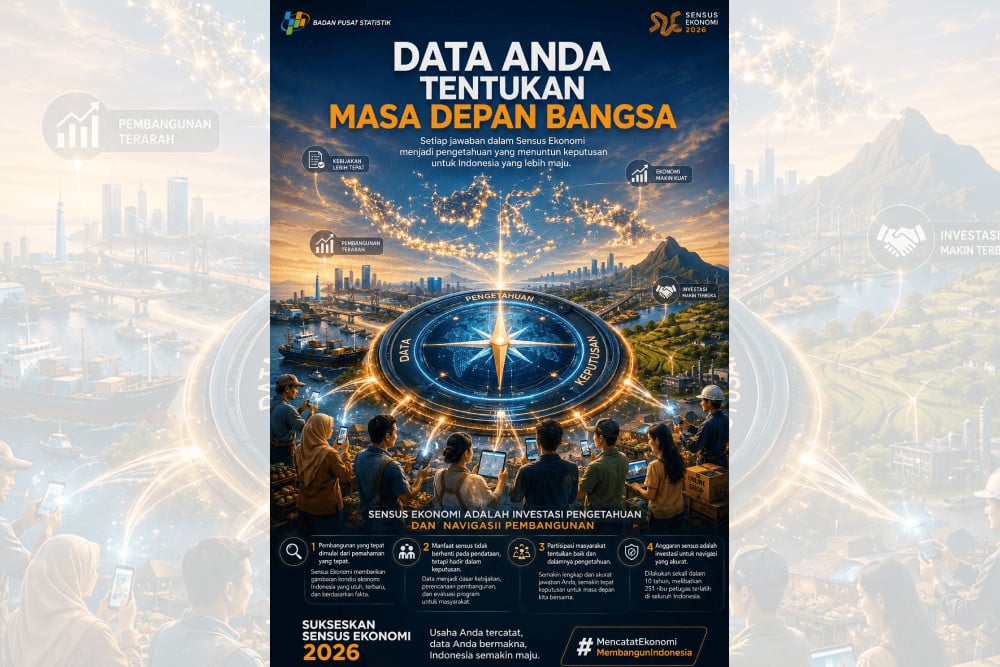
Every day, the government makes decisions that affect the public’s economy, from designing UMKM development programmes and building infrastructure to expanding markets, creating capital, encouraging investment, and evaluating existing policies. For these decisions to be accurate, the government needs to understand the actual state of the economy. The 2026 Economic Census is therefore vital, as it collects data from business actors and households across Indonesia. Data is knowledge that provides a complete and up-to-date picture of the national economic condition. This knowledge serves as a navigation tool for development. Like a GPS that helps determine the direction of a journey, the Economic Census results help the government see where economic activity is growing, which sectors require attention, which regions need a boost, and which groups should be prioritised. Consequently, decisions are based on actual conditions rather than mere estimates. The benefits of the Economic Census do not end when data collection is complete. The greatest value of the census emerges when the data is used as a basis for decision-making. The better the understanding, the more accurately needs can be identified. The success of the Economic Census depends heavily on public participation. Correct, complete, and honest answers will produce more accurate data. Accurate data enriches knowledge, clarifies the navigation of development, and helps produce sound decisions. Conducting an Economic Census in Indonesia is no easy task. Indonesia is an archipelagic nation with a vast territory, diverse geographical conditions, and millions of business actors spread across remote areas. To reach all these regions, the 2026 Economic Census involves around 251,000 officers who have undergone training with the same standards across the country, from Sabang to Merauke. Implementing a census on a national scale requires a significant budget. For this reason, the Economic Census is held once every ten years, usually in the middle of the year. This economic census is also conducted by many other countries. The Central Statistics Agency (BPS) has been preparing for the Economic Census since 2024, a process spanning more than two years. The budget for the Economic Census is an investment in knowledge. This investment yields knowledge that serves as a navigational tool for Indonesia’s development. Its value lies not only in the costs incurred during data collection but in the benefits generated when the data is used to guide decisions—not just by the government, but also by business actors planning expansion, researchers making recommendations, aspiring entrepreneurs opening their first business, UMKM looking to scale up, and the public at large experiencing a quality economy.