
Eco-enzyme: a thrifty solution with useful waste
Indonesia still faces challenges in managing waste properly, causing accumulation and piles of rubbish at final disposal sites (TPAS). Many factors contribute to the build-up of waste, including population growth, changing lifestyles and the absence of an adequate waste processing system. High population growth and widespread urbanisation have led to increased consumption levels.
The habit of buying food rather than cooking at home is more practical and leaves behind plastic packaging waste as well as food scraps. If population growth and people’s lifestyles are difficult to control, then creating a waste processing ecosystem offers certain hope for tackling the waste problem.
According to data from the National Waste Management Information System (SIPSN) of the Ministry of Environment and Forestry (KLHK), national waste reached 31.9 million tonnes in 2023. Of that amount, 11.3 million tonnes, or around 35.6 percent, could not be managed.
The accumulation of unmanaged waste carries a high risk of landslides and fires caused by methane gas produced by organic waste at landfill sites. Disasters resulting from waste being piled up without proper management, also known as open dumping, occur frequently.
Last June, a major fire broke out at the Jatiwaringin landfill in Mauk District, Tangerang Regency, Banten, forcing hundreds of residents to evacuate and suffer from acute respiratory infections (ISPA). The fire occurred across almost half of the landfill area because methane gas accumulated from organic waste and was ignited by hot weather. Extinguishing it took more than ten days.
The accumulation of waste at landfill sites is also a risk in Bogor. Household waste from Bogor Regency and Bogor City is diverted to the Galuga landfill, which receives up to around 2,000 tonnes of waste daily from the two areas. To date, an estimated 15 million tonnes of unprocessed waste have accumulated at the 31.8-hectare site. The Galuga landfill even experienced a landslide in 2019 that caused 18 residents to lose farmland and assets.
The waste problem could become a time bomb if not addressed promptly. To minimise the risk from waste accumulation at the Galuga landfill, one village in Bogor Regency is working to process organic waste from residents’ homes into something more useful.
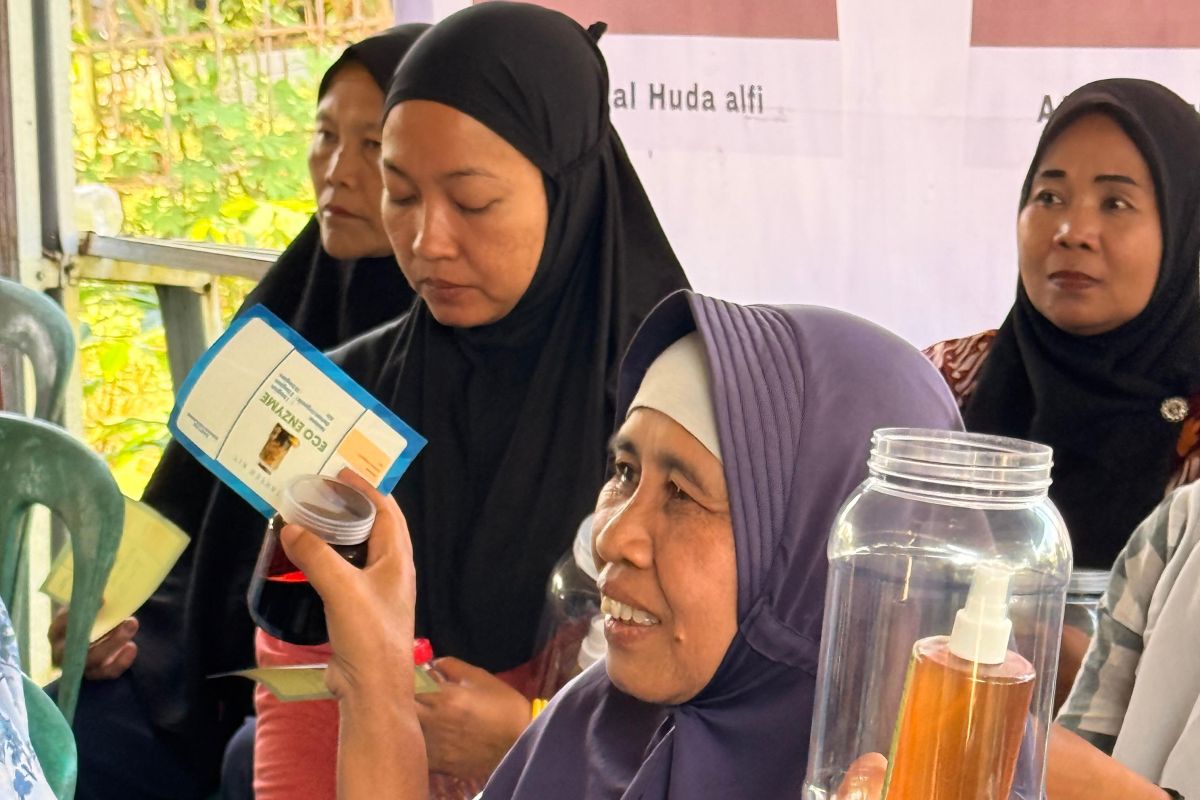
In Benteng Village, Ciampea District, Bogor Regency, residents are enthusiastic about processing their organic waste into eco-enzyme, a fermented liquid produced from organic waste such as fruit and vegetable pulp with added molasses or sugar water.
Before processing organic waste, residents need to sort their household waste by separating organic and inorganic materials. Organic household waste can then be collected to make eco-enzyme liquid.
During eco-enzyme training in Benteng Village at the end of July, around 40 people, mostly housewives from the village, gained new knowledge about making eco-enzyme. Assisted by agricultural extension officers from the Food Security, Horticulture and Plantation Agency (Distanhorbun) of the Bogor Regency Government and eco-enzyme activists from the Eco-enzyme Nusantara Bogor Raya Community, the housewives of Benteng Village made eco-enzyme liquid and stored it in their respective homes.
After three to four months, the eco-enzyme liquid can be used as a wound treatment and for indoor air sanitation. The liquid can even be used to make dishwashing soap and laundry soap by adding methyl ester sulphonate (MES) and soap base or salt.
Tati, a 54-year-old woman who gardens daily, admitted it was her first time learning about eco-enzyme. She constantly produces organic waste at home, which she usually throws into the bin and then burns. Tati said making eco-enzyme liquid from organic waste is not difficult. After making the liquid during the training, Tati said she could not wait for the fermented organic waste liquid she made to become eco-enzyme.
“As for eco-enzyme liquid, I only just found out about it and this is my first time. It turns out it is easy to make. Later, once it is ready, I want to use it to spray plants. At home I always have waste from fruit peels and vegetables. So, I will try making it,” said Tati.
Most residents of Benteng Village work as farmers growing secondary crops such as cassava, maize, beans and guava. Neneng (56) has been sorting waste at home since 2019 after receiving guidance on separating organic and inorganic waste. Until now, however, Neneng had only processed organic waste from her home into maggots as feed for the fish and chickens she keeps.
“There are so many maggots in my fish pond that they pile up. In fact, because there are already so many maggots, I simply throw away leftover fruit and vegetable waste from my kitchen. With this eco-enzyme training, I now know there is another way to process organic waste,” said Neneng.
Making eco-enzyme is not difficult because it only requires three ingredients: organic waste from fruit peels and vegetable scraps, molasses or sugar water, and water, in a ratio of 3:1:10 respectively. So, with 300 grams of fruit and vegetable scraps, one needs to add 100 grams of molasses and one litre of water.
All ingredients are then placed into a tightly sealed plastic container. Glass containers should not be used because eco-enzyme fermentation produces gas. Ideally, the plastic container should be somewhat larger so there is still room for the fermentation gas. During the first week after placing all ingredients into the plastic container, the lid should be opened periodically.