
Eastern Indonesia's Sago and Tuber Consumption Declines as Rice Expands
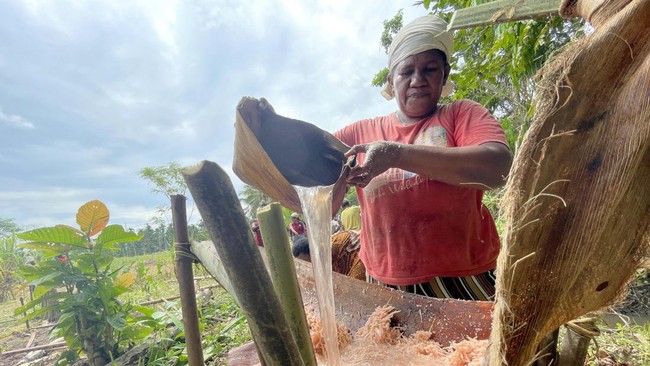
Sago has long been a pillar of food security in Indonesia. The Ministry of Agriculture recorded that national sago production reached 463,542 tonnes in 2018 before declining to 359,838 tonnes in 2019. Production gradually recovered to 381,065 tonnes in 2021, though it has not yet returned to pre-pandemic levels. Papua remains the main production hub, with output relatively stable at around 66,000 to 69,000 tonnes per year between 2017 and 2021, meaning the national sago supply still relies heavily on the eastern region of Indonesia.
Conversely, data from Statistics Indonesia (BPS) shows that consumption of tuber groups in Indonesia is trending downwards. Average per capita weekly consumption was 13.564 kg in 2021, falling to 12.768 kg in 2022, rising slightly to 13.135 kg in 2023, before weakening again to 12.491 kg in 2024 and 11.602 kg in 2025. This decline reflects the diminishing share of tubers in household consumption patterns.
This shift is also being felt in regions that have been home to sago for centuries. BPS data for 2025 indicates that tuber consumption in most districts and cities in Eastern Indonesia is now at a low level. Sorong Selatan is an exception, with consumption reaching 1.003 kg per capita per week. After that, the figures drop significantly, with Seram Bagian Timur at 0.264 kg, Jayapura at 0.203 kg, Kaimana at 0.114 kg, and both Maluku Tengah and Merauke at 0.09 kg. Several areas in Maluku even recorded consumption as low as 0.001 to 0.008 kg per capita per week.
This dietary shift aligns with the strengthening position of rice as the primary staple in Eastern Indonesia. The consumption of local sago-based foods is gradually declining, particularly in urban areas and among the younger generation. Sago has been a staple for communities in Papua and Maluku for centuries because it grows naturally in the local environment. Sago palms are easily found in forests, swamps, and river basins. The tradition of processing sago trunks into flour has been passed down through generations, giving rise to various traditional foods such as papeda. A single sago trunk can yield approximately 150 to 300 kilogrammes of raw flour, making it a primary source of carbohydrates for local communities.
Despite these changes, sago-based culinary traditions have not disappeared entirely. Traditional sago dishes persist across various regions of Indonesia, from papeda in Papua and Maluku, to sagu dange in Sulawesi, sago noodles in the Riau Islands and Kalimantan, and kapurut sago in Mentawai. This variety of preparations demonstrates that sago holds cultural value far beyond being a mere agricultural commodity.
For the national food sector, this situation presents a distinct challenge. Sago production persists, especially in Papua, while consumption of tuber-based foods continues to shrink. If this trend continues, the market space for sago could narrow further, even though Indonesia possesses one of the largest sago forest reserves in the world. Sago ultimately tells a story of changing dietary preferences in Indonesian society. Once a primary energy source in many eastern regions, it is now more commonly encountered as a traditional food or regional speciality. This shift has occurred gradually over many years, reflected in the declining consumption data, even as production was maintained by key producing regions up to 2021.
At the same time, the government is now concentrating rice field development in Eastern Indonesia, including Papua, particularly Merauke. The region is being designed as the centre of a programme to create new rice fields and optimise land in Tanah Papua, while also being prepared as a new food hub in the eastern part of the country. The Governor of South Papua, Apolo Safanpo, revealed that of the total 84,000 hectares of new rice fields developed across Tanah Papua, 48,000 hectares are located in Merauke Regency, meaning more than half of the rice field expansion programme in Papua is concentrated in that area.