
East Java's Exports Rise Amid Global Conflicts, Food and Beverage Sector Becomes Key Pillar
REPUBLIKA.CO.ID, GRESIK – East Java’s foreign trade performance recorded an impressive leap amid global geopolitical dynamics. In 2025, the value of East Java’s non-oil and gas exports reached $29.77 billion, surging 18.17% from the previous year’s $25.19 billion.
This achievement is inseparable from aggressive market diversification strategies. China still holds a 13% share, followed by Japan at 9%, and the ASEAN region dominating nearly 20% of the total market share.
East Java Deputy Governor Emil Dardak emphasised that strengthening economic partnerships through the Comprehensive Economic Partnership Agreement (CEPA) scheme is key to accessing local products in global markets, including Australia and the European Union, whose contributions now range from 7% to 14%.
The manufacturing sector, which supports 30% of East Java’s economy, serves as the main driver. The food and beverage industry (mamin) contributes one-third of the total manufacturing value. With mamin export value reaching $2.4 billion or 8.7% contribution, this sector has become the new backbone for regional economic stability.
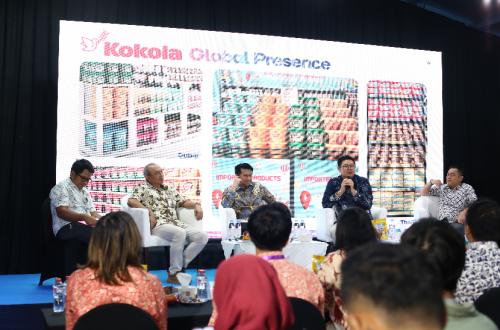
“Our food and processed exports in 2025 rose 13.85% year-on-year (yoy). This is driven by diversification of processed goods, quality improvements, and expansion of alternative export markets necessitated by trade wars. We see extraordinary growth in cocoa products, up 20.62%, and beverages surging up to 72.58%. Mamin product exports have become the backbone of East Java and Indonesia’s economic growth,” said Emil Dardak during the 2026 Press Working Visit event themed “Ministry of Finance Supports Labour-Intensive Sectors to Drive Economic Growth”, in Gresik, East Java, on Friday (17/4/2026).
This expansion success is also evident in business players’ boldness in targeting non-traditional export destinations like Yemen. One example is PT Mega Global Food Industry (MGFI), which successfully recorded a significant increase in export volume, from 7,500 tonnes to 13,000 tonnes.
Emil stressed the importance of integration in the global supply chain, where ease of inbound and outbound goods flow supported by Customs and strategic financing becomes a determining factor in eliminating business bottlenecks.
Financial support through the Special Export Assignment (PKE) scheme managed by the Indonesia Export Financing Agency (LPEI) has proven to provide resilience for East Java exporters. Synergies between the central government through the Directorate General of Financing and Risk Management (DJPPR) and local government ensure that companies with large export potential receive targeted capital injections and guarantees, especially when facing supply uncertainty in international markets.
“Thank you to LPEI and DJPPR for providing support through PKE for companies in East Java. We live in a global supply chain; almost no factory has a purely domestic supply chain. Therefore, this financing support is crucial. We continue to monitor any obstacles, whether permitting or other issues, to ensure this significant export volume growth is maintained,” added Emil.