
East Java Provincial Government Deploys Animal Health Inspection Team Ahead of Eid al-Adha
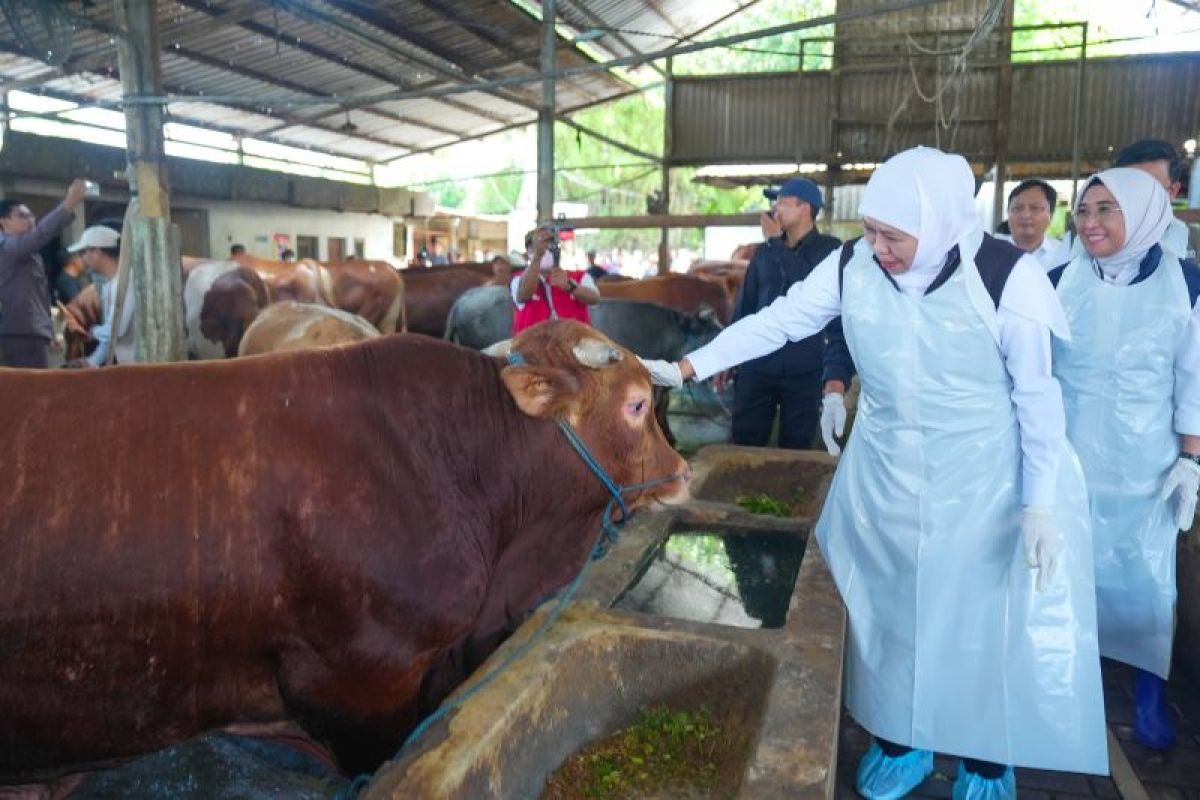
East Java Provincial Government is deploying animal health inspection teams ahead of Eid al-Adha 2026 to ensure that sacrificial animals are in good health and fit for consumption. “Ahead of Eid al-Adha, we continue to deploy animal health inspection teams from relevant agencies to monitor, examine, and ensure that all sacrificial animals are free from diseases, particularly PMK and LSD. We ensure that livestock is healthy and its meat is fit for consumption,” said East Java Governor Khofifah Indar Parawansa in Nganjuk on Saturday. The Governor, while inspecting a cattle farming centre in Sukorejo Village, Loceret Subdistrict, Nganjuk Regency, explained that the Provincial Livestock Service has provided personnel to inspect sacrificial animals. These personnel consist of 950 medical veterinary doctors, 1,500 veterinary paramedics, 145 livestock seed supervisors, 75 feed quality supervisors, and 1,997 certified halal slaughterers (Juleha). She emphasised that inspecting sacrificial animals is crucial both during and after slaughter. In addition to ensuring animal health, this is to prevent the spread of diseases, including foot-and-mouth disease (PMK). Governor Khofifah stated that the readiness of sacrificial livestock stock is inseparable from the strength of East Java’s livestock sector, which currently ranks first nationally in terms of livestock population. According to available data, the total projected need for sacrificial livestock in East Java is 427,060 heads, consisting of 70,550 cattle, 297,900 goats, 58,600 sheep, and 10 buffalo. The projected need for sacrificial animals in East Java for 2026 shows a significant surplus compared to availability. “Up to now, the projected need for sacrificial cattle in East Java is 70,550 heads. Meanwhile, our availability is 629,119 heads. Thus, there is a surplus of 558,569 heads,” she said. For goats, the projected need is 297,900 heads with availability of 940,693 heads, resulting in a surplus of 642,793 heads. Similarly, for sheep, the projected need is 58,600 heads with availability of 484,468 heads, resulting in a surplus of 452,868 heads. As for buffalo, the projected need is 10 heads with availability of 1,698 heads, resulting in a surplus of 1,688 heads. “Sacrificial livestock in East Java is available to meet sacrificial needs and is guaranteed healthy because vaccination, biosecurity, and livestock treatment have been carried out,” she said.