
East Java PR Introduces 'Triangle Shield' Strategy to Build Public Trust in the Digital Age
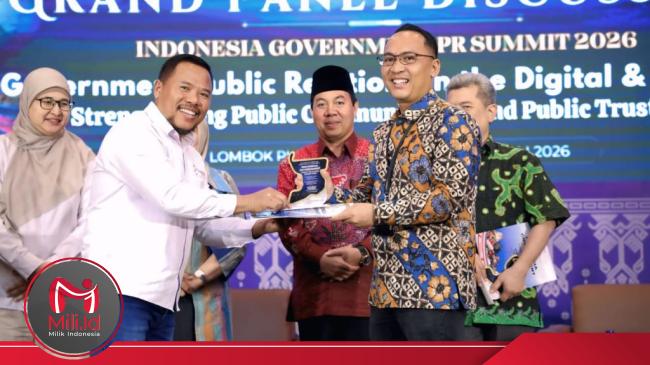
The Head of the Public Affairs Division of the East Java Provincial Government, Zainal Muttaqin, has introduced the Government Public Relations Triangle Shield concept as a new strategy to strengthen public communication and maintain public trust amid rapid developments in digital technology and Artificial Intelligence (AI).
Zainal presented the idea while speaking at the Indonesia Government Public Relations (IGPR) Summit 2026 in Mataram, West Nusa Tenggara, held from 27 to 29 July 2026. The national forum carried the theme “Government Public Relations in the Digital and Artificial Intelligence Era” and was attended by government public relations practitioners from various ministries, agencies, regional governments and universities across Indonesia.
“AI may serve as the engine, but humans must remain the compass. Public trust is not built by algorithms, but by communication that is honest, consistent, collaborative and human-centred,” Zainal asserted.
He explained that the Triangle Shield concept consists of three main pillars: Pentahelix Public Relations, the SAKTI Framework, and Humanist Public Relations. These three elements are designed to complement one another as the foundation of government public communication that adapts to technological developments without neglecting human values.
According to him, Pentahelix Public Relations emphasises the importance of collaboration between government, media, academics, the business community and civil society through stakeholder mapping, listening to public aspirations, building engagement, collaborating and conducting joint evaluations.
Meanwhile, the SAKTI Framework serves as a framework for strengthening the competencies of public relations human resources, prioritising the values of being Responsive, Accurate, Credible, Transparent and Inclusive. This working culture begins with listening, verifying information, crafting narratives, distributing messages, responding quickly and conducting continuous evaluation.
The Humanist Public Relations approach, meanwhile, places empathy at the heart of government communication services.
Zainal also highlighted the role of AI, which he considers capable of assisting government public relations in issue monitoring, data analysis and rapid content production. However, he argued that artificial intelligence will never replace the ethics, integrity and moral responsibility of a public relations practitioner.
Beyond presenting the Triangle Shield concept, Zainal shared various good practices already implemented by the East Java Provincial Government. These range from strengthening stakeholder mapping, the SAKTI working culture, the development of listening and early warning systems, narrative orchestration across regional agencies, the application of AI ethics, to measuring public trust levels as an indicator of successful government communication.
Meanwhile, the Rector of UIN Mataram, Prof. Dr. TGH. Masnun Tahir, described IGPR Summit 2026 as a strategic moment positioning Lombok as the epicentre of Indonesian Government Public Relations through collaboration between government, universities, media, professional organisations and all stakeholders.
In closing his presentation, Zainal expressed hope that IGPR Summit 2026 would give rise to a new paradigm for Indonesian government public relations that is increasingly adaptive to technological developments whilst continuing to prioritise integrity, empathy, collaboration and the public interest.
“The speed of information is certainly important, but public trust is far more important. That is why the primary task of government public relations is to ensure that every technological innovation always goes hand in hand with integrity, empathy and the public interest,” he concluded.