
East Java Police Foil Smuggling of Protected Wildlife Abroad
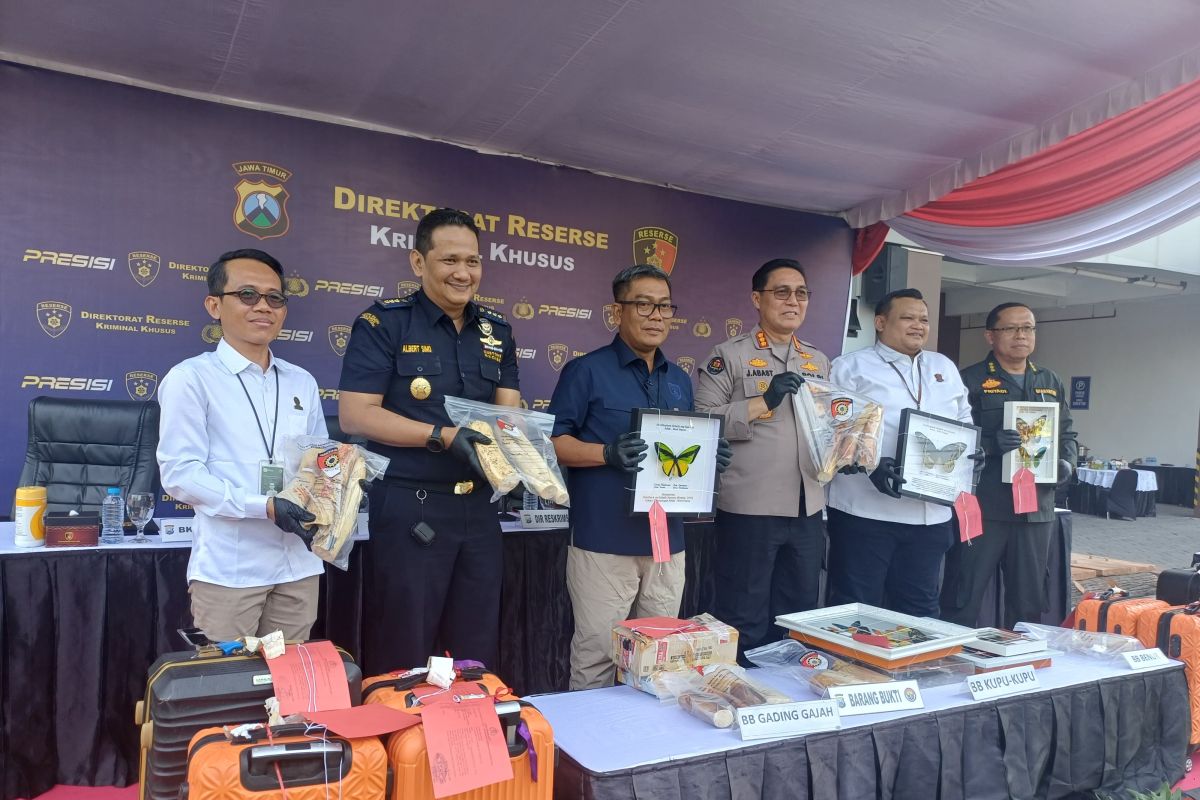
The East Java Regional Police have foiled the smuggling of protected wildlife abroad, including elephant tusks, butterflies, and clear lobster seeds, through Juanda Airport, implicating four suspects in three separate cases. Director of the Special Criminal Investigation Directorate of the East Java Police, Senior Commissioner Roy Hutton Marulamrata Sihombing, stated that the first case uncovered involved the smuggling of 53 pieces of elephant tusk with a suspect identified by the initials HAJ. ‘The goods originated from abroad and were brought into Indonesia by entrusting them to returning Umrah pilgrims. The tusks were wrapped in aluminium foil and black paper and disguised as car accessories,’ Roy said in Surabaya on Tuesday. According to Roy, the suspect utilised nine Umrah pilgrims returning from Saudi Arabia to carry the elephant tusks, which were wrapped in aluminium foil and black paper and placed into cardboard boxes and suitcases. The case came to light after Juanda Customs officers secured nine suitcases belonging to the Umrah pilgrims at Terminal 2 of Juanda Airport and discovered 53 pieces of elephant tusk without health certificates or quarantine documents. For his actions, the suspect is charged under Article 86 letter a and/or letter c in conjunction with Article 33 of Law Number 21 of 2019 concerning Animal, Fish, and Plant Quarantine, which carries a maximum penalty of 10 years’ imprisonment and a fine of up to IDR 10 billion. Separately, investigators uncovered the smuggling of 39,960 clear lobster seeds destined for Singapore via Juanda Airport. In this case, police named two suspects, FM and JSK, who placed the lobster seeds into suitcases wrapped in wet towels to keep them alive during the journey. ‘The modus operandi was to put the lobster seeds into suitcases wrapped in wet towels, with the destination being Singapore using a Singapore Airlines flight through Juanda Airport,’ Roy said. The case was revealed after police received information about an attempt to send lobster seeds abroad without official permits. Officers then secured a suitcase containing nearly 40,000 lobster seeds along with several other pieces of evidence. The two suspects are charged under Article 92 in conjunction with Article 26 paragraph (1) and/or Article 88 in conjunction with Article 16 paragraph (1) of Law Number 6 of 2023 concerning Fisheries, which carries a penalty of eight years’ imprisonment and a fine of IDR 1.5 billion. Another case targeted the trade of protected wildlife involving 2,113 butterflies of various species intended for shipment to China, France, the United States, Canada, the Czech Republic, and Germany. Police named a suspect with the initials LL, who sent the preserved butterflies via cargo services at Juanda Airport. ‘Ten DHL airway bills were found, all containing dead protected butterflies to be sent to China, France, the USA, Canada, the Czech Republic, and Germany,’ Roy stated. The suspect is charged under Article 40A paragraph (1) letter e of Law Number 32 of 2024 concerning Conservation of Biological Natural Resources and Their Ecosystems, as well as Article 87 letter a of Law Number 21 of 2019 concerning Animal, Fish, and Plant Quarantine, with a maximum penalty of 10 years’ imprisonment and a fine of IDR 200 million. Head of Public Relations of the East Java Police, Senior Commissioner Jules Abraham Abast, said that crimes against wildlife and lobster seeds not only cause ecological losses but also disrupt the economic sustainability of future generations, making law enforcement essential to safeguard national environmental resilience. ‘These three cases have different characteristics, but they share a common thread, namely the exploitation of natural resources that threatens ecosystem sustainability and harms the nation’s interests,’ Jules said. He added that the successful uncovering of these cases is a tangible manifestation of the East Java Police’s commitment, together with relevant stakeholders, to protecting Indonesia’s biological wealth from illegal trade and unlawful exploitation.