
East Java maintains overall champion title at national OPSI for sixth consecutive time
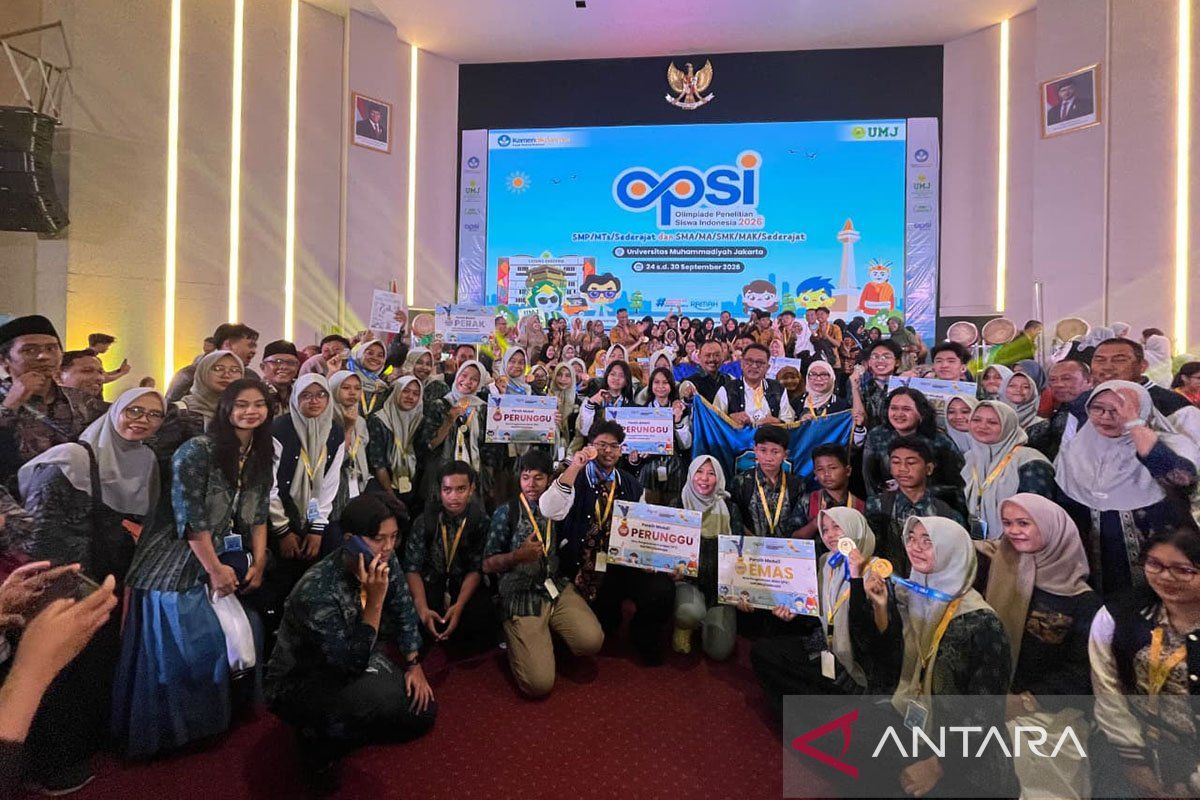
Surabaya (ANTARA) - East Java has once again defended its overall champion title at the 2026 National Indonesian Student Research Olympiad (OPSI), securing nine medals and marking its sixth consecutive victory as the overall winner.
The Head of the East Java Education Office (Dindik), Aries Agung Paewai, stated in Surabaya on Friday that this achievement is inseparable from the intensive coaching and preparation conducted by the East Java Education Office through a training centre (TC) prior to the competition.
“We finalised the preparations over two days. Their research had already been conducted alongside their supervising teachers. We simply focused on refining their presentation skills and mental fortitude. Our goal was to ensure they could present their findings effectively without psychological interference, so they could deliver positive results,” he said.
The nine medals consist of three silver medals from the SMA/MA (senior high school) level and one special award, while the SMP/MTs (junior high school) level contributed two gold medals and four bronze medals.
During the training centre, the East Java Education Office brought in several experienced experts who frequently participate in national-level OPSI competitions to help students and mentors understand the final stages and prepare strategies for facing participants from various regions.
“Alhamdulillah, we were represented by 2rag 22 teams at the recent OPSI, consisting of nine teams from the high school level and 13 from the junior high school level. From those efforts, we successfully brought home a total of nine medals,” said Aries.
According to Aries, achievements in OPSI are not merely competitive successes but also demonstrate the importance of building a research culture starting from the school level.
He noted that research activities train students to identify problems, develop data-based solutions, and produce innovations that can benefit their surrounding environments. Currently, research within educational units is conducted through activities such as the Youth Scientific Group (KIR).
Through these activities, students are encouraged to undertake various research projects using problem-solving approaches to issues in their local communities.
“Research must be an integral part of the learning process in schools. Children should not only learn theory but also be trained to identify problems, conduct research, and generate solutions. This is what will shape their critical and innovative thinking abilities,” Aries added.
In the 2026 OPSI, student research was competed across several fields, including Mathematics, Science, and Technology (MST), which covers basic sciences, mathematics, chemistry, biology, and pure science. Additionally, the Applied Physics and Engineering (FTR) field includes technological innovation, engineering, renewable energy, and applied research. Meanwhile, the Social Sciences and Humanities (ISH) field encompasses social research, psychology, economics, and various humanities studies.
East Java’s consistent success in OPSI demonstrates that research coaching in schools is continuously directed towards building an educational ecosystem that encourages students to generate ideas and solutions for various societal issues.