
East Java Deputy Governor: Handling TNBTS Forest Fires Requires Multi-Party Involvement
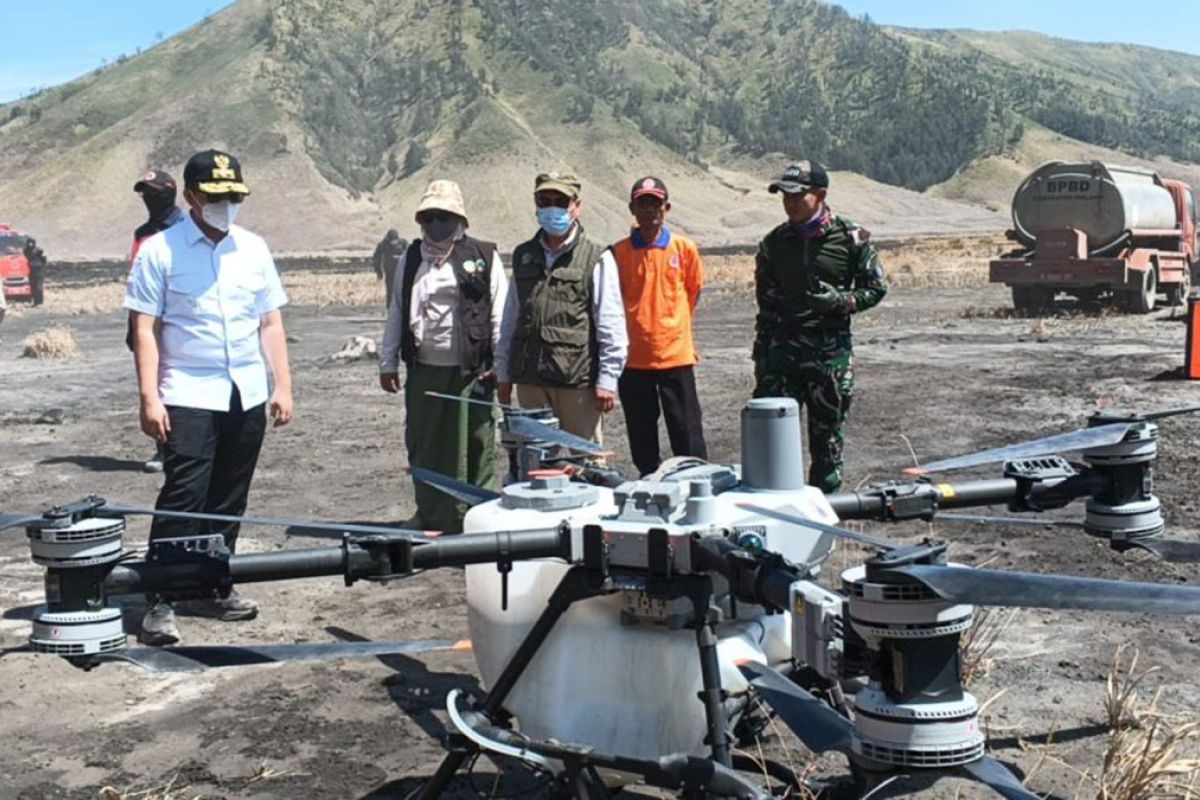
Probolinggo, East Java (ANTARA) - East Java Deputy Governor Emil Elestianto Dardak has said that handling forest and land fires in the Bromo Tengger Semeru National Park (TNBTS) area requires the integrated involvement of many parties because the terrain in the Bromo area is quite difficult.
“We are coordinating together because the handling requires cooperation from all parties,” he said after going down directly to inspect the condition of the Mount Bromo area in Probolinggo Regency on Sunday.
He saw the field conditions first-hand while participating in fire handling coordination with government elements, the Indonesian National Armed Forces (TNI), the Regional Disaster Management Agency (BPBD), national park managers and volunteers.
The coordination was attended by Head of the Bromo Tengger Semeru National Park Centre (BB-TNBTS) Rudjanta Tjahja Nugraha, Commander of Military District Command 0820 Probolinggo Lieutenant Colonel Inf Ribut Yudho Apriantono, Head of the East Java BPBD Gatot Soebroto, Head of the Probolinggo Regency BPBD Oemar Sjarief as well as a number of volunteer representatives involved in fire handling.
Based on preliminary monitoring results, a number of hotspots were still found in the P30 area of Sumber District, Probolinggo Regency, up to the Penanjakan 1 area, so joint officers continued to conduct sweeps to ensure no remaining embers could potentially trigger further fires.
Before heading to the affected points, the joint team first devised a firefighting strategy taking into account wind direction, vegetation conditions and the level of terrain difficulty. Firefighting efforts were then carried out through a combination of ground routes and aerial operations.
“We carry out firefighting by looking at the conditions and terrain in the field. There is ground firefighting and we also support it with firefighting from the air,” he said.
Hundreds of joint personnel were deployed to carry out manual firefighting, open access routes and sweep areas where embers were still found. They came from TNI elements, BPBD, BB-TNBTS and volunteers.
“Nevertheless, the firefighting process has not been easy. Changing winds are one of the main obstacles because they can cause the fire to spread again to other areas,” he said.
In addition to weather factors, officers faced limited manual equipment because the beaters used to extinguish fires at a number of points had even been completely used up.
The steep terrain, which mostly consists of hills, means access to fire points cannot always be reached by vehicle, so officers have to walk and require more time in the firefighting process.
Therefore, ground and aerial operations continue to be combined so that hard-to-reach hotspots can still be handled.
Based on preliminary data up to Sunday, the burned area reached around 520 hectares, with affected vegetation including typical mountain grassland and a number of plant species growing in the conservation area, including edelweiss flowers.
Although the fire area is quite extensive, the fire was reported not to have reached the Watangan Valley or Teletubbies Hill, which are among Bromo’s tourist attractions. Officers are now not only focused on extinguishing visible fires, but also anticipating new fires from remaining embers.