
Earth's Rotation Slows, Paving the Way for New Life
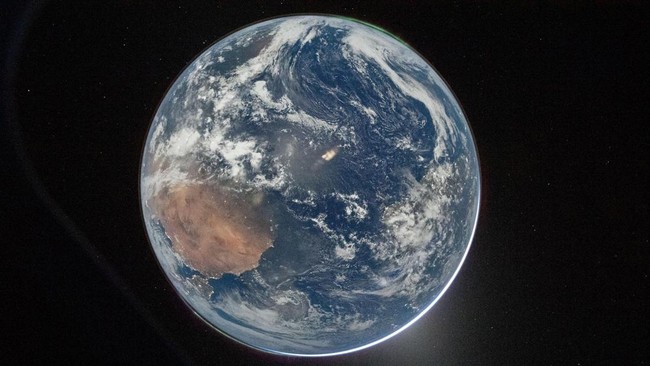
Earth currently completes one full rotation in 24 hours. However, around four billion years ago, the planet spun much faster, with a day lasting only about six hours. This change in the duration of day and night has been found to affect microbial activity. As the day length increased, microbes released more of the oxygen they produced.
A study discovered this link in a section beneath Lake Huron, located in Michigan, USA, and Ontario, Canada. This section, 91 metres in diameter and 24 metres below the surface, is a low-oxygen environment where sulphur-rich water hosts numerous microbes. Two types of microbes live there: purple cyanobacteria, which seek sunlight and produce oxygen through photosynthesis, and white bacteria, which consume sulphur and release sulphate, living much deeper during the daytime.
“There is a relationship between light dynamics and oxygen release, and a relationship based on the physics of molecular diffusion where thermal changes cause molecules to migrate from high to low concentration areas,” explained researcher Judith Klatt from the Max Planck Institute for Marine Microbiology. The research team modelled variations in day length and microbial oxygen output, finding that bacteria photosynthesise and release more oxygen when days are longer. Fellow researcher Arjun Chennu from the Leibniz Centre for Tropical Marine Research noted this is not because the microbes perform more photosynthesis, but because a sufficiently long day allows sunlight to shine for a longer period, resulting in more oxygen being produced.
The reason for Earth’s slowing rotation is not constant. Research led by Ross Mitchell, a geophysicist from the Chinese Academy of Sciences, indicates that the deceleration occurred in phases. For about a billion years, the length of a day was locked at around 19 hours due to a balance between the tidal forces of the Moon, which slow the Earth’s rotation, and atmospheric tides driven by the Sun, which push it faster. This period of stability, often called the ‘boring billion’, kept global oxygen levels extremely low, at about 0.1% of today’s levels, because the short days limited the oxygen output of photosynthetic microbes. Only after Earth exited this resonant state and days began to lengthen again did a significant rise in oxygen occur, paving the way for the evolution of complex cells and animals. Judith Klatt, a biogeochemist from the University of Michigan, stated that if the day length had remained locked at 19 hours, complex life as we know it likely would never have developed. Earth’s rotation continues to change, with modern atomic clocks detecting millisecond-level fluctuations influenced by atmospheric dynamics, ocean currents, and movements in the planet’s liquid core.