
Earth's Inner Core Rotation Reversal: Scientists Explain the Phenomenon and Its Impact
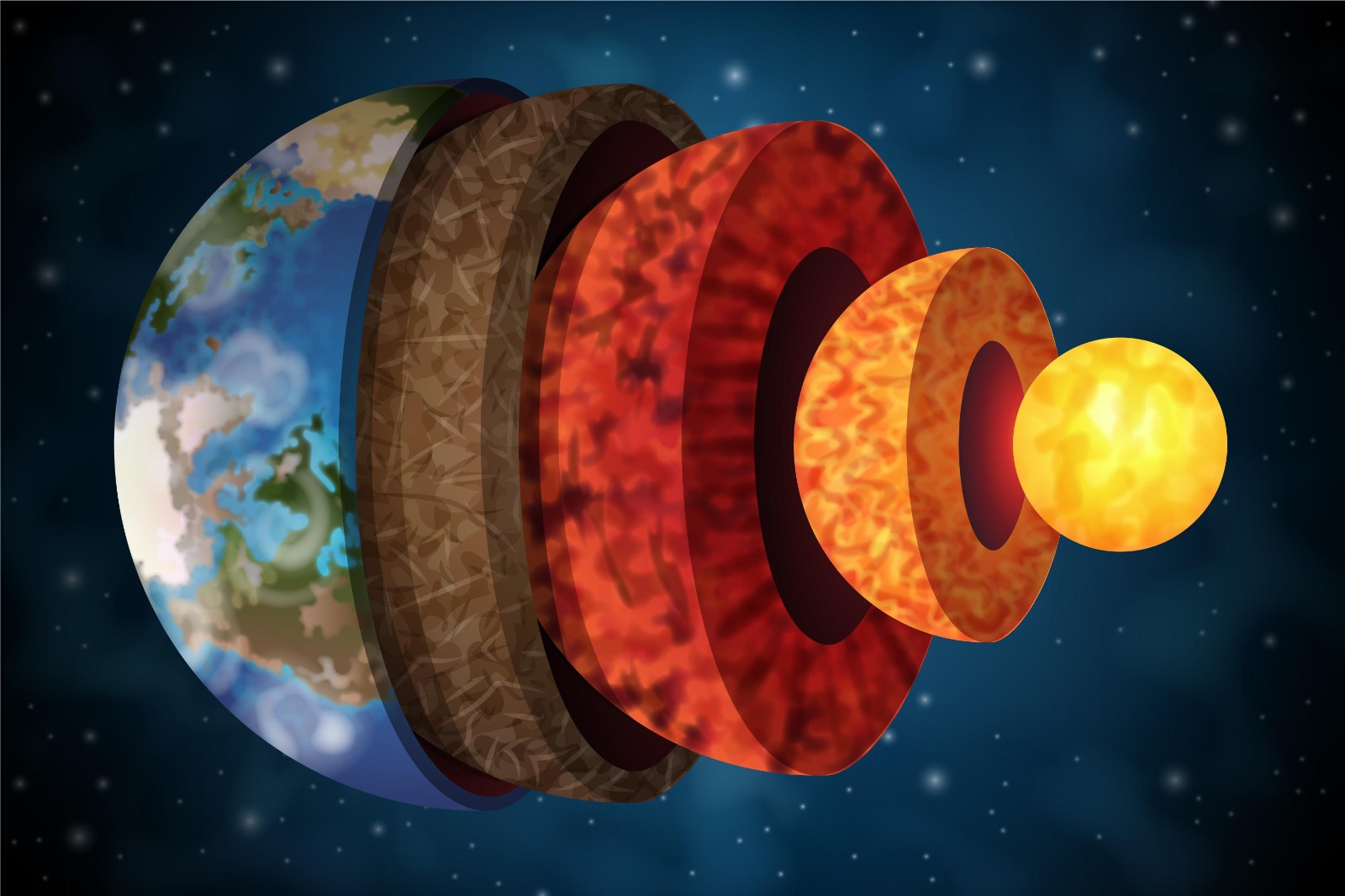
Recent research has revealed that Earth’s inner core has been slowing down, appearing to stop relative to the planet’s surface, before moving in the opposite direction. Based on an analysis of seismic waves from hundreds of earthquakes, scientists found that since around 2009–2010, the inner core has been rotating more slowly than the Earth’s mantle and crust.
Although often described as the “Earth’s core spinning backwards”, the change occurs only in relative rotational speed and is a natural process that poses no threat to human life.
The inner core is a solid layer composed of iron and nickel, located more than 5,000 kilometres beneath the Earth’s surface. According to Nature Geoscience, the change in its rotation is thought to be influenced by interactions between the magnetic field of the liquid outer core and the gravitational force of the Earth’s mantle, causing its rotational speed to change as part of a natural cycle lasting several decades.
So, could the change in the inner core’s rotation affect life on the Earth’s surface? Scientists emphasise that its impact is virtually imperceptible. The change only causes very slight variations in the length of a day on Earth, amounting to fractions of a millisecond. Such figures can only be detected using highly precise scientific instruments and will not affect everyday human activities.
The research also found no evidence that the slowing or change in the direction of the inner core’s rotation could trigger earthquakes, volcanic eruptions or other natural disasters. In other words, this phenomenon is not a sign of major changes to the Earth’s condition, but rather part of the normal dynamics of the planet’s interior that has been occurring for millions of years.
Although it has no direct impact on humans, research into the Earth’s inner core is considered important for understanding how the planet works from its innermost reaches. The movement of the inner core is linked to the dynamics of the outer core, which generates the Earth’s magnetic field — a natural shield that protects the planet from harmful solar radiation.
Scientists hope that further research using longer seismic datasets will uncover more information about the relationship between the inner core’s rotation, the magnetic field and small changes in the Earth’s rotation. These findings are expected to enrich our understanding of the Earth’s evolution while helping to explain various geological processes that remain a mystery to this day. (Source: Earth, Nature Geoscience)