
Earth Is Becoming Rounder, and Humans Are Feeling the Effects
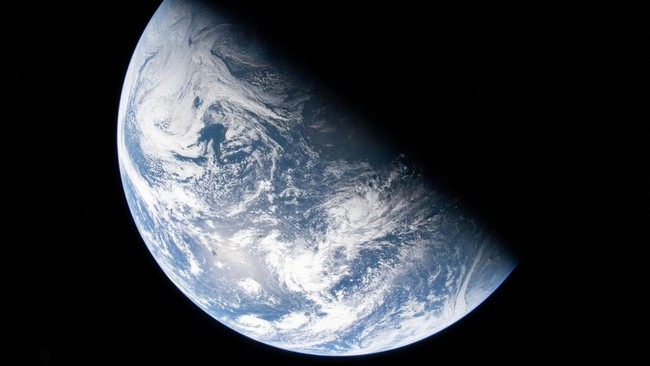
Jakarta, CNBC Indonesia – We have long learnt that Earth is not a perfect sphere: it is flattened at both poles and bulges at the equator. This shape is caused by centrifugal force as Earth rotates. The middle is pushed outwards, while areas near the axis are compressed inwards.
However, recent satellite measurements have revealed something surprising. Earth is gradually becoming rounder, and the main cause is directly connected to climate change driven by human activity.
The main explanation lies in a phenomenon known as isostatic rebound. For thousands of years, ice sheets kilometres thick in Antarctica and Greenland pressed the Earth’s crust downwards, making the polar regions appear more flattened. As global temperatures rise and ice melts on a large scale, that enormous weight is lifted. The land that was compressed gradually rises again – a process that continues for thousands of years after the ice has disappeared.
As a result, the distance from Earth’s centre to its surface in polar regions increases. Around the equator, meanwhile, the surface contracts slightly. This happens because water that was once held on land now flows into the oceans, distributing mass more evenly across the surface. The overall result is that Earth’s shape is moving closer to a perfect sphere.
Ice melt is not the only cause. Other human activities also alter the distribution of mass across Earth’s surface:
Large-scale groundwater extraction shifts water from underground to the surface and then into the oceans.
Dams hold water at higher elevations that would otherwise flow into the sea.
Changes in rainfall patterns and the drying of wetlands also alter the weight pressing on the Earth’s crust in different places.
These changes happen gradually, but satellites can detect changes in Earth’s shape down to the millimetre.
Changes to Earth’s shape are more than an interesting scientific fact. They have practical effects:
Earth’s rotation: Shifts in mass can change the speed of Earth’s rotation and the position of its axis, although the changes are very small.
Navigation systems: Position-monitoring satellites must be continually adjusted to keep maps and directions accurate.
Climate warning: Changes in Earth’s shape provide tangible evidence that ice is melting rapidly and that its effects are being felt globally.
A sign of ongoing change: Isostatic rebound will continue for centuries, even if global temperatures stop rising today.