
Early Childhood Education Services Need Sustainable Funding to Address Climate Change
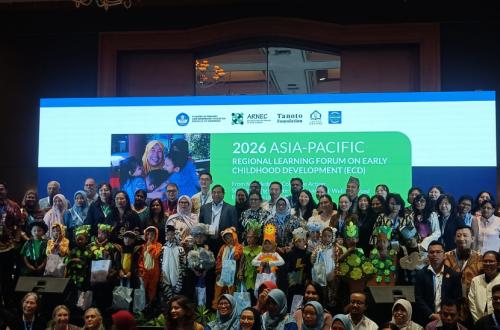
Early childhood education (PAUD) services need to be prepared for the challenges of climate change through education policies and sustainable funding support. The age-appropriate use of technology and a stronger role for families are also important to improving the quality of education in the early years.
Gogot Suharwoto, Director General of Early Childhood, Primary and Non-formal and Informal Education at the Ministry of Primary and Secondary Education (Kemendikdasmen), said climate change was one of the challenges that needed to be addressed in developing PAUD services. The issue requires adequate policy and financing support.
“There are two important topics being discussed today. The first is how we prepare our children to face climate change,” Gogot said at the 2026 Asia-Pacific Regional Learning Forum on Early Childhood Development (ECD) in Jakarta on Thursday (22 October 2026).
According to Gogot, countries attending the forum shared experiences of policies and measures they had implemented to improve early childhood education services. The exchange is expected to help participating countries tackle the challenges of climate change and education funding.
Gogot said the forum reached three conclusions. First, PAUD services should be improved so they can respond to climate change through appropriate policies and education systems.
Second, the use of technology in education must take children’s developmental stages and ages into account. Third, families’ role as an educational environment that influences children’s development should be strengthened.
Gogot said early childhood education takes place not only at PAUD centres but also within families. Parents therefore need support to help them guide their children’s learning at home.
“How can we also provide education for the family, education for the home,” Gogot said.
Meanwhile, SEAMEO CECCEP Director Vina Andriani said the forum addressed two main issues: how early childhood education should respond to climate change and how PAUD funding can be made sustainable. Both issues, she said, are linked to efforts to broaden access and improve the quality of education services.
Vina explained that PAUD contributes to development beyond the education sector. Early-years education is also connected to economic development and social conditions in communities.
“Ultimately, this forum affirms that early childhood education plays a very important role not only in a country’s economy, but, no less importantly, in ensuring social wellbeing,” Vina said.
Developing PAUD services therefore requires the involvement of various parties, including the government and private sector. Such cooperation is needed to support access to education, service quality and sustainable financing.
Tanoto Foundation Head of Policy and Advocacy Eddy Henry said the three-day forum demonstrated the importance of cross-sector cooperation in developing PAUD. Collaboration can involve the government, private sector and stakeholders from Indonesia and overseas.
“We can see that pentahelix collaboration and public-private partnerships can indeed be realised, not only in Indonesia but also with the involvement of actors from abroad,” Eddy said.
Eddy said Indonesia has a number of PAUD management practices it can share with other countries. At the same time, Indonesia can learn from the experience of other Asia-Pacific countries to improve early childhood education services.
“We can also learn about practices that have worked in neighbouring countries, to help us provide the best services, both by expanding access and improving the quality of services for young children,” Eddy said.
The 2026 Asia-Pacific Regional Learning Forum on Early Childhood Development was organised by ARNEC, Tanoto Foundation, SEAMEO CECCEP, the National PAUDHI Coalition and Kemendikdasmen. The event provided a platform for stakeholders to exchange experiences on climate change, funding and improving the quality of PAUD services.
Source: jawawa.id (https://jawawa.id/newsitem/early-childhood-education-services-need-sustainable-funding-to-address-climate-change-1792731122)
Originally published by Republika (https://esgnow.republika.co.id/berita/tncc4u416/hadapi-perubahan-iklim-layanan-paud-perlu-didukung-pendanaan-berkelanjutan), translated from Indonesian