
Dutch Scholar's Controversial Makkah Entry Ends in Conversion to Islam
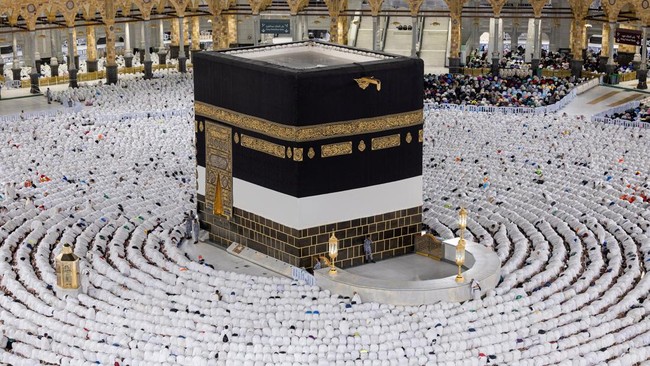
Jakarta, CNBC Indonesia - In the late 19th century, the Islamic world was stunned by the story of Dutch scholar Christiaan Snouck Hurgronje. Born on 8 February 1857, he was one of history’s most controversial orientalists for successfully entering the holy city of Makkah, which was then closed to non-Muslims.
Each season of Hajj, Makkah is visited by many people from various ethnicities, races, and religions. However, the Saudi government closely scrutinises all visitors, as non-Muslims are strictly prohibited from entering Makkah. Anyone attempting to do so would be arrested.
Born into a devout Christian family in the Netherlands, Snouck developed a strong interest in Islam. His father was a pastor, but from a young age, he was more drawn to studying Arabic, Middle Eastern traditions, and Muslim life. Some records suggest he later became an atheist or agnostic.
He spent most days in the library reading extensively about the Islamic world, studying its language and culture. It’s no surprise he became proficient in Islam compared to other European youths.
In 1880, his interest in Islam led him to write a study at Leiden University titled ‘Het Mekkaacnshe Feest’ (The Makkah Celebration). According to Hamid Algadri in Dutch Politics Towards Islam and Arab Descendants in Indonesia (1988), the research was conducted without ever visiting Makkah, relying solely on various sources.
His desire to visit Makkah was fulfilled in December 1884, funded by the Dutch government. He arrived in Saudi Arabia and stayed in Jeddah at a friend’s residence.
In his memoirs, Snouck knew it would be difficult to enter Makkah as a non-Muslim, especially for research. Thus, he changed his identity, adopting the name Abdul Ghaffar.
He also decided to convert to Islam. Around 1885, he recited the Shahadah. However, his conversion sparked debate. Wim Van Den Doel’s biography of Christiaan Snouck Hurgronje (2023) notes many doubted his sincerity, believing he adopted Islam merely as a means to enter Makkah and study its weaknesses.
Despite the controversy, Snouck was officially registered as a Muslim and underwent circumcision, a requirement for adult Muslim men. On 21 February 1885, his penis was cut by a circumciser, which later facilitated his entry into Makkah.
Upon arriving at the Holy City, Snouck was initially denied entry by Saudi police who suspected he was non-Muslim due to his European appearance. Since proving his religion was difficult, the only way was to show his circumcised penis.
Snouck then lowered his trousers to show the circumcision mark, convincing the officers of his Muslim identity. He thus became the first European scholar to enter Makkah.
During his six-month stay, Snouck successfully posed as a Muslim scholar, gathering research material on Islam, including performing Umrah. However, authorities expelled him after receiving reports of his deception, despite the circumcision proof.
Nonetheless, he completed his research and later became a special advisor to the Dutch government on Muslim life in Indonesia. In the 1890s, he lived in Indonesian cities from Aceh to Jakarta, advising on ‘handling’ Indonesian Muslims.