
Dunhuang, a Gateway to the Ancient Silk Road Time Capsule
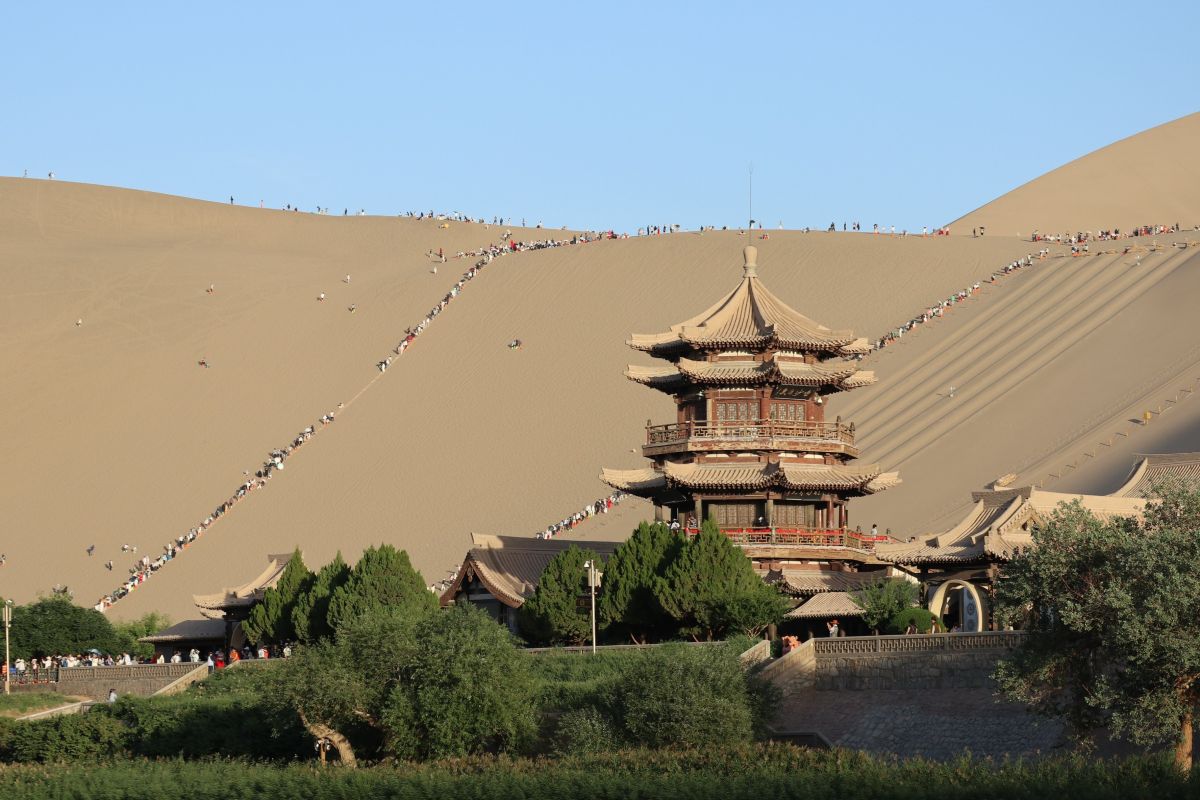
From caves filled with Buddhist artwork, to oases that sustained life in the midst of the desert, to ancient fortresses and trading posts, all of these show that the Silk Road was far more than just a trade route.
Dunhuang (ANTARA) - Standing in the city of Dunhuang, one’s imagination is easily carried away to processions of treasure-laden camel caravans making their way through the perilous desert. After facing bands of nomadic tribes and nearly losing their way in the endless sands, those merchants would at last find respite in the Dunhuang oasis.
Dunhuang is a small city on the western edge of the Gobi Desert, in Gansu Province, China.
Most of Gansu has a continental climate with very low rainfall. In Dunhuang, average annual rainfall is only around 50 millimetres, accompanied by extreme temperature differences between day and night, as well as between summer and winter.
Despite its harsh environment, Dunhuang flourished into an important node of the Silk Road. After the Han Dynasty’s armies defeated the Xiongnu nomads around 110 BC, the trans-Asian trade route to the West opened up, later becoming known as the Silk Road.
The Silk Road was not a single road, but rather a network of overland trade routes connecting China with Central Asia and the Western world. Within this network, Dunhuang served as a military outpost and a vital frontier gateway securing the trade route newly opened by the Han Dynasty.
One of its main routes was the Hexi Corridor, a narrow passage roughly 1,000–1,200 kilometres long stretching between the snow-capped Qilian Mountains to the south and the vast Gobi Desert to the north. For more than two millennia, this corridor served as the main artery for trade in silk, spices and other commodities, as well as the route through which Buddhism spread and culture was exchanged between Asia and Europe.
Interestingly, the term ‘Silk Road’ was not used at the time. The name was only introduced in 1877 by the German geographer Ferdinand von Richthofen to describe the network of trade routes that carried silk, a luxury commodity from China highly coveted in the Western world.
For that reason, visiting the various historic sites of Dunhuang in the 21st century feels like retracing the footsteps of the merchants, pilgrims and explorers who once traversed one of the most influential trade routes in world history.