
Due to US Actions, This Indonesian Industrial Product is Disrupted!
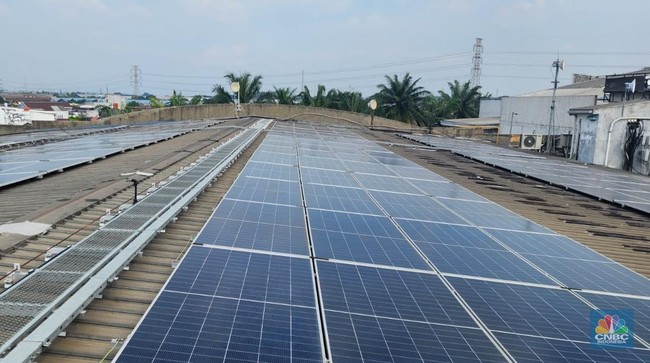
The National Energy Council (DEN) has revealed that the domestic solar panel industry is currently facing serious pressure due to high tariff policies set by the United States (US). Export barriers to Uncle Sam’s country have left domestic production capacity unoptimally absorbed.
DEN member Sripeni Inten Cahyani stated that Indonesia actually has a solar panel production capacity of around 11 Gigawatts (GW) per year. This capacity comes from about 5 GW for domestic needs and around 6 GW previously targeted for the export market.
“Currently, national production is 5 plus the current export which reaches around 6. So the total is 11 GW of PLTS production,” said Sripeni in Jakarta, quoted from K (21/4/2026).
However, the US’s high tariff policy on imported solar panel products, reportedly reaching up to 120%, makes it difficult for Indonesian products to enter that market. As a result, production previously allocated for export is now piling up.
“With taxes of 120% for some and 80% for others. Crazy, right? So they can’t go there. Now it’s piling up,” she said.
This situation is being directly felt by industry players. One of them is PT Trina Mas Agra Indonesia, located in Kendal, Central Java. The factory with a production capacity of around 1 GW per year has reportedly begun experiencing operational disruptions due to low market absorption since the start of production.
“Because there’s been none since it started production, no one has absorbed it. The only absorber is the quota PLTS. That’s why, as mentioned earlier, from 1.5 GW, the quota PLTS has truly become a dark horse,” said Sripeni.
As is known, after the Agreement on Reciprocal Trade (ART) between Indonesia and the United States (US) was signed on Thursday, 19 February 2026, US President Donald Trump suddenly dealt a blow to Indonesia’s solar panel industry.
Trump imposed retaliatory import duties (countervailing duty) of 104.38% on solar cells and panels imported from Indonesia. Trump’s policy also applies to similar products from India and Laos.
Not only that, the US Department of Commerce (DOC) imposed individual tariffs on several Indonesian companies, namely PT Blue Sky Solar at 143.3%, while PT REC Solar Energy at 85.99%.
The reason for these tariffs is to support similar factories in the US and claims that solar panel companies in Indonesia, India, and Laos have received subsidies from their governments. This has made products from similar industries in the US uncompetitive.
The reasoning used by the US feels like a severe blow to Indonesia. How not? With the ART pact already signed, Indonesia must provide maximum preferential treatment for US goods entering the domestic market.
In addition to 99% of US products enjoying tariff elimination and access to Indonesia’s 280 million population market, they will also move freely without having to comply with Indonesian technical regulations. And, if there are technical regulations, they must refer to US standards.