
Due to Extremely Strong El Niño, These Indonesian Regions are Experiencing Dry Seasons
The Indonesian Meteorological, Climatological, and Geophysical Agency (BMKG) has confirmed the severity of drought conditions in Indonesia, which are predicted to persist longer, alongside a potential delay in the onset of the rainy season.
This is due to an extremely intense El Niño currently affecting Indonesia, with 80.7% of Indonesia’s 564 Seasonal Zones (ZOM) experiencing the dry season. This was stated during the ‘Rainy Season Prediction’ briefing at the BMKG MHEWS Building in Jakarta on Tuesday (22/9/2026).
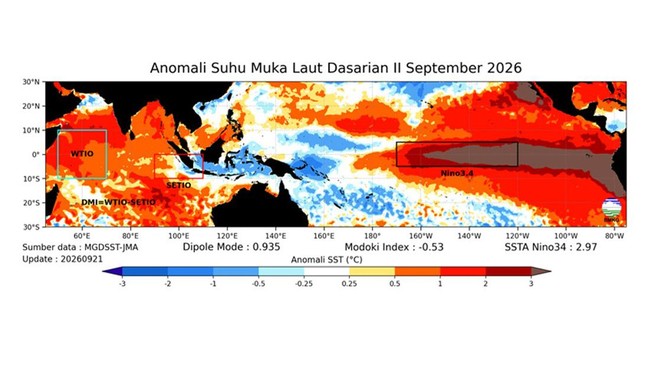
According to the Atmospheric Dynamics Analysis for the second ten-day period of September 2026 released by BMKG on 23 September 2026, the SSTA value in the Nino3.4 region was +2.97 (compared to +2.83 in August). The ENSO index (3-month average) for JAS (July-August-September) stands at 2.63, indicating an extremely strong El Niño.
Simultaneously, the decadal IOD index is +0.935 (compared to +0.376 in August). This positive Indian Ocean Dipole condition in the Indian Ocean is contributing to reduced rainfall and is predicted to remain positive until the end of the year.
“The combination of the El Niño and IOD phenomena occurring simultaneously is exacerbating and lengthening the drought period in most parts of Indonesia, resulting in a delayed and shorter rainy season,” said Faisal, as quoted on Thursday (24/9/2026).
BMKG Climate Change Director, A Fachri Radjab, added that one of the clear indicators of El Niño’s impact is the drought experienced across various Indonesian regions. Due to the extreme intensity of El Niño, even areas previously categorised as having rainfall throughout the year are now experiencing a dry season.
“Based on seasonal monitoring results, 556 ZOM, covering 61.91% of Indonesia’s land area, are currently experiencing the dry season,” he said.
Analytical data shows many observation points reporting ‘days without rain’ (HTH) exceeding 60 days across 25 provinces, with the longest period currently in the Bantul region at 131 days (over 4 months).
“In fact, the 2026 El Niño is causing dry periods in several ZOM that typically feature year-round rainfall,” added Fachri.
With the dry period expected to be prolonged, BMKG recommends that ministries, agencies, local governments, and the public take anticipatory measures to optimise existing resources amidst water scarcity. For the food sector, it is necessary to implement planting schedules and use crop varieties with shorter growth cycles, alongside efforts to control plant pests.
“The scarcity of rainfall requires special attention to ensure more economical usage, increasing storage capacity at the household level, and regulating the inflow and elevation of reservoirs, as well as proportional water release for hydroelectric power plant (PLTA) operations,” said Faisal.
He added that local governments and stakeholders are urged to identify potential groundwater basins and borehole locations, and to optimise drainage management and sustainable water conservation.
Regarding the timing of the rainy season, BMKG Deputy for Climatology, Ardhasena Sopaheluwakan, revealed that the start of the rainy season in Indonesia will not occur simultaneously. Most regions will only begin their rainy season in November 2026 (185 ZOM/24.66% of the area) and December 2026 (266 ZOM/17.31% of the area).
According to him, the coverage for the November rainy season includes parts of Sumatra, Java, Kalimantan, Bali, NTB, a small part of NTT, Sulawesi, North Maluku, Maluku, North West Papua, and South Papua. The December rainy season will affect parts of Lampung, most of Java, South Kalimantan, most of Bali, most of NTB, most of NTT, most of Sulawesi, Maluku, and South Papua.
“Compared to the climatological average, 529 ZOM or 61.08% of Indonesia’s land area is experiencing a delayed rainy season. Only 11 ZOM (1.12% of land area) are experiencing an early rainy season, and 26 ZOM (2.15%) are entering the rainy season as normal,” he explained.
“Although predicted to be shorter, the 2026/2027 rainy season is generally normal for 510 ZOM (69.76% of Indonesia’s land area). However, attention must be paid to 147 ZOM (18.55% of Indonesia’s land area) because the rainfall will be wetter, while 42 ZOM (11.69%) are predicted to be below normal or drier,” Ardhasena emphasised.
Source: jawawa.id (https://jawawa.id/newsitem/due-to-extremely-strong-el-nino-these-indonesian-regions-are-experiencing-dry-seasons-1790254424)
Originally published by CNBC Indonesia (https://www.cnbcindonesia.com/news/20260924173015-4-770661/saking-sangat-kuatnya-el-nino-wilayah-ri-ini-ikut-alami-musim-kemarau), translated from Indonesian