
Dual Citizenship Discourse Should Prioritise Children of Indonesian Descent
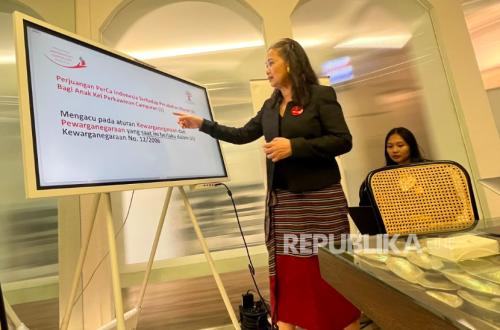
The government’s discourse on opening dual citizenship specifically for foreign talents, former Indonesian citizens, and accomplished diaspora members has drawn attention from the Indonesian Mixed Marriage Society (Perca). Perca believes that if the policy is truly implemented, the government also needs to pay greater attention to children of mixed marriages who have Indonesian blood.
Perca Indonesia Chairwoman Rulita Anggraini said that citizenship issues for children of mixed marriages still leave various administrative problems. One of them relates to the time limit for children with dual citizenship to determine their citizenship choice.
Based on Law Number 12 of 2006 concerning Indonesian Citizenship, children of mixed marriages can have limited dual citizenship. After turning 18 years old or getting married, the child is required to declare their citizenship choice no later than three years later.
According to Perca, this provision can become a problem if the child or their family does not understand the administrative obligation. In fact, there are cases of children who have lived and attended school in Indonesia since childhood, but then have to face citizenship status problems because they were born abroad.
One highlighted case is a Chemical Engineering graduate from Udayana University who was born in the United States to an Indonesian mother. He was brought to Indonesia as a toddler and spent almost his entire life in Indonesia.
However, after his mother passed away when he was over 21 years old, the young man only then learned of his American citizenship status based on the principle of ius soli. This condition then caused him to face citizenship administration problems in Indonesia because he had never registered his dual citizenship status in accordance with the provisions.
He was then faced with residence permit issues and the threat of fines amounting to hundreds of millions of rupiah. In the end, he chose to become a foreign national and had to abandon his desire to maintain his status as an Indonesian citizen.
Rulita said similar problems also have the potential to make Indonesia lose talents who have blood ties with Indonesia. She cited the example of a junior swimming athlete of Balinese-German descent who had once been a world champion.
“Because of the demands to train in France in order to obtain world-class facilities that boost his performance, the athlete was forced to relinquish his Indonesian citizenship status because he could not have dual citizenship on the international stage,” she said.
On the other hand, the issue surfaced alongside the government’s discourse on providing limited dual citizenship space for certain talents. President Prabowo Subianto previously conveyed the idea of granting dual citizenship to foreign talents, former Indonesian citizens, or diaspora members deemed to have achievements and contributions to Indonesia.
The discourse is said to be included in the draft amendment to the law, including through Article 27. The government stated that the policy will later be implemented selectively by considering national interests.
“This policy will be designed selectively and measurably, accompanied by integrity tests, clear obligations, and full protection of state security and interests,” said Prabowo.
Meanwhile, Minister of State Secretary Prasetyo Hadi emphasised that the idea is still a thought that needs further study. He assured that if the policy is agreed upon, its implementation will not be carried out carelessly.
Perca believes that providing dual citizenship space to attract foreign talents needs to be accompanied by an evaluation of the rules for children of mixed marriages.
Rulita questioned the basis for the policy change if dual citizenship is later granted based on economic value, achievement, or state needs.
“Does this mean that the legal principle of Indonesian citizenship will change? From single to dual?” said Rulita.
According to her, a policy that grants dual citizenship to foreign nationals due to national team needs or certain interests has the potential to make citizenship merely a professional instrument.
On the other hand, children of mixed marriages who have blood ties with Indonesia actually face lengthy procedures when they lose their Indonesian citizenship status and wish to return to being Indonesian citizens.
Perca noted that the process can be pursued through naturalisation with costs reaching Rp 75 million and culminating in the issuance of a Presidential Decree.
Meanwhile, foreign nationals who marry Indonesian citizens can apply for naturalisation through the marriage route. The tariff for that route, which increased in August 2026, is said to be Rp 25 million with a process up to a Ministerial Decree.
Perca considers this difference to indicate an issue of equal treatment in citizenship policy.
Through the campaign “Once Indonesia, Always Indonesia”, Perca is encouraging the government to ensure that children of Indonesian descent are not placed in a more difficult position than foreign talents who will later receive facilities through the new policy.
Perca emphasised that it does not reject the government’s plan to open dual citizenship space. However, the organisation requested that the policy also pay attention to the rights of children of mixed marriages who have blood ties with Indonesia.