
DSI Chief Details Export Mechanism for Three Strategic Commodities from 1 January 2027
Jakarta, CNBC Indonesia – PT Danantara Sumberdaya Indonesia (DSI), a state-owned export company under BPI Danantara, has outlined the mechanism for exporting three major commodities—coal, crude palm oil (CPO) and ferro-alloys—which will take effect on 1 January 2027.
DSI chief executive Luke Thomas Mahony said exports of the three strategic commodities from that date would be handled through DSI’s NADI (National Data Intelligence) portal, which is directly connected to the Finance Ministry’s Directorate General of Customs and Excise CEISA system and the Indonesia National Single Window (S-INSW).
Luke stressed that DSI would act only as a single intermediary. He said the NADI portal integrates transaction data to verify variables including price, quantity, quality and export proceeds.
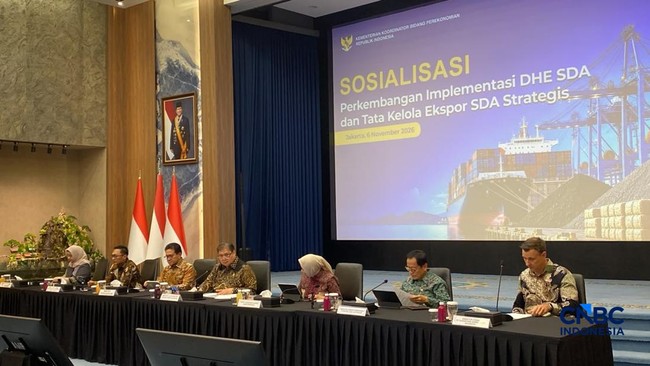
“From DSI’s perspective, this is all about connecting data. A lot of data is already available through ministry systems, and this is about how we can work further with existing programmes, systems and ministries to integrate and connect market data, and report daily transactions,” Luke said at a press conference at the Coordinating Ministry for Economic Affairs in Jakarta on Friday (6 November 2026).
Implementation will begin with a technical briefing on 15 November 2026 to explain the changes and provide exporters with guidance on using the system. The next step will be opening company-account registrations and enabling administrative documents to be uploaded to the NADI portal from 15 December 2026.
“At a very high level, on 15 November we will hold a technical briefing to explain the changes, gather feedback and set out what is expected of exporters,” he said.
The NADI portal is scheduled to become fully operational on 1 January 2027. It will be used to upload contract documents, register Export Declaration of Goods (PEB) forms and submit final cargo information.
Exporters will be required to register a single company account and upload commercial contracts as the basis for pre-clearance and post-clearance checks.
“Once they are registered, it is about uploading documents and commercial contracts, which form the basis for the PEB,” he said.
In preparation, DSI, Customs and the Indonesia National Single Window have tested the NADI portal with 100 exporting companies, representing 50 per cent of the total export value of the commodities. The trial involved processing around 340 transaction contracts to assess system reliability and data security.
“Ultimately, this is about prioritising business certainty, continuity of exports and market confidence, which underpin the design and deployment,” he said.
He reiterated that all commercial negotiations, the movement of goods and payment flows would continue directly between sellers and buyers.
“Under the single-intermediary model, DSI will interact with the seller without obstructing exports, negotiations or the flow of goods. We will act as an intermediary,” Luke said.
Luke said PT DSI would not take ownership of the exported commodities. Nor would it be involved in their commercial operations or buying and selling.
“The commercial agreements, movement of goods and payment flows will remain between the buyer and seller. We will not take ownership of the goods or be involved in commercial operations at this time,” he said.
Export process
According to DSI’s presentation, the export process through the NADI portal is as follows:
- Account registration
Enter company details once to create a single company account, before uploading the first commercial document.
- Upload commercial documents (contracts, purchase orders)
Commercial documents form the basis for analysing each related shipment (PEB). They need to be uploaded only once, not for every shipment, after the documents have been signed.
- Complete PEB and pre-clearance
Select the PEB type according to the export facility, then complete the PEB fields and upload supporting documents. The information in the PEB is checked against the uploaded commercial documents. This is done before the PEB is forwarded to CEISA for validation and issuance of the Export Service Note (NPE).
- Upload export documents and post-clearance
After the NPE has been issued and export documents—such as certificates of analysis (CoA), certificates of weight (CoW) and the final invoice—have been received, data on price, quantity, quality and HS codes are checked against government and market reference data. DSI’s methodology will guide the checks. If discrepancies are found, DSI will ask the exporter for an explanation.
DSI described its roles in exports of the three strategic commodities as follows:
Data integrator: connecting reporting, government systems and market information to improve the visibility, traceability and quality of strategic commodity trade data.
Market facilitator: working with government institutions, businesses, financial institutions, industry associations and international buyers to maintain continuity, certainty and confidence during implementation.
Governance platform: establishing systems, standards and coordination mechanisms to strengthen transparency and accountability in trade governance over the long term.
Source: jawawa.id (https://jawawa.id/newsitem/dsi-chief-details-export-mechanism-for-three-strategic-commodities-from-1-january-2027-1793976642)
Originally published by CNBC Indonesia (https://www.cnbcindonesia.com/news/20261106173602-4-783085/bos-dsi-beberkan-mekanisme-ekspor-3-sda-strategis-mulai-1-januari-2027), translated from Indonesian