
DSI Analyses 6,500 Export Transactions Worth US$14 Billion
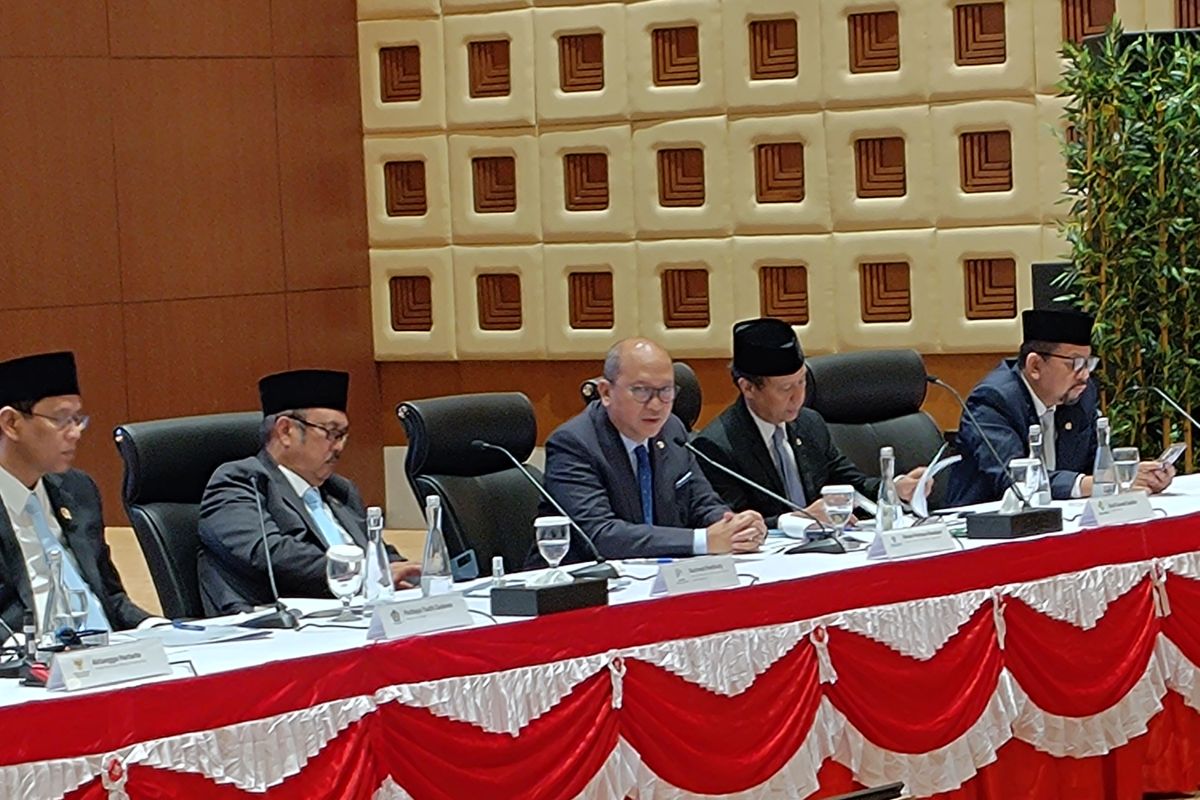
Jakarta (ANTARA) - Minister for Investment and Downstreaming/Head of BKPM and CEO of the Daya Anagata Nusantara Investment Management Agency (Danantara) Rosan Roeslani said PT Danantara Sumberdaya Indonesia (DSI) has analysed around 6,500 export transactions worth US$14 billion, or approximately Rp248.92 trillion, since June 2026.
He said the analysis was carried out through cross-ministerial and institutional data integration to monitor, among other things, export locations, prices, volumes, destination countries, export values, and data related to state revenue.
“Indeed, so far we have analysed approximately 6,500 transactions since June. Since June there have been 6,500 transactions amounting to approximately US$14 billion,” Rosan said at the Press Conference on the 2027 State Budget Plan and Financial Note in Jakarta on Friday.
He explained that DSI integrates data from, among others, the Ministry of Finance, Ministry of Trade, Ministry of Transportation, Ministry of Energy and Mineral Resources, Ministry of Agriculture, Bank Indonesia, and other relevant agencies.
The integration is aimed at increasing transparency of export transactions while detecting under-invoicing, transfer pricing practices, and inaccurate transaction data.
“Our objective is how we can suppress, reduce, and even eliminate transfer pricing and under-invoicing,” he said.
In its implementation, DSI compares export transaction prices with reference price indices.
If a transaction price is found to be below the index, DSI issues a warning for evaluation.
Rosan said the gap between declared prices and price indices previously found in export transactions is now narrowing after data from various agencies was integrated.
“And indeed, what we see is that the gap between the index and the declared price before DSI existed — now, thank God, once this is connected we can monitor it, we can see that prices are now very closely aligned with the index price. So if it is said that there is under-invoicing, we have the data, and we can see it, but thank God this has now improved, very much improved,” he said.
Nevertheless, he stressed that DSI’s existence does not alter trade contracts between exporters and buyers.
Transactions can still be carried out directly by exporters to buyers, including for long-term contracts already in progress.
“So from the outset there was never a concept that DSI would become a sole exporter,” Rosan said.
According to him, the prevailing regulations provide room for DSI to conduct evaluations and to act as an intermediary or exporter, but do not make DSI the only party carrying out exports.
At this stage, DSI is still evaluating and monitoring exports of three commodities.
The government next plans to expand the monitoring to other commodities so that export transactions can be evaluated and detected more broadly.
Rosan said the strengthening of the system is directed at ensuring export transaction values can be recorded more transparently and in line with reference prices, so that the economic benefits of Indonesian commodity trade can be more optimal.