
Dry Season Intensifies, BMKG Warns of Forest Fire Threat and Local Extreme Weather
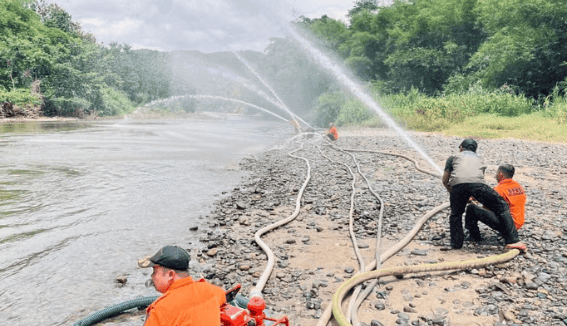
The agency has issued an early warning for the entire country. As of mid-July 2026, the dry season is reported to be increasingly dominating most of Indonesia’s territory. Even so, the public is urged not to let their guard down against the potential for localised extreme weather in the form of heavy rain accompanied by lightning and strong winds.
In its weather outlook for the period 14–20 July 2026, BMKG recorded that 432 Seasonal Zones, or around 60.5% of Indonesia’s territory, had entered the dry season in the first ten-day period of July 2026. That figure represents an increase of 11.6% compared with the previous ten-day period.
“The dry conditions are also reflected in the monitoring of Days Without Rain (HTH). As many as 596 observation points, or 12.2%, have experienced the long category of 21–30 days without rain, while 331 observation points, or 6.8%, have entered the very long category of 31–60 days,” BMKG stated in an official release on Tuesday (14 July).
BMKG explained that the spread of dry air masses from the southern part of Indonesia across Java, Nusa Tenggara and southern Kalimantan is reducing the chance of rain cloud formation.
These conditions are also influenced by the El Niño phenomenon, which persists over the Pacific Ocean, with the Niño 3.4 index at +1.25 and the Southern Oscillation Index (SOI) reaching -26.2.
In the second ten-day period of July 2026, around 91.45% of Indonesia’s territory is forecast to experience low rainfall. Meanwhile, 8.52% of the territory is predicted to see moderate rainfall, and only 0.03% is potentially in line for high rainfall.
Although the dry season is strengthening, BMKG said several atmospheric disturbances, such as Kelvin Waves and Equatorial Rossby Waves, could still trigger the growth of rain clouds in some areas.
“In addition, the presence of Tropical Cyclone Haishen is forecast to have an indirect impact in the form of moderate rain in parts of North Sulawesi and North Maluku, as well as increasing sea wave heights in a number of waters in eastern Indonesia,” BMKG explained.
For the period 14–17 July, BMKG is warning of the potential for heavy to very heavy rain, with a stand-by status in Papua. Moderate-intensity rain is also possible in North Sumatra, West Sumatra, Riau, Bengkulu, West Java, West Nusa Tenggara, Central Kalimantan, East Kalimantan, North Kalimantan, West Sulawesi, Central Sulawesi, South Sulawesi, Maluku and Highland Papua.
In addition, strong winds could hit Aceh, Banten, West Java, West Kalimantan, the Bangka Belitung Islands, Lampung, East Nusa Tenggara, South Sulawesi, Southeast Sulawesi, North Sulawesi, Maluku and West Papua.
BMKG is urging the public to be aware of the effects of hot weather during the dry season by using protection from sun exposure and maintaining adequate fluid intake to avoid dehydration.
The agency is also calling on communities and regional governments to heighten vigilance against the emergence of hotspots and the potential for forest and land fires (karhutla).
“BMKG reminds everyone not to carry out burning to clear or prepare land or to burn rubbish, especially in fire-prone areas such as peatland, scrub, forests and dry land,” it said.
At the same time, the public is still being asked to anticipate the potential for extreme weather that can occur locally. BMKG is reminding people to watch out for fallen trees, collapsed billboards, flooding and lightning strikes, and to avoid taking shelter under trees or fragile structures during bad weather.
Source: jawawa.id (https://jawawa.id/newsitem/dry-season-intensifies-bmkg-warns-of-forest-fire-threat-and-local-extreme-weather-1784001034)
Originally published by Media Indonesia (https://mediaindonesia.com/humaniora/910640/kemarau-makin-dominan-bmkg-ingatkan-ancaman-karhutla-dan-cuaca-ekstrem-lokal), translated from Indonesian