
Dry Ice Falls into Residential Areas, BNPB Installs Special Screens on Aircraft
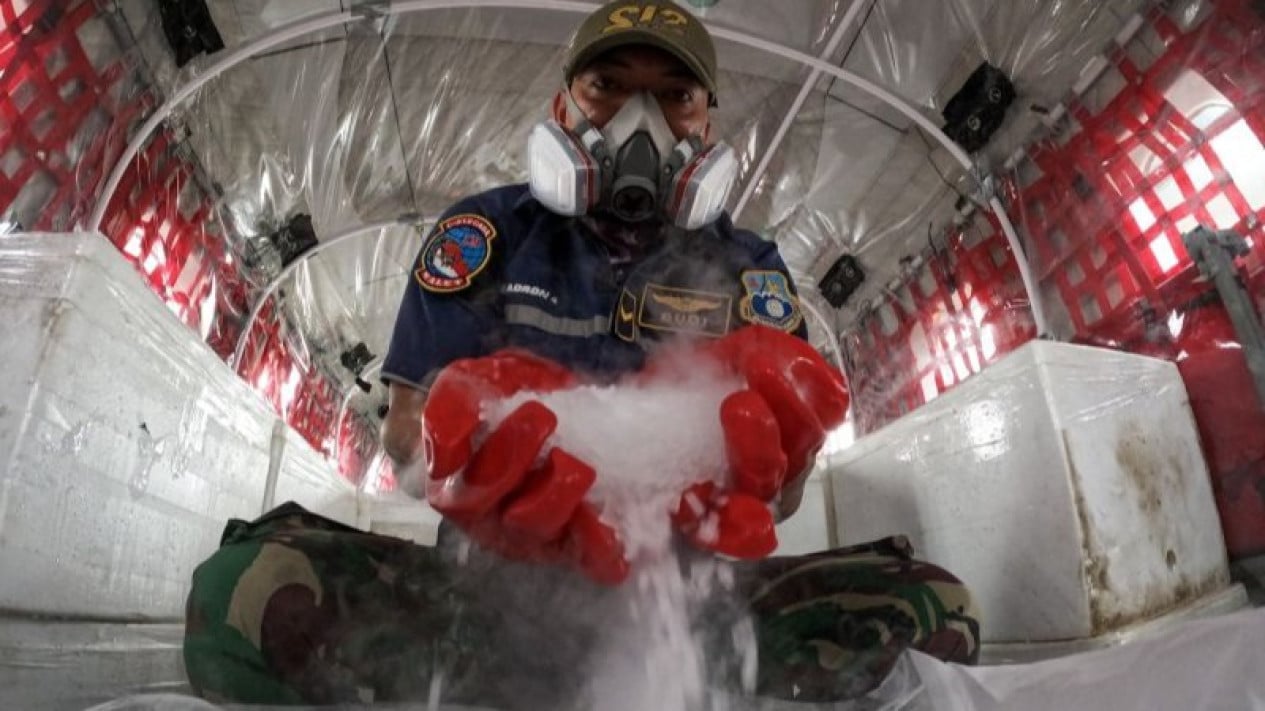
Jakarta – Indonesia’s National Disaster Management Agency (BNPB) has tightened standard operating procedures for dispersing dry ice after receiving reports from residents that material had fallen into residential areas during weather-modification operations.
Berton Panjaitan, acting head of BNPB’s Disaster Data, Information and Communication Centre, said the procedures had been adjusted by installing special screens on the aircraft’s dispersal chute and breaking the dry ice into finer particles so it evaporates in the air before reaching the ground.
The measures apply to weather-modification operations using dry ice, or solid carbon dioxide, at a temperature of minus 78.5 degrees Celsius. The technology is used to help disperse a build-up of haze caused by forest and land fires.
During the operations, dry ice is dispersed from aircraft into an inversion layer at an altitude of 5,000 to 7,000 feet to trigger atmospheric cooling. The process is intended to push smoke trapped in the lower layer upwards, allowing it to spread.
BNPB said trials of the technology had improved visibility at Sultan Mahmud Badaruddin II Airport in Palembang, South Sumatra. Dispersing dry-ice particles measuring about three millimetres on 16 October 2026 reportedly improved visibility compared with the previous day.
Weather-modification operations in South Sumatra began on 16 October 2026 through a partnership between BNPB, the Indonesian Military (TNI) and the Meteorology, Climatology and Geophysics Agency (BMKG), using a Casa 212 aircraft, registration A-2117. The operation was extended to Central Kalimantan on 19 October 2026 using a Casa 212-200, registration A-2107.
BNPB has also deployed 49 aircraft to tackle forest and land fires: 32 for water bombing and 17 for patrols and weather-modification operations. Ground operations are supported by more than 60,000 personnel from joint teams across six priority provinces.
As of 19 October 2026, fires had been extinguished across 454.25 hectares, against a target area of 1,024.33 hectares. The priority areas are Riau, Jambi, South Sumatra, West Kalimantan, Central Kalimantan and South Kalimantan.
“People are urged to continue wearing masks when outdoors and not to engage in activities that could trigger forest fires, in the interests of everyone’s safety,” Berton said.
Source: jawawa.id (https://jawawa.id/newsitem/dry-ice-falls-into-residential-areas-bnpb-installs-special-screens-on-aircraft-1792507844)
Originally published by VIVA.co.id (https://www.viva.co.id/berita/nasional/1937372-dry-ice-jatuh-ke-permukiman-bnpb-pasang-saringan-khusus-di-pesawat), translated from Indonesian