
Dramatic surge: US dollar hits 18-month high — here are five drivers
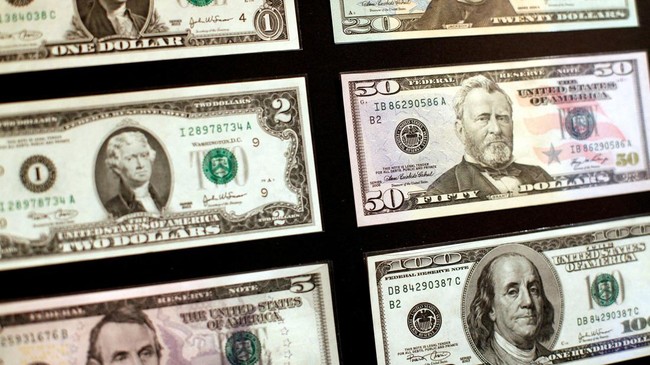
Jakarta, CNBC Indonesia — The US dollar has regained strength in global financial markets. After fluctuating throughout the year, the currency has reached its highest level in 18 months.
The move is reflected in the US dollar index (DXY), which measures the dollar against six major world currencies. On Monday, 12 October 2026, the DXY closed 0.37% higher at 102.58, its strongest level since April 2025. The index has risen by more than 4% year to date in 2026.
This comes as the global economy faces a range of pressures, from war in the Middle East and high oil prices to growing concerns about some countries’ debt. Amid this uncertainty, investors are increasingly favouring the US dollar. What is behind its renewed strength?
- Middle East war drives investors towards the dollar
One factor supporting the dollar is rising geopolitical tension, particularly the widening US-Israeli war with Iran.
The Middle East has again heated up after Yemen’s Houthi group increased missile and drone attacks on Saudi Arabia. The attacks have targeted key facilities, including airports and energy infrastructure. At the same time, attacks on tankers have heightened concerns about the security of global oil-trading routes.
When global conditions become more uncertain, investors tend to reduce their holdings of riskier assets and seek places they consider safer to hold their money. One of their main choices is the US dollar.
The dollar remains the currency most widely used in international trade and financial transactions. Dollar-denominated asset markets, particularly US government bonds, are also highly liquid. As a result, demand for the dollar often rises when geopolitical tensions escalate.
But the war in the Middle East is not the only reason the US currency has strengthened recently.
- High oil prices make it harder for the Fed to cut rates
The conflict in the Middle East is also putting significant pressure on energy markets. Brent crude has again risen above US$100 a barrel and briefly reached around US$107 a barrel in trading on Monday, 12 October 2026.
Higher oil prices pose a challenge for the global economy, including the US, because oil is essential to economic activity, from transport and industry to the production of a wide range of goods.
As oil becomes more expensive, production and distribution costs may rise. Those higher costs can ultimately push up the prices of goods and services.
This puts US inflation at risk of remaining elevated, even as the US central bank, the Federal Reserve (Fed), continues trying to bring it back towards its 2% target.
In September 2026, the Fed raised its benchmark interest rate by 25 basis points to 3.75%–4.00%. Fears that inflation has yet to subside have led markets to expect US rates to remain high for longer.
A further rate rise remains possible if inflation picks up again. High US interest rates keep dollar-denominated assets attractive because they may offer greater returns.
This is one reason higher oil prices can support the dollar by shaping expectations for Fed policy.
- High US Treasury yields make the dollar more attractive
In addition to the Fed’s policy rate, the dollar has been supported by rising yields on US government bonds, or US Treasuries.
Global bond markets have come under pressure in recent weeks amid concerns about inflation and governments’ substantial financing needs. The pressure has pushed bond prices down and yields up.
The 10-year US Treasury yield briefly topped 5.3% last week before returning to around 5.2%.
Why does this matter for the dollar? In simple terms, when US government bonds offer higher yields, they can become more attractive to global investors. Investors in other countries who want to buy US bonds also need dollars to complete their transactions, potentially providing additional support for the currency.
Rising yields, however, have another side. If they continue climbing because of concerns about US government debt, they could put financial markets under pressure. The dollar’s movement therefore depends not only on how high Treasury yields are, but also on the reasons for their rise.
- Trouble in Europe sends the euro lower
Beyond US-specific factors, the weakening euro is also important in explaining the DXY’s rise.
The euro carries the largest weight in the US dollar index, at 57.6%. The Japanese yen accounts for 13.6% and the British pound for 11.9%. With this composition, a weaker euro can give the DXY a substantial boost, even when the dollar is not strengthening against every currency worldwide.
From the start of 2026 to early October, the dollar gained about 5% against the euro. The euro is now at US$1.1156 per euro and close to its weakest level in 17 months, last seen in May 2025.
One reason is growing concern about the economic and financial position of several European countries, particularly France. France is grappling with a large budget deficit, high government debt and political uncertainty ahead of the 2027 presidential election.
These conditions have made investors more cautious about holding French assets. The pressure is reflected in rising yields on French government bonds. The yield spread between French and German bonds has also widened, signalling greater investor concern about France’s financial risks.
The concerns have also drawn attention from Nobel Prize-winning economist Paul Krugman. He warned that France was on an unsustainable fiscal path and risked a debt crisis that would be difficult to manage.
“France may have crossed the line from too big to fail to too big to save,” Krugman wrote on Substack on Thursday, 8 October 2026, as quoted by CNBC International.
The warning reflects fears that the scale of France’s debt problems could make a rescue by the European Central Bank (ECB) extremely costly and difficult. France is one of Europe’s largest economies. If its fiscal problems worsen, investors fear the pressure could spread to other European countries, including Italy, which also has a heavy debt burden.
The ECB, meanwhile, faces a difficult choice. High energy prices are making it harder to bring inflation down, but raising interest rates too aggressively could further burden an economy already under strain.
This has reduced the euro’s appeal relative to the US dollar. With the euro making up more than half of the DXY, its weakness has been one of the factors driving the dollar index higher recently.
- Global investors are betting more aggressively on the dollar
The dollar’s rise is also reflected in changes to investors’ positions in financial markets. Data on speculative positions in US markets show that investors are increasingly betting on the dollar to rise.
Net long dollar positions increased to about US$36 billion in the week ending 7 October 2026, up from just US$8.4 billion around three weeks earlier. The increase suggests that more market participants expect the dollar to have further room to strengthen.
The rise in these positions occurred mainly as investors reduced their bets on the euro.
However, the situation also warrants caution. When too many investors have taken the same position, the dollar could face a sharp correction if events do not unfold as expected.
For example, the currency could weaken if US inflation proves lower than anticipated, oil prices fall or tensions in the Middle East begin to ease. Investors who had bought dollars may then take profits, putting downward pressure on the currency.