
Draft Asset Forfeiture Bill Urged to Consider Existing Regulations
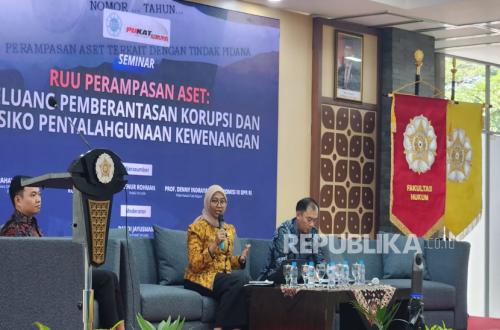
The discussion surrounding the Draft Asset Forfeiture Bill has resurfaced as a critical element in Indonesia’s efforts to combat corruption. While the regulation is deemed essential for accelerating the return of criminal proceeds to the state, it has simultaneously sparked concerns regarding its potential use as a tool for the abuse of authority.
During a seminar titled ‘The Asset Forfeiture Bill: Opportunities for Corruption Eradication and the Risk of Abuse of Authority’ held at the UGM Faculty of Law auditorium on Monday (14/09/2026), the Coordinator of the United Nations Office on Drugs and Crime (UNODC), Putri Wijayanti, stated that asset forfeiture can fundamentally serve as a vital instrument for recovering criminal proceeds. However, she warned that such authority could be exercised arbitrarily if not constrained by clear regulations.
“Asset forfeiture can be a tool to seize the proceeds of crime. But on the other hand, it could also become a tool for arbitrary seizure. That is why we need to redefine its urgency,” Putri said on Monday.
She noted that the formation of the Asset Forferess Bill needs to consider several existing regulations. Indonesia currently possesses provisions within the Law on the Eradication of Corruption Crimes and the Money Laundering Crimes Law that allow the state to seize and forfeit criminal assets.
Consequently, she argued that this Bill should not merely repeat existing provisions. The regulation must provide a more effective mechanism while ensuring that the rights of the public and good-faith third parties remain protected.
Echoing these sentiments, the Chairman of Commission III of the Indonesian House of Representatives (DPR RI), Habiburokhman, stated that a key issue in the discussion of the Bill is ensuring that the authority granted to law enforcement does not transform into a space for the abuse of power.
“The public’s concern is the potential for power misappropriation by law enforcement officials. We must ensure this law does not become a means for eradicating corruption, but rather a means to eliminate political opponents,” said Habiburokhman.
He emphasised that the creation of the regulation must account for legal dynamics and societal needs. The DPR has also received various inputs from academics, practitioners, students, and civil society groups during the deliberation process.
According to Habiburokhman, the scope of the Asset Forfeiture Bill is not solely directed at corruption. Several other crimes, such as narcotics, terrorism, human trafficking, forestry crimes, mining, taxation, and banking crimes, are also part of the debate regarding the scope of the regulation.
Meanwhile, constitutional law expert Denny Indrayana also highlighted the issue of transparency in the discussion of the Bill, questioning public access to the latest draft.
“We are discussing a draft law, but we do not know where the latest draft is,” said Denny.
He argued that the openness of the draft is crucial, as civil society and academics require the document to provide substantive input. This is particularly important as the Asset Forfeiture Bill will have significant consequences regarding the state’s authority to seize wealth suspected to be linked to criminal activity.