
DPR Urges Budget Policy to Favour Regional Autonomy
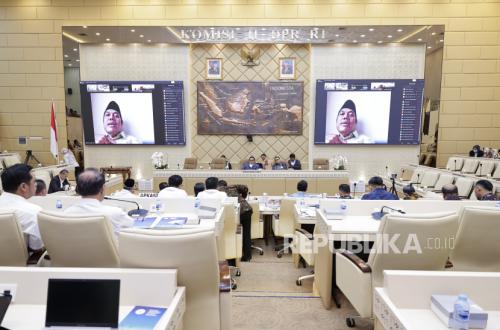
Deputy Chair of the House of Representatives (DPR) Commission II, Zulfikar Arse Sadikin, has stated that strengthening regional autonomy cannot be achieved through regulation alone but must also be reflected in national budget policy. He argued that the government needs to be bold in changing the paradigm of central-regional relations by granting greater authority to local governments, including through changes to the State Budget (APBN) posture.
This view was conveyed by Zulfikar during an online working meeting and public hearing of Commission II with Home Affairs Minister Tito Karnavian and associations of regional heads. The meeting, held at the Nusantara Building, Senayan, Jakarta, on Thursday (30/7/2026), discussed three main agendas: remuneration for regional heads and deputies, the systematics of revenue-sharing funds, and increasing locally generated revenue (PAD).
Zulfikar stressed that discussions on strengthening regions must begin with a complete understanding of Indonesia’s constitutional spirit. He said the approach should not be purely administrative but must be based on scientific foundations and the courage to resolve fundamental issues in central-regional relations. “The overarching theme is how we truly empower regional governments, both in terms of authority and finance,” he said.
He explained that this spirit is already reflected in Law Number 23 of 2014 on Regional Government, which stipulates that the central government only handles six absolute affairs: foreign policy, defence, security, justice, national monetary and fiscal matters, and religion. Most other affairs are delegated to regional governments. However, Zulfikar noted that implementation has not aligned with this legal construct, as the mindset and working methods of ministries and institutions still tend towards programme execution at the central level.
“Ministries and institutions should no longer be given capital expenditure. If the legal construct is like that, the central government should focus more on drafting regulations, providing guidance, and supervision. Programme implementation should largely be handed over to regional governments,” said the Golkar Party legislator.
Zulfikar urged political courage in the discussion of the 2027 State Budget. He proposed a thorough evaluation of capital expenditure for ministries and institutions so that the portion of the budget managed by regions can be increased. He also noted that regional fiscal instruments have been strengthened through the Law on Central and Regional Financial Relations, which provides space for regions to optimise their revenue sources. However, he cautioned that success depends on consistency in implementing the regulatory mandate.
“The law has provided room to empower regions financially. The problem is that our way of working often does not yet follow the way of thinking built into the regulation,” Zulfikar said. He expressed hope that the meeting’s conclusions would not merely remain as recommendations but would be realised in next year’s national budget policy. He views the 2027 APBN discussion as a momentum to test the seriousness of the government and DPR in strengthening regional autonomy through adequate authority and fiscal support.