
DPR to Begin Deliberations on Asset Forfeiture Bill Next Week
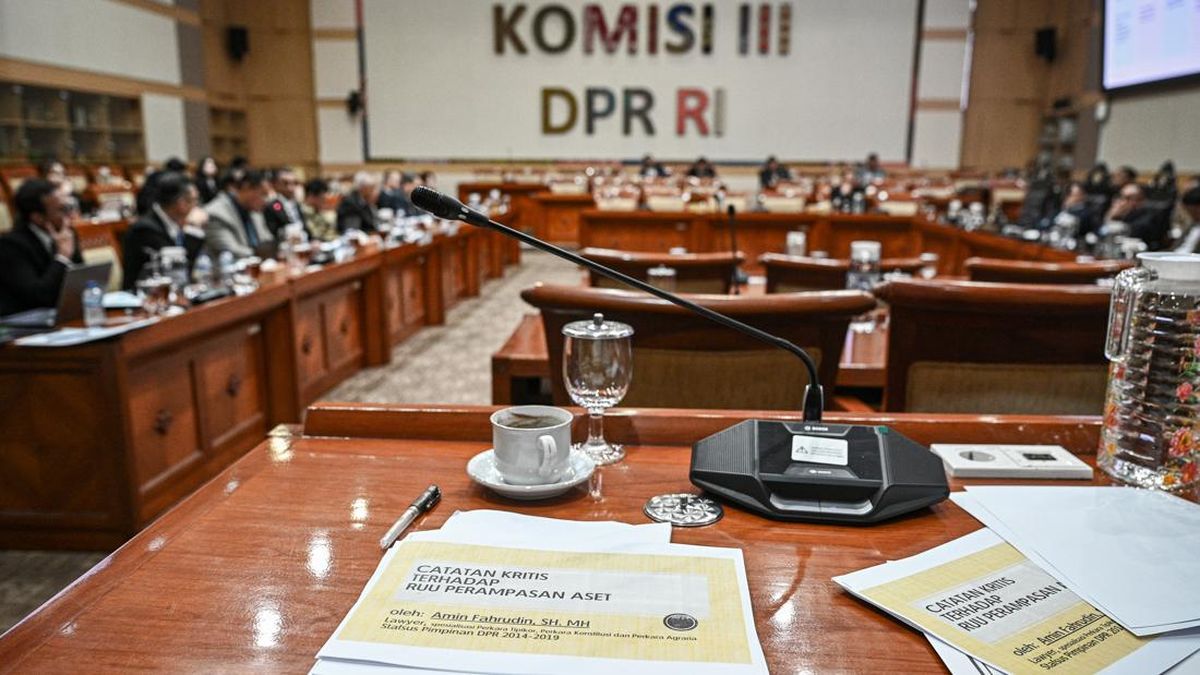
Deputy Chairman of Commission III of the House of Representatives (DPR), Ahmad Sahroni, said the commission would begin meetings on the substance of the Asset Forfeiture Bill next week, on 5 November 2026.
“On 5 November, if I’m not mistaken, there will be a working-group meeting chaired by Mr Habiburokhman,” Sahroni said after attending a public hearing on the bill at the parliamentary complex in Senayan, Jakarta, on Wednesday (28 October).
Commission III has so far held public hearings with a number of groups and members of the public. Sahroni said these hearings could continue until 5 November. He also hoped the bill could be passed earlier than the previous target of 15 December 2026.
“Hopefully it can be done sooner, in line with what [Deputy Speaker of the House] Professor Sufmi Dasco promised: 15 December. Hopefully it can be sooner. The important thing is that these public hearings continue until 5 November,” said the NasDem politician.
Sahroni said that, as of Wednesday (28 October), Commission III had heard from 86 contributors on the bill.
He said the main point raised by many of them was that the Asset Forfeiture Bill should not become an instrument of power that could be abused.
“It seems much the same as what we’ve heard before: above all, this bill must not be used as an instrument of power or as a target, and we do not want it to be abused,” Sahroni said.
One issue raised, Sahroni explained, was that the losses attributed to many corruption cases were not accurately disclosed during trials.
“As I said earlier, there are many claims that corruption offences caused losses of hundreds of trillions [of rupiah], but when the cases go to trial, the amount alleged at the outset is not actually disclosed,” he said.
He said calculations of state losses must therefore be provided and decided by the final institution authorised to audit them, the Supreme Audit Agency (BPK). He also urged law enforcement agencies to resolve the issue of how such losses are calculated.
Sahroni clarified that submissions from various groups on the bill were still under review. The DPR has not circulated an official draft because it is still assessing the results of the public hearings.
“All these submissions will be studied. Once they have been assessed, they will be incorporated into a draft. A draft may eventually circulate as an illustration, but it will not be from us. We have not prepared the draft yet; we will continue to study the findings from the public hearings,” he said.
The DPR had previously promised to pass the Asset Forfeiture Bill by 15 December 2026. The commitment was announced during a demonstration by the Pati United Community Alliance (AMPB) and others outside the DPR building in Jakarta on Thursday (27 August).
The bill’s working group is led by Commission III Chairman Habiburokhman, with Soedeson Tandra of the Golkar Party as deputy.
The bill has faced a number of controversies during its deliberation. Several civil society coalitions have called on the DPR and the government to publish the draft and the Bill Inventory of Issues (DIM).
Civil society groups have identified at least three contentious points in a DPR draft dated 10 July 2026, compared with the government’s version. First, they suspect the DPR removed provisions on illicit enrichment. Second, they suspect it narrowed the scope for non-conviction-based (NCB) asset forfeiture. Third, they say the draft leaves the institution responsible for managing assets without a clearly defined person in charge.
However, some parties oppose including illicit enrichment in the Asset Forfeiture Bill. One is Said Karim, a professor at the Faculty of Law at Hasanuddin University in Makassar, South Sulawesi. He argues that illicit enrichment belongs to substantive criminal law, whereas the Asset Forfeiture Bill concerns criminal procedure.
Said also said the concept of illicit enrichment in the United Nations Convention against Corruption (UNCAC) is only a recommendation. Indonesia ratified the convention through Law No. 7/2006.
He also questioned the effectiveness of illicit enrichment laws in countries that have adopted the concept, citing Nigeria, Sri Lanka, Bangladesh, Ukraine and Uganda.
Despite the controversy, the bill would cover offences beyond corruption. It lists 13 categories of crime targeted by asset forfeiture:
Corruption;
narcotics and psychotropic-substance offences;
terrorism;
human smuggling;
the smuggling of weapons, ammunition and hazardous materials;
forestry offences;
environmental offences;
tax offences;
banking offences;
insurance offences;
mining offences;
maritime and fisheries offences; and/or
human trafficking.